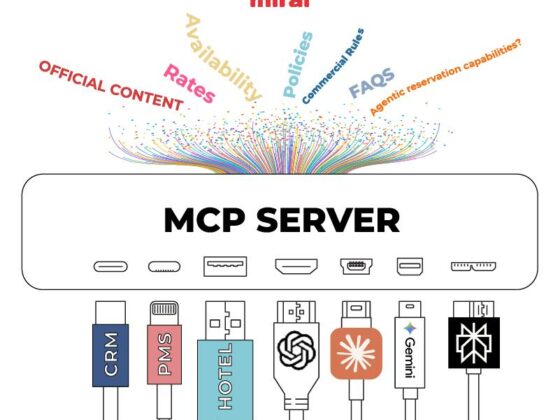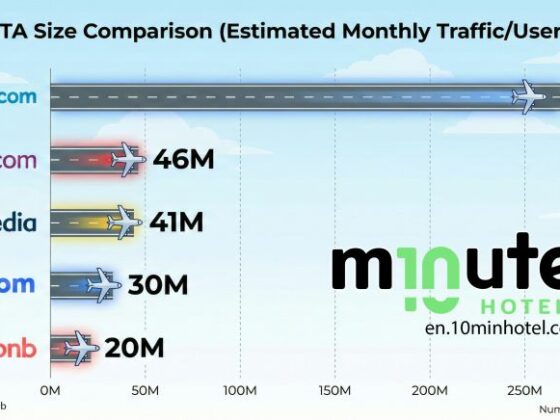
Two years ago, when my book “We Are The Glitch” came out, I wrote something that felt more like a provocation than a prediction. At the time, the idea that platforms like Expedia Group or Booking.com could live inside a conversational interface sounded speculative, even poetic. And yet, this week, with OpenAI announcing native apps within ChatGPT and naming those very brands among the first integrations, that line between vision and reality has vanished.
Those of us who spend our lives studying technological signals, cultural tremors, and the semiotics of innovation know that the act of prediction is less about being right and more about learning to listen. Our intuitions are often correct, though our timing rarely is. What we sense early often takes longer to manifest, not because it was wrong, but because the world needed to catch up.
As I wrote in the book, writing about the future means accepting the inevitability of being wrong about it. And that’s just part of the game.
When I started “We Are The Glitch” in late 2022, ChatGPT had just been released, and the industry still treated it as a novelty. But I already saw it as the embryonic interface of a new web, one that would replace the static surface of sites and screens with a living, dialogic medium.

It is fascinating, and slightly unsettling, to see that intuition materialize.
For those who haven’t read the Italian edition, you can still find it here (or you can download a pirated version here…).
It’s old now, but worth revisiting, if only to laugh at what I got right and what I got spectacularly wrong. For everyone else, I am finally working on the (updated) English edition, scheduled for release in early 2026.
And, to prove how much of this was already taking shape in my mind back then, below is the full text of Chapter 1.18, written three years ago.
Enjoy!
1.18. APIs and Plug-ins: GenAI in Travel
[…] This paradigm shift suggests a profound transition in how web interfaces are conceived and used. From a hypothetical standpoint, tools such as ChatGPT could one day become the primary, or even the only, interfaces for accessing the web.Let us imagine a future in which tools like ChatGPT transcend their current roles as mere processors of external data. Instead, these models could evolve into the primary aggregators and distributors of information, particularly in fields like travel. Such a development would represent a fundamental inversion of the traditional digital ecosystem and the emergence of a new interface dynamic.
If today Expedia is powered by OpenAI’s APIs, tomorrow OpenAI itself could be powered by Expedia’s APIs. This evolution would mark a radical transformation in the architecture and interface of the World Wide Web as we know it.
In this theoretical future, the conventional practice of navigating across multiple websites or proprietary apps could become obsolete. Users might prefer to interact exclusively through a single omniscient conversational platform.
It would be a transition from an informational web, based on HTML interfaces and mobile apps, to a generative web, sustained by sophisticated LLM algorithms and guided by a new AI-driven paradigm of search.
A centralized AI assistant, powered by a myriad of APIs, with the World Wide Web as its underlying infrastructure and ChatGPT as its user interface.
This shift could lead to a significant departure from our traditional reliance on autonomous (and fragmented) sites and apps, toward a more unified and recomposed digital interaction.
Ideally, a user could scan the label of a wine bottle, receive an immediate evaluation of its quality, then seamlessly transition to requests about the wine’s origin, suggestions for travel destinations related to that origin, recommendations for local experiences, and even tools to communicate with locals, all within a single interface.
This evolution would not merely be a technological advancement but a behavioral redefinition of how we interact with the digital world, converging specialized functionalities into a cohesive, AI-centered user experience.
If today we open a thousand browsers and apps, tomorrow we will open just one conversational platform. The habit of sifting through countless sites and applications is, after all, a convention born of necessity, and therefore not immutable.
The web began with websites, which were then indexed by search engines. This led to the creation of meta-search engines, which in turn indexed the search engines themselves. The advent of mobile technology then brought apps designed to improve this frustrating user experience, which later required the development of app stores to organize this chaotic ecosystem.
We built platforms to aggregate other platforms, which in turn aggregate other platforms.
With over one billion websites and nine million apps (not counting data from wearables, gaming consoles, and IoT devices), I believe the digital world is ripe for a change (one as transformative as it is necessary) toward a web where decision-making processes and digital interaction are simplified and finally aligned with human cognitive and conversational models.