1. The Market Positioning: Mastering the Immersive Experience Economy
The Strategy
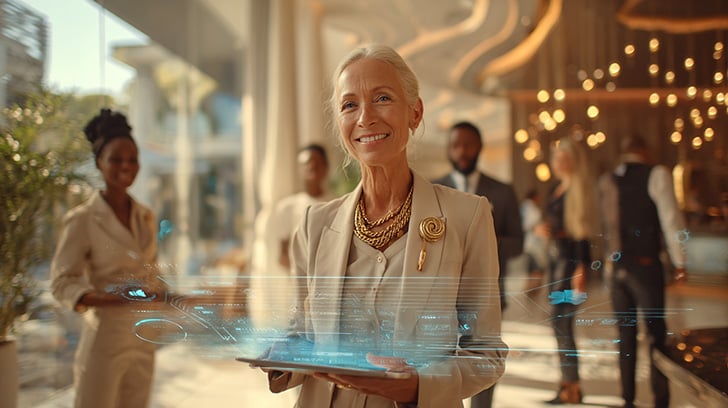
Start with the guest. In a market where standardized service is the baseline, your competitive edge in 2026 lies in moving from “passive” stays to “active” immersion. This doesn’t mean building a theme park in your lobby; it means curating experiences that give guests a reason to choose you over a cheaper competitor.
Why It Drives Profit
- Spending Power: Experiences currently show the strongest spending growth, as travelers prioritize meaningful encounters over goods.
- Loyalty & ADR: Guests are willing to pay more for “transformative” experiences. Loyalty is now driven less by the product and more by “an experience worth paying for,” allowing you to command higher Average Daily Rates (ADR).
- Emotional Connection: Leveraging sensory marketing and storytelling creates an emotional connection that “lasts far beyond the moment,” distinguishing your brand in a crowded OTA market.
How AI Agents Elevate the Experience
Standard personalization (like “Welcome back, Mr. Smith”) is no longer enough. AI Agents now handle the complexity required to deliver true immersion.
- The “Cultural Mediator” Agent: Standard apps translate words; this agent translates context. For a guest confused by a local custom, the agent provides “verified origin” details and storytelling in real-time. It builds trust by explaining why a dish is prepared a certain way or how to navigate local etiquette, preventing the “outsider” feeling that lowers satisfaction.
- The “Agent-to-Agent” Negotiator: Instead of a guest fighting with a rigid booking engine, their personal AI talks to your hotel’s agent. Your agent is authorized to “curate a personalized guest offer” autonomously. If a loyal guest wants a specific room type that is technically “unavailable” but actually just dirty, the agent can flag it for priority cleaning and secure the booking—capturing revenue a standard engine would reject.
- The “Digital Shadow” for Hyper-Personalization: Current PMS data is static. An AI agent analyzes unstructured data—interaction history and tone of voice—to predict needs. It moves from “service on demand” to “anticipatory care,” such as asking, “Shall I prepare the room service menu?” for a guest arriving late.
2. The Delivery Engine: Human-Centric Leadership
The Strategy
You cannot deliver a high-touch, immersive experience with a burnt-out or transient workforce. In 2026, the battle won’t just be for guests, but for talent. The strategy here is simple but challenging: treat leadership as a retention tool, not just a management function.

Why It Drives Profit
- Stopping the Revenue Leak: Labor shortages are expensive. Hotels facing recruitment difficulties report an average revenue loss of 4%. When you stick to rigid, top-down management in a labor crisis, you actively choose to cap your revenue.
- The Productivity Multiplier: “Soft skills” deliver hard returns. Happy employees are 12% more productive, and teams led by human-centric leaders perform 27% better.
- Gen Z Retention: By 2026, Gen Z will dominate frontline roles. This generation explicitly values empathy, mentorship, and purpose. If your leadership style ignores this, your recruitment pipeline dries up.
How AI Agents Support Your Team
Empathy is hard to scale. AI Agents act as a “buffer,” protecting your staff’s mental health and confidence so they can be their best selves.
- The “Burnout Buffer” (Emotional Firewall): Hospitality has high turnover due to stress. An AI agent monitors communication channels to “buffer” staff against burnout. If a guest sends an abusive message, the agent intercepts it, drafts a de-escalated response for the employee to review, and flags the incident to management, protecting the staff member from the emotional hit.
- The “Whisperer” (Confidence Coach): New staff often feel overwhelmed. An AI agent acts as a private “coach,” providing real-time answers to complex questions. Instead of panicking when asked about allergens, the employee gets an instant answer in their earpiece, boosting confidence instantly.
- The “Fairness” Scheduler: Standard scheduling software optimizes for coverage, ignoring the human cost. An AI agent analyzes “peak stress periods” to ensure fairness. It assigns rooms based on effort required (not just room count), ensuring no single housekeeper is consistently burned out by the heaviest floors.
3. The Operational Backbone: Productivity & Cost Control
The Strategy
Once the guest experience is defined and the team is in place, the final step is to conduct a brutal audit of your inefficiencies. In 2026, the hype around “Generative AI” (writing marketing copy) will fade in favor of “Agentic AI”—systems that don’t just talk, but do. The goal is to deploy invisible digital agents to handle the repetitive, complex logic that currently ties up your limited human resources.
Why It Drives Profit
- Bottom-Line Impact: Early adopters report 6% annual revenue growth and equal cost savings.
- Operational Savings: Autonomous agents can reduce predictive maintenance downtime by 20-30% and cut housekeeping scheduling hours by 10-30%.
- Net Profit: AI-driven “menu engineering” alone can increase net profit by 5-15%, proving that efficiency tools can directly fund the premium experiences you offer in step #1.
How AI Agents Drive Productivity
Human managers shouldn’t be doing robot work. AI Agents handle the “coordination chaos” between departments.
- The “Silo-Buster” (Inter-Departmental Agent): Hotels suffer when departments don’t talk. An AI agent acts as the bridge. Suppose the kitchen runs out of a key ingredient. In that case, the Kitchen Agent automatically notifies the F&B Agent to update digital menus and the Procurement Agent to re-order, without a chef needing to shout at a waiter.
- The “Ghost Booking” Hunter: Revenue managers spend hours verifying suspicious reservations. An AI agent autonomously audits bookings for fraud and verifies intent via messaging. It releases inventory back to the market in real-time, optimizing occupancy without human intervention.
- The “Knowledge Keeper” (Institutional Memory): High turnover means knowledge walks out the door. AI agents “retain memory across interactions”. If a boiler needs a specific “kick” to start, the Agent remembers and instructs the new employee, preserving the “organizational knowledge” that usually disappears when a veteran staff member quits.
Conclusion
The roadmap for 2026 is not about chasing the next shiny object. It is about a disciplined return to the fundamentals of hospitality, supercharged by technology. You protect your pricing power by offering Immersive Experiences. You secure your operations by adopting Human-Centric Leadership. And you protect your margins by letting AI Agents handle the drudgery. The hotels that thrive in 2026 won’t necessarily be the newest; they will be the ones that are exciting to visit, supportive to work for, and ruthlessly efficient behind the scenes.