The Engine of Efficiency (Why We Can’t Go Back)
Let’s be clear: Technology is not the enemy. In fact, in the current landscape, it is the primary survival kit for any profitable hotel. We cannot go back to the days of manual room racks and gut-feeling pricing. The complexity of modern distribution and the speed of market changes make “analog” hospitality impossible.
When specific systems work well, they act as powerful engines for productivity:
- Automation of the Mundane: By automating repetitive tasks—like sending pre-arrival emails or updating rates across OTAs—technology frees up staff to focus on high-value work. We want our teams to be thinking about improving the guest experience and the business, not data entry.
- Data-Driven Precision: Revenue Management Systems (RMS) and Business Intelligence tools allow us to process vast amounts of historical and market data instantly. What used to take a Revenue Manager a full day of spreadsheet analysis can now be calculated in seconds, allowing for real-time pricing adjustments that capture every dollar of demand.
- Operational Visibility: Modern systems offer a level of granularity previously impossible. We can track acquisition costs by channel, analyze guest profitability by microsegment, and monitor housekeeping efficiency down to the minute.
The intention behind every piece of software in your stack is noble: to make a specific aspect of running a hotel faster, cheaper, or smarter.
However, there is a catch.
While each individual tool solves a specific problem, piling them on top of each other without a unifying strategy creates a new, invisible problem. We have built a high-performance engine, but we have given the driver twenty different steering wheels.
The “Toggle Tax” (Where Productivity Goes to Die)
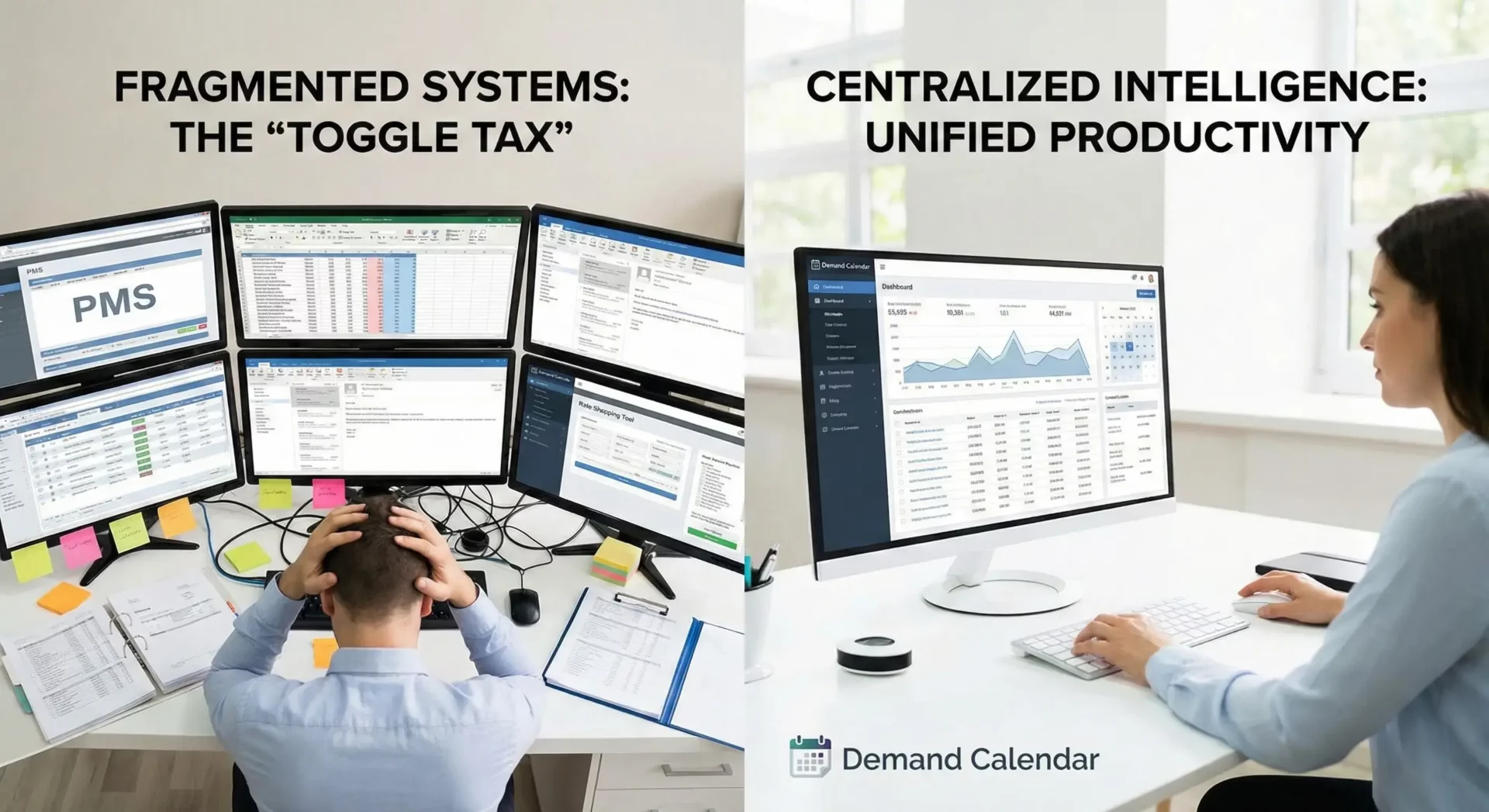
If individual systems are so powerful, why does managing them feel so exhausting? The answer lies in a concept psychologists call Context Switching, or as we like to call it in the hotel industry, the “Toggle Tax.”
It turns out that the cost of jumping between tools is not just a feeling—it is a measurable drain on your hotel’s profitability.
The Three Hospitality Productivity Killers:
- The “Swivel Chair” Interface: Imagine a General Manager preparing for an owner’s meeting. They have the P&L in one system, the sales pipeline in another, and the revenue forecast in a third. To answer a simple question like “Is our corporate segment profitable?”, they have to physically swivel (or digital-toggle) between three conflicting sources of truth. This isn’t analysis; it’s data assembly.
- Data Silos Create People Silos: When tools don’t talk to each other, neither do the teams. Marketing is looking at website analytics, Sales is looking at CRM targets, and Revenue is looking at the RMS. Because they are all looking at different data points in various systems, alignment becomes impossible. You end up with endless meetings to agree on the numbers, rather than on what to do about them.
- The Drag on “Getting Things Done”: The ultimate irony is that having too many productivity tools often prevents actual work from happening. When information is scattered, simple tasks become complex projects. The friction of gathering data to justify a decision slows the decision-making process. By the time the data is collated, the opportunity might be lost.
The Solution – Centralized Intelligence with Demand Calendar
So, how do we solve the paradox? How do we keep the powerful benefits of our technology without paying the heavy “Toggle Tax”?
The answer is not to delete your data, but to consolidate it. The solution is Centralized Intelligence.
This is the philosophy behind Demand Calendar. We recognized that for a hotel to be truly productive, it doesn’t need more places to look for information; it requires one place where all that information lives together. By acting as a unification layer that sits on top of your existing tech stack, Demand Calendar turns a fragmented workflow into a focused one.
1. The “Single Source of Truth.”
Instead of forcing your staff to act as human bridges between incompatible software, Demand Calendar automatically ingests and normalizes data from your PMS, POS, benchmarking tools, and market data sources.
- The Result: No more arguments about whose numbers are correct. No more manual copy-pasting into Excel. The data is simply there, ready for analysis the moment you log in.
2. One System for All Roles
The “silo problem” vanishes when everyone looks at the same screen. Demand Calendar is designed to be the daily workspace for the entire commercial team:
- Revenue Managers: Instantly view pick-up, pace, and market position without opening three browser tabs.
- Sales & Marketing: Track production against targets and corporate performance in the same view that the GM uses.
- Finance & Owners: Access real-time profitability tracking without waiting for end-of-month exports.
3. Action Over Admin
Most importantly, Demand Calendar is designed to help you get things done. It is not just a passive reporting tool; it is an active workspace. Because the context is already there—your revenue data sits next to your market data, which sits next to your events calendar—you can make decisions instantly. You spot a distress date, you understand the cause, and you collaborate on the solution, all without leaving the platform.
By reducing those 1,200 daily switches down to a manageable few, you aren’t just saving time. You are giving your team the mental space to do what they were actually hired to do: be hospitable and strategic.
Conclusion: The Future is Frictionless
The hospitality industry is at a crossroads. We have successfully digitized our operations, but in doing so, we have fragmented our attention. The “Productivity Paradox” is real: we have more tools than ever, yet we often feel less productive.
Actual efficiency in a modern hotel isn’t determined by the number of software subscriptions you hold; it’s reflected in the seamless collaboration of your team.
If your best people are spending 40% of their day switching contexts, 23 minutes recovering from every interruption, and hours manually bridging the gaps between systems, you aren’t getting the ROI on your technology. You are paying a hidden tax on your time and talent.
The solution is not to reject technology, but to tame it. By moving toward Centralized Intelligence, you stop the digital whiplash. You create an environment where data serves the user, not the other way around.
Stop Paying the “Toggle Tax”
Your team was hired to strategize, connect with guests, and drive revenue—not to wrestle with data silos.
It’s time to bring your Commercial, Operations, and Finance data into one unified view.
Would you be ready to see how much time you can save? Discover how Demand Calendar eliminates tool fatigue and empowers your entire hotel to get things done in one system.