
Hotel technology has come a long way. But for those of us responsible for scaling and streamlining hotel operations, the pace of change is now forcing us to confront an uncomfortable truth: what got us here is no longer enough.
The conventional systems that helped us modernize yesterday are starting to show their age. If we want our tech infrastructure to support growth, efficiency, and rapidly evolving guest expectations, we need to rethink the fundamentals.
Understanding our challenge ahead starts with understanding how we got here. Hotel technology has gone through five major phases. The first was dominated by on-premise, all-in-one systems. These custom-built installations centralized every operational function, from reservations to housekeeping to reporting. They were stable, but slow to change. Integrations were rare or non-existent.
Then comes the shift to cloud-based systems, which lowered costs and increased flexibility. You no longer need in-house servers or IT staff, and scaling has become easier. While integrations were technically possible, some were expensive to build and maintain.
Then came open APIs, and with them, the promise of modular, best-of-breed tech stacks. Hoteliers could select the ideal tool for each function – from booking, check-in, to payments – and connect them into a cohesive ecosystem. This offered enormous flexibility, but it also shifted the integration burden onto hotel teams. Not all have the technical expertise, which has led to long implementation cycles.

Improvements came with low-code and no-code tools. These platforms allowed hoteliers – even non-technical ones – to create custom workflows and automation without writing code. It marked an important shift in who could build technology. Front desk managers, operations lead, and revenue teams could design and deploy automations that previously required developers. But these tools remained rule-based, and they still require oversight.
Which brings us to today: the era of AI-first and agentic architecture. Unlike no-code platforms, AI agents do not rely on “if-this-then-that” logic. Instead, they understand context and intent. They can operate across systems, making decisions and executing tasks independently.
You do not need to tell them how to do something; you just tell them what you want done. So instead of manually linking a CRM to a messaging platform and designing a workflow, you can simply instruct an AI agent to handle guest inquiries or trigger a loyalty campaign. You set the outcome, for example, “increase upsell revenue by 10 percent within the next three months”, and the agent figures out the rest.
These agents are already delivering results, reducing hotels’ call center volume by 50 percent, automating group booking management, and personalizing guest communication. But they all need the right underlying infrastructure: open, API-first, and AI-first. Without these, you’re stuck with a tool that can’t work in a wider ecosystem.
So what does this mean for hotel leaders trying to future-proof their tech stack?
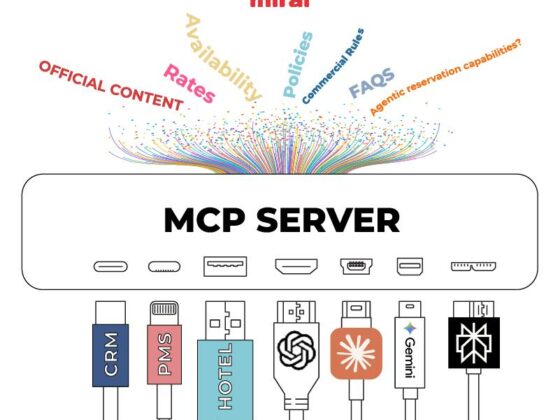
Firstly, it means insisting on openness. Every system you invest in, whether PMS, CRM, RMS, should offer full API access. Not just to read or import data, but to access full functionality in real-time. This is now no longer a nice-to-have. It is the basic requirement for interoperability and AI integration. If your vendor cannot offer that, you should be asking why.
Secondly, it means adopting a culture of experimentation. The speed of change makes long-term planning less effective than short-term iteration. Your teams should have the space to test new tools, run pilots, and build workflows in safe, open environments. When you are not locked into a vendor’s ecosystem, this becomes much easier. If something doesn’t work, you swap it out. If it does, you scale it.
Finally, it means evaluating your current systems through a new lens. Can they support the AI shift? Can they evolve alongside agentic AI, or will they require custom workarounds? An AI-first infrastructure allows real-time data access and seamless integrations with other AI tools. The goal is to ensure your infrastructure can serve not just your current needs, but future opportunities.
This is where you revisit the all-in-one systems. On the surface, they may reduce complexity, but at the cost of flexibility and control. In practice, they lock hoteliers into a fixed set of features and a single vendor’s development priorities. Open-API platforms instead allow operators to choose the most effective tool for each function, so they can adapt quickly as guest expectations or business needs change. If your underlying infrastructure is open and well-designed, best-of-breed setups can be cohesive and scalable without a vendor lock-in.
The time has come for hoteliers to prioritise having flexible, well-integrated systems. If you’re still thinking about your tech stack in terms of features and vendors, it’s time to think bigger, because the hotel tech playbook that helped us get here has completely changed.