Having recently written about the threat of Google Agentic AI Travel agents, it was fascinating to listen to the Phocuswright Conference interview with Rob Ransom, the Chief Strategy Officer of Booking.com, which revealed the strategic moat they believe they have built to avoid an Agentic AI invasion of their traditional territory.
Throughout most of their history, online travel agencies (OTAs) like Booking.com existed to solve a simple problem: information fragmentation. By gathering hotels, flights, prices, and availability in one place, they enabled large-scale online travel bookings. However, that original value proposition now faces a significant AI challenge. All the major AI platforms can already collect content, compare prices, display images, and even complete bookings through a single conversational interface. If aggregation is no longer rare, what role does a company like Booking.com now play?
Booking’s answer, articulated clearly by Sorrells, is that aggregation was never the real job to be done. The enduring value lies in orchestrating the full travel journey, before, during, and after the booking and at a global scale.
Beyond aggregation: defending the OTA role
In an AI-first world, travellers are not just seeking lists of options. They want reassurance that prices are fair, clarity on cancellation and flexibility, secure payments, customer support if plans change, and trust that someone will assist if things go wrong during the trip. Booking positions itself as the link that manages these complex, high-stakes details.
This reframing is strategically significant. While AI models can reason and suggest, they do not inherently provide customer service operations, payment infrastructure, fraud protection, supplier relationships, or regulatory compliance across numerous markets. Booking is betting that even if discovery shifts into AI interfaces, travellers and suppliers will still require a trusted marketplace layer to execute and support the trip.
Partnering with AI giants, not fighting them
Rather than trying to block AI platforms, Booking has chosen to partner with them. Its integrations with ChatGPT and Google’s AI Mode signal a pragmatic acceptance that consumer demand will increasingly originate outside traditional search and apps.
The longstanding threat that Google or another platform could completely disintermediate travel is not ignored; instead, Booking has simply reshaped its response. Booking believes that travel is unusually complex, fragmented, and service-heavy; therefore, no single AI platform is well-positioned to manage the entire process end-to-end without partnering with companies like Booking.com to deliver these intricate services at scale.
What remains unresolved is how AI platforms will route demand among multiple OTAs. This could be driven by explicit user choice (“book this via Booking.com”), opaque algorithmic ranking, or commercial agreements behind the scenes. For now, Booking regards itself as an early adopter, gaining a first-mover advantage by using these integrations as learning environments. Volumes are modest, but the company is collecting data on user intent, conversion behaviour, and the performance of conversational booking flows.
Interestingly, Booking is relying on traditional commercial models remaining relevant and expects its core expertise in performance marketing, testing, bidding, and optimisation to transfer into new formats such as conversational ads and AI-native placement mechanisms, with the AI models seeking to maximise commercial gain over the best customer experience.
I fundamentally disagree here and believe that competition among AI engines will drive a consumer-focused approach to delivering the best service, with commissions maximised by increasing conversions through better matching customer needs. However, I completely agree that it makes sense for AI search engines to collaborate with just a few of the most prominent players, like Booking.com, who can handle the complexity that travel involves.
Building “Brand” demand inside AI ecosystems
A more subtle strategic change relates to how brand marketing develops within conversational interfaces. In the past, branded search queries have been highly valuable for bookings and customer acquisition, with customers either visiting the website directly or arriving through relatively inexpensive Google brand PPC. This success has been built over years, as customers value the simplicity of booking interfaces and inherently believe they get the best prices, especially when, like me, they are “Genius” members receiving ongoing “loyalty” discounts.
Booking believes that a similar dynamic is likely to develop in AI environments: only a minority of users will explicitly mention brands like Booking.com, but those who do will be highly intent-driven so are worth chasing.
This introduces a new challenge for the brand. Booking may need to teach consumers not just to “download the app” or “search Booking.com,” but to invoke the brand within AI assistants. Simultaneously, the company must compete fiercely for unbranded travel intent, where the AI platform determines which intermediary appears.
Booking believes that its scale and willingness to experiment are crucial assets in the race to evolve distribution in a world upended by AI Search. The company has spent decades optimising demand capture across shifting digital channels. For them, AI-driven interfaces represent just another step in evolution, not an entirely new game.
Using the Booking.com app as a ringfenced “Customer Container”.
Despite all the attention on external AI platforms, Booking remains deeply app-centric. More than half of bookings now flow through its app, and that share continues to grow. Strategically, the app is positioned as the primary container for AI-enhanced experiences, with Booking combining large language models with its proprietary data, inventory, and customer history to deliver a better AI experience within its app than provided by AI Search engines outside its borders.
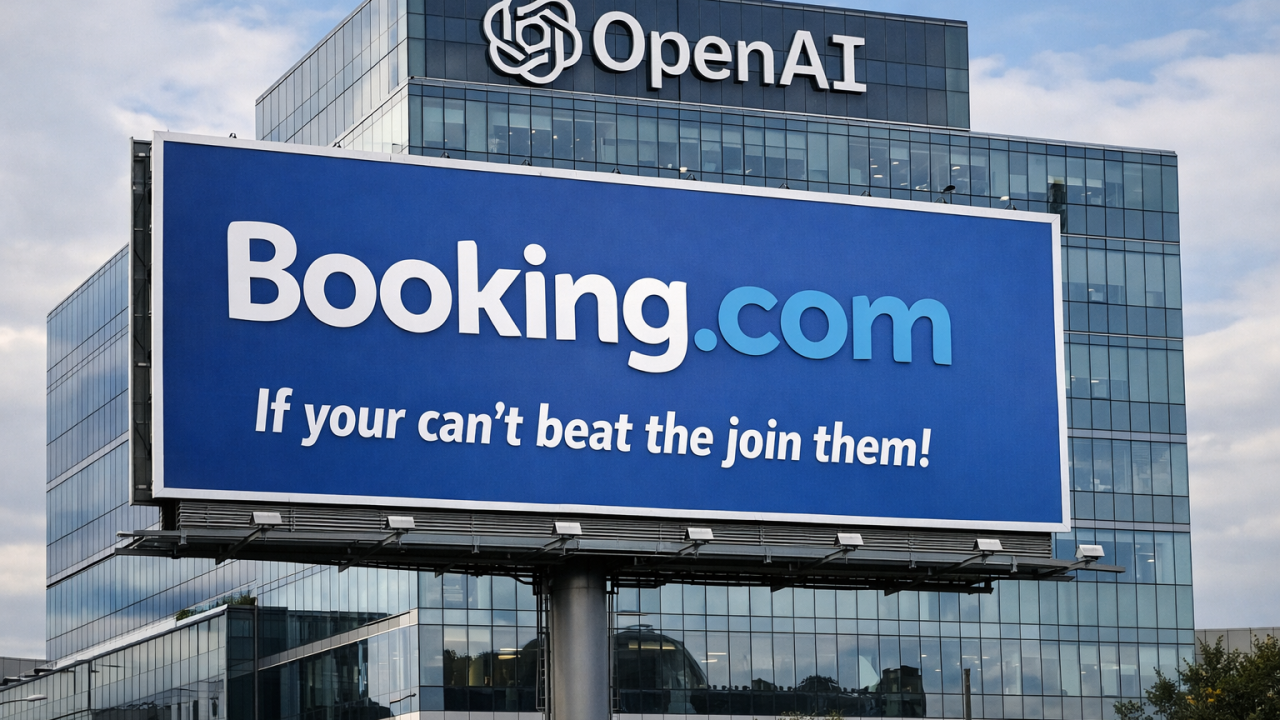
For me, this is the strategic move that all major travel brands need to adopt. If you can’t beat them, join them and incorporate all the benefits that AI search can offer into your own secure app environment, so that customers continue to come directly to you, as the search remains just as effective, but the “Service” locks in the travel brand.
The web remains relevant, especially on desktop, but Booking’s leadership expects mobile to dominate in the long term. Looking ahead, Booking is also monitoring emerging AI-powered devices such as glasses and wearables. The unifying idea is simple: wherever consumers interact with intelligent agents, Booking wants to be the environment where those interactions turn into real, supported trips.
Fairness, gatekeeping, and small suppliers
AI’s tendency to surface only a handful of results raises uncomfortable questions about power and visibility. Booking is already designated a “Gatekeeper” under the EU’s Digital Markets Act, supposedly making fairness and transparency non-negotiable deliverables, but let’s be honest, who is actually regulating Booking.com?
From Booking’s perspective, personalisation is inevitable. Showing five highly relevant properties can be better for travellers than forcing them to sift through hundreds of listings. The greater challenge is ensuring that small, independent properties are not systematically excluded from AI-mediated demand.
Many of these suppliers rely on OTAs because they lack the resources to develop direct distribution channels or to integrate deeply with autonomous agents. Booking sees an opportunity to stay the connector, offering tools, reach, and technology that allow smaller hotels to access AI-driven marketplaces they could not reach on their own. However, this merely reinforces the status quo, and, bluntly, Booking.com is like an addiction to “Heroin” for many small hotels, with its rate-parity demands and payment-on-arrival terms often resulting in 25% no-shows. In truth, many of the factors that foster Booking.com customer loyalty stem from the hardships faced by hoteliers. What happens, therefore, if the Google CPC traffic to independent hotels’ websites is replaced by AI search engines that simply use one connection to Booking.com? I fear the answer is higher prices and more commission for Booking.com.
In Resort Tools
Finally, Booking’s long-term strategy goes beyond accommodation to include flights, experiences, and in-destination activities. The acquisition of FareHarbor indicated an early realisation that travellers remember what they did more than where they booked their hotel.
Booking therefore continues to aim at expanding its customer reach by offering in-resort services, as this improves both customer satisfaction and brand loyalty.
Again, this is a strategy that I’d expect OTAs like On the Beach and Love Holidays to be following, but there are no signs of this occurring yet, unless you count On the Beach’s airport lounge scheme, which I personally don’t.
If you can’t beat them, join them.
Booking.com intends to use its “App as its castle” to attract customers by combining AI search with service and previous booking history to streamline the booking process and aims to retain 50% of its customers booking through this controlled and low-cost route.
However, it also believes that its scale, pricing, and support services make it a natural one-stop shop for AI search engines to connect to as they expand their offerings to include availability and booking within the search engine itself, enabling it to continue capturing a broader range of travel intent driven by search.
The key question is how many suppliers AI Search engines will want to integrate with, since it’s unlikely they will want to link to individual hotels. In the wider retail market, we have seen the technology aggregator Shopify solve this issue for its 5 million independent retail stores, so I would not be surprised if a Trivago or other price comparison engine fulfils this role in the Travel Sector to enable independent hotels to continue attracting direct customers.
The travel ecosystem is evolving rapidly, and smaller players need to elevate their strategic approach if they want to survive against the dominance of Booking.com and others.