One year after passage, New York City’s unprecedented short-term rental regulations have failed to deliver on their promise to combat the housing crisis. In the wake of stringent measures, consumers are instead facing all-time high hotel prices and residents facing all-time high rents.
New data underscores the consequences of Local Law 18 (LL18), an outlier when it comes to short-term rental regulations.
A more expensive destination for consumers
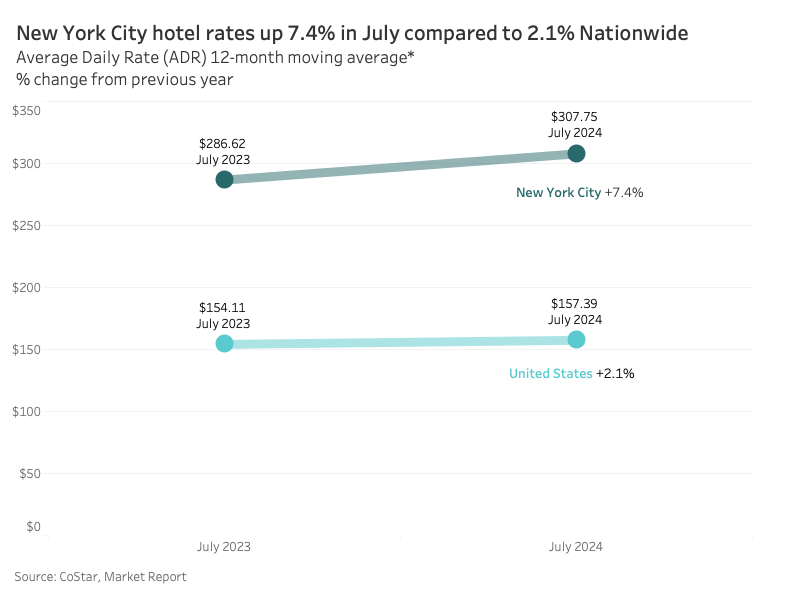
In the year since these rules took effect, there have been predictable outcomes, including a rise in hotel prices, which risks pricing out everyday people hoping to travel to New York City.
The average hotel prices in New York rose 7.4 percent in 12 months1, compared with an only 2.1 percent increase, nationally, according to data from CoStar.
Despite the law’s promise, rents rise and vacancy rates stay stagnant
Legislators claimed LL18 would protect affordable housing yet an overwhelming body of evidence from the past year shows this approach has not delivered on that promise. Alicia Glenn, the former NYC deputy mayor for housing under Mayor Bill de Blasio, went as far as to say that she never saw data showing that short-term rentals were affecting the housing crisis in a significant way.

Insights one year later, prove that point:
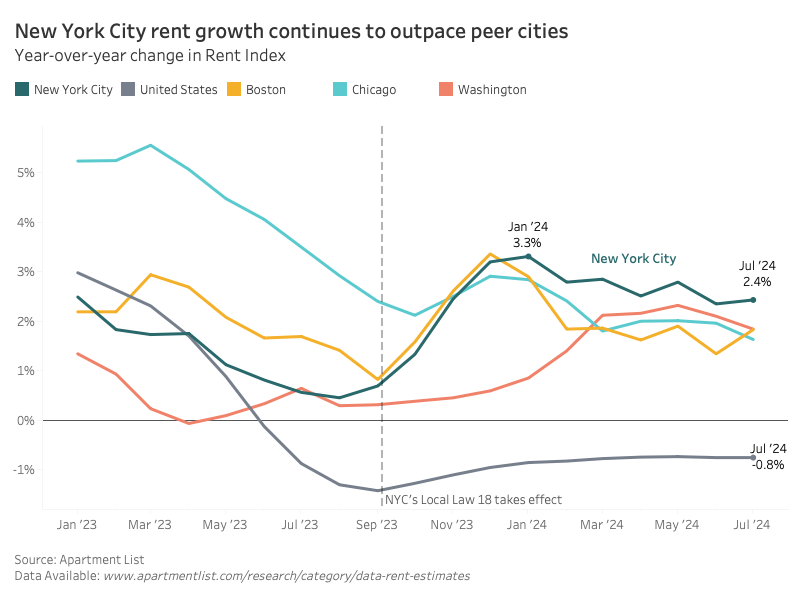
Rent in New York City continues to rise: Regulators promised that banning Airbnb in New York City would unlock housing. Instead, rent climbed 3.4 percent during the first 11 months of the law, according to StreetEasy, suggesting that other factors are driving up rent prices. In fact, the median asking price of rent downtown Manhattan over the past year reached a peak of $5,000 for the first time in history.
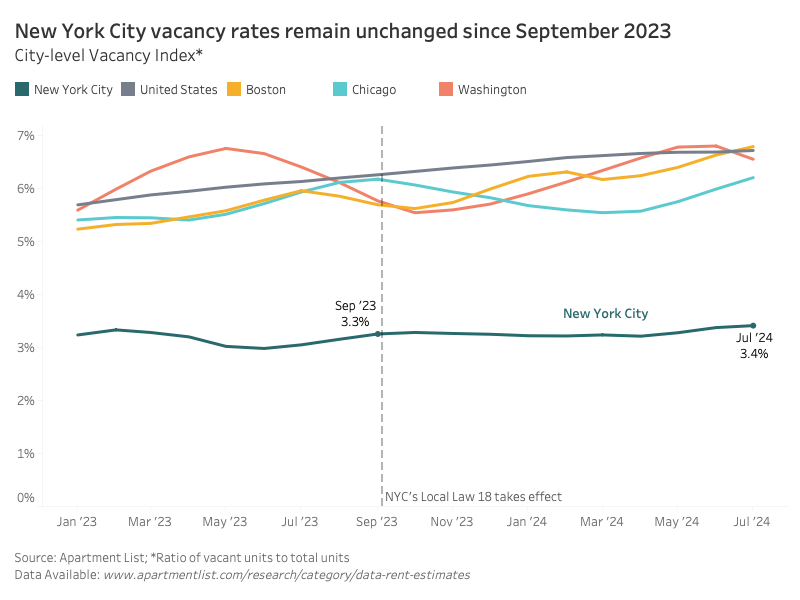
Vacancy levels remain unchanged: Vacancy rates for apartments in New York City have remained virtually unchanged (at 3.4 percent) since the law took effect, according to Apartment List.
New York remains out of step with other major cities: While rents may have cooled nationally, the increase in New York rents NYC’s rent increase since the law took effect continues to outpace nearby cities like Boston, Chicago and Washington, D.C. Meanwhile, New York City’s vacancy rates also continue to significantly lag behind Chicago, Boston and Washington, D.C.
“New York City’s short-term rental regulations have backfired—disproportionately impacting outer borough communities, driving up travel costs, and doing nothing to solve the housing crisis. Instead of improving affordability, these regulations have priced out everyday consumers and left former hosts struggling to make ends meet.”
Theo Yedinsky, VP, Public Policy at Airbnb
The outer boroughs are left with almost no accommodation options
With most of New York’s hotels clustered in midtown Manhattan, LL18 significantly reduced available accommodations in the outer boroughs, condensing travelers, limiting where they stay, and where and how they spend.
Airbnb listings in much of the city served areas without hotel options. Prior to LL18, Airbnb listings were more geographically dispersed across all five boroughs compared to hotels with fewer than half of the total Airbnb listings in Manhattan, while Brooklyn and Queens were home to 37 percent and 13 percent of Airbnb listings, respectively.
In 2023, the typical Airbnb guest in New York City spent an average of approximately $260 per day, with more than a third of spending near their listing2. A lack of available short-term rental accommodations disproportionately hurts the outer boroughs, leading to fewer stays and less spending outside Manhattan.
Organizations like the Brooklyn Chamber of Commerce have sounded the alarm about the law’s disparate impacts. In a city where the cost of living continues to climb, the loss of income has devastated those who rely on home-sharing to cover essential expenses and small businesses reliant on tourism dollars.
“The reality has been a significant setback for Brooklyn’s tourism and local economy, without the corresponding promised increase in rental housing availability the government hoped for. We hope the City Council carefully revisits the law to support the local homeowners and economic development of communities in the outer boroughs.”
Randy Peers, President and CEO, Brooklyn Chamber of Commerce, in an op-ed in the Brooklyn Paper
Those concerns were echoed by the Dominican American Chamber of Commerce.
“Local Law 18 has favored large corporations at the expense of middle-class residents and local small businesses. With rent prices surging and many families relying on short-term rentals for supplemental income, the law has created financial strain for individual hosts and a decline in revenue for local businesses that thrive on tourism.”
Manuel Lebron, CEO and Founder, Dominican American Chamber of Commerce
An alternative path forward: Re-evaluating LL18
Even the bill sponsor, former council member Ben Kallos, said that single families who rent one space should not be “worried.” One year later, that couldn’t be further from the truth. The solution to solving LL18 lies in a more balanced approach that recognizes the value of short-term rentals while addressing one of the root causes of housing affordability – building more homes.
“It’s time for New York City to re-evaluate LL18 and consider amendments that would at a minimum, allow homeowners to once again host guests. By rolling back parts of the law, the city can increase the supply of accommodations for consumers, support resident hosts, and revitalize local businesses that depend on tourism dollars. A more sustainable, sensible and equitable model benefits residents, visitors, and the broader community – ensuring that regulations support, rather than stifle, community and economic growth.”
Theo Yedinsky, VP, Public Policy at Airbnb