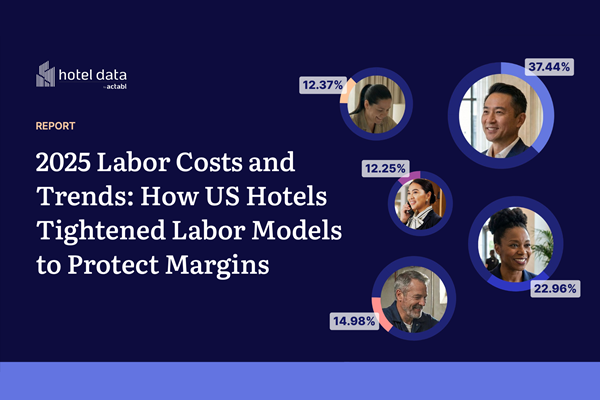
Despite wage increases rising some 5.9% this year, labor costs per occupied room rose between 2% and 11.2%, while staffing grew 4% to 9%, according to data from Actabl, used as part of a 2025 Hotel Labor Costs & Trends report. Operators, it was noted, looked to shore up profit margins by reducing hours per occupied room and improving productivity across key departments.
From January to September, hours per occupied room declined 13.5% in guest services, 7.1% in housekeeping, and 14.6% in management. Productivity, measured by minutes per occupied room, increased across front-line and leadership positions. Room attendants became 5.5% faster, guest service representatives 12.7% faster, and assistant and general managers roughly 14% faster. Overall, minutes per occupied room dropped 9% across evaluated roles.
“Labor defined hotel performance more than any other cost category in 2025,” said Sarah McCay Tams, head of research at Actabl. “Operators entered the year expecting strong revenue, but softer top-line results and rising labor costs forced a new level of discipline. What stands out is how hotels improved productivity without cutting teams, instead using forecasting, cross-training and scheduling accuracy to protect margins in a challenging environment. Labor efficiency is now as important as rate strategy. In 2026, the hotels that outperform will be those that connect labor directly to demand and deploy staff dynamically.”

Hotels entered 2025 with aggressive revenue expectations. Room revenue budgets were projected to grow 14.1% year over year in the first nine months, while ADR was anticipated to decline between 1.9% and 2.4%. Efficiency improvements enabled operators to keep profitability near 2024 levels despite these gaps.
Average wages rose 3.7% to 5.9%, and labor costs per occupied room increased 2% to 11%. Operators limited margin erosion by optimizing shift structures rather than reducing headcount. Total staffing grew 9% through summer and remained 4% higher than January levels, with overtime used as a controlled buffer for demand.
Hotel type influenced labor intensity. Extended Stay properties had 1.30 hours per occupied room, Select Service 1.44, Full Service 2.57, and Resorts 4.48, highlighting the need for type-specific forecasting and staffing models in 2026.
The report recommends three priorities for hotels in 2026: integrate forecasting directly with labor to align staffing with demand, prioritize efficiency over cuts to maintain margins, and continue evolving service models through refinements to stayover cleaning, digital engagement, and streamlined F&B.
These findings demonstrate that hotels can protect profitability by enhancing labor productivity and aligning staffing with operational demands, even in an environment of rising wages and slower revenue growth.