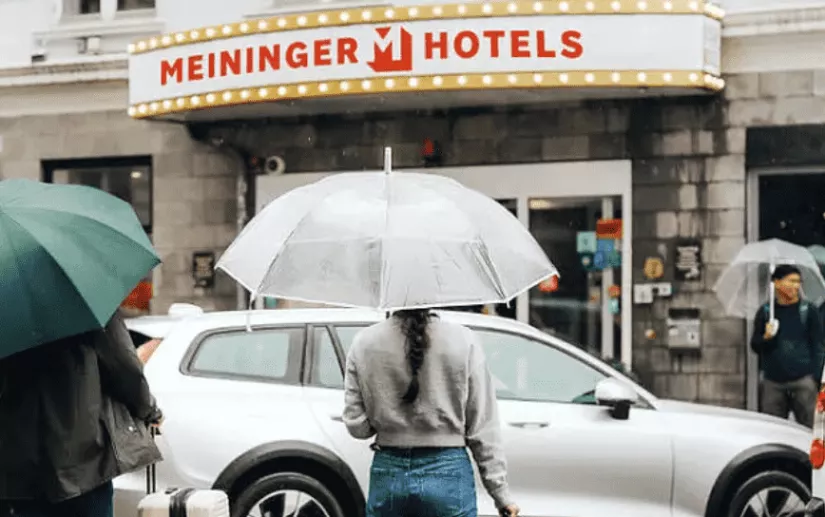
Copenhagen: brand reinforcement in a high-growth Nordic market
Denmark continues to demonstrate solid hospitality fundamentals, supported by sustained growth in hotel demand. According to official tourism statistics cited in the press release, the country recorded around 20 million hotel overnight stays in 2024, marking a new historical high and confirming the resilience of the Nordic travel market. Greater Copenhagen remains the primary growth engine, benefiting from strong international leisure demand and stable corporate travel flows.
This favourable market context underpins MEININGER Hotels’ decision to rebrand its Copenhagen property as MEININGER Hotel Copenhagen Vesterbro, a move designed to reinforce brand visibility and consistency in a city where hybrid accommodation formats have gained increasing acceptance over the past decade.
Originally opened in 2015 under the name Urban House Copenhagen by real-estate owner Pandox, the 235-room, 873-bed property was the Danish capital’s first hybrid accommodation concept, combining hotel services with hostel-style flexibility.
The current rebranding aligns the property fully with MEININGER’s European brand architecture, strengthening its positioning within a competitive urban market increasingly shaped by demand for flexible, experience-led and cost-efficient accommodation models.
Malin Widmarc-Nilsson, VP Commerce at Meininger Hotels, highlights the strategic relevance of the capital:
“Copenhagen is a key location for us in Europe and a magnet for guests from all over the world. With the new name, we connect the recognizability of our brand with the location. Guests can experience the unique charm of Copenhagen while enjoying our hybrid concept – a combination of hotel comfort and hostel atmosphere.”
Madrid: a targeted entry into one of Europe’s most competitive urban markets
Meininger is also strengthening its Southern European footprint with its first hotel in Madrid, developed in partnership with BNP Paribas Real Estate and Therus Investment. Scheduled to open at the end of 2027, the project covers more than 7,700 m² on Avenida del Mediterráneo 44, five minutes from Retiro Park, and will offer 193 rooms, 691 beds and 15 parking spaces.
Madrid remains one of Europe’s strongest metropolitan markets, drawing more than 10 million visitors annually and recording roughly 25 million overnight stays. With Europe’s fifth-largest airport, a strong university population and nearly 100 international congresses and trade fairs each year, the city offers favourable fundamentals for a hybrid model designed to accommodate families, groups, students and long-stay guests.
Accordingly, the room mix prioritizes quadruple rooms, complemented by twin, triple, quintuple and sextuple formats.
Ajit Menon, CEO of Meininger Hotels, notes:
“We are pleased to be working with BNP Paribas Real Estate and Therus Investment to realise our first hotel in Madrid. The central location in the Pacífico district provides the ideal basis for successfully implementing our hybrid concept and further strengthening our presence in one of Europe’s most important travel markets.”
This development builds on Meininger’s ongoing engagement with mobility-driven and student segments, as seen in its recent partnership initiatives.
A broader European strategy rooted in density, flexibility and urban demand fundamentals
Together, the Copenhagen rebranding and Madrid opening illustrate Meininger’s ambitions to increase operational density in key European metropolitan areas. The group’s hybrid model—combining hotel-standard comfort with hostel-style communal spaces and optimised room density—continues to appeal to investors seeking stable occupancy performance, diverse revenue streams and capital-efficient development structures.
These moves also align with the expansion paths previously observed across the Meininger portfolio, reflecting a disciplined approach to growth, strong local partnerships and positioning in markets where diversified demand patterns remain resilient.
By consolidating its presence in Copenhagen and expanding into Madrid, Meininger strengthens its role as a notable operator in Europe’s hybrid hospitality landscape. These projects contribute to a broader European platform designed to capture evolving travel expectations, urban mobility patterns and resilient leisure-business demand across major cities.