

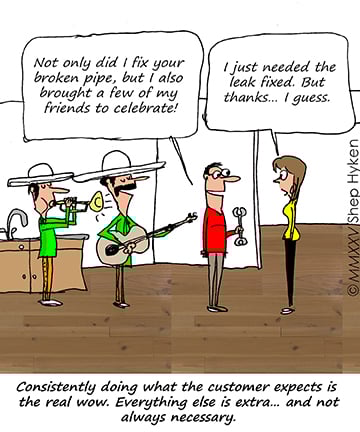
 This is a story about a disagreement I had with a client. I should mention, this was a friendly disagreement. His idea of an amazing experience was to go above and beyond, always exceeding the customer’s expectations.
His company is the one you call when a disaster, such as a flood, tornado, or fire, hits your home or office. The company specializes in cleanup and restoration. The owner believed it was important to go above and beyond in every interaction. So, I asked him for an example.
He said that when a customer calls – day or night, 365 days a year – someone will be there, and an emergency team will be dispatched immediately.
As nicely as I could, I told him that what he described was not an above-and-beyond example. No, what he described was what every customer expected. While the customer may be elated with how quickly the company responds to their emergency, that’s what his company is supposed to do.
Above and beyond experiences are reserved for unexpected moments. Not long ago, I wrote about the story Steve Wynn, the chairman of Wynn Resorts, a group of hotels and casinos, shared about how an employee helped a guest get medicine she had left at home. That was truly an above-and-beyond example.

It doesn’t always have to be something big.
However, it doesn’t always have to be something big. For example, the surprise piece of cake with a candle the server at a restaurant brings to the table, not because someone told him it was a guest’s birthday, but simply because he overheard the patrons talking about the birthday. He took advantage of that information and created the surprise-and-delight moment, another version of above-and-beyond.
But you can’t count on emergencies and birthdays to happen every time. You can take advantage of those moments when you know they’re coming, but if every day, in every interaction, you focus on giving the customer your best effort to meet, and even slightly exceed, their expectations, you’re operating in the zone of amazement.
Going above and beyond should never be the goal for every interaction. It’s not sustainable, and it’s definitely not a realistic goal. What is realistic is delivering consistent and predictable experiences that meet expectations every time and occasionally rise just a bit above them. The point is, customers don’t demand fireworks unless that’s the kind of experience you sell. What they want is reliability, ease, and empathy. When those are in place, the occasional above-and-beyond or surprise-and-delight moments become icing on the cake, not the foundation of your service. Do what customers expect, every time, and you’ll amaze them with your consistency. That’s what builds trust, loyalty, and the kind of reputation that gets customers to say, “I’ll be back.”