
What are hotel departments?
The departments of a hotel are the different organisational areas that enable it to function properly, from guest services to internal management. Each one serves a specific purpose, acting as the cogs and gears that drive the daily operations of your hotel.
Although customers often have the impression that everything runs smoothly and seamlessly, behind every detail, coordinated teams are working relentlessly. From those who prepare the rooms to those who handle billing, from the kitchen to reception and maintenance, everyone is part of a much larger and well-defined structure.
Understanding the internal organisation of a hotel, what each team does, how they interact with one another, and what responsibilities they hold is key if you are taking your first steps in the hotel industry or if you are considering a restructuring to maintain a high-quality experience. And although everything seems calm from the outside, there is a lot of activity behind the scenes to ensure that everything is in its place.

The 13 main hotel departments and their functions
Although they may vary or merge depending on each type of hotel or chain, hotel departments are, by definition, internal organisational divisions that have particular functions which, when combined, ensure that the entire system runs smoothly.

Below are the main departments any hotel should have:
1. Management Department
Like any other business, a hotel needs a management team to lead the company’s main operational decisions. In other words, it needs a “brain” to direct and coordinate all other areas.
Although it may be an out-of-sight department for guests, it is essential for the proper running of the property. Some of its basic functions include: the supervision and general management of the staff working at the hotel, the implementation of commercial and operational strategies, and the supervision of the general maintenance schedule for the facilities, among others.
The size of this department can vary considerably depending on the size of each hotel. However, it normally has: a general manager, an operations manager, a front office manager, a purchasing and sales manager, a marketing director, a maintenance director, a security manager, a housekeeper manager, and an IT (information technology) manager, among others.
2. Management and Finance Department
If there’s a team responsible for monitoring cash flow, expenses, and the profits generated by the hotel’s activity, it is clearly the finance department. Their main responsibility is to manage the company’s bookkeeping, i.e., the money coming in and going out of the hotel daily .
Among their most common tasks are: paying salaries and utilities, generating financial reports, processing invoices, and managing and optimising revenue from sales. This department usually has a financial director or head of administration, an accountant, an internal auditor, and in some cases, staff dedicated to treasury, purchasing, or financial analysis.
All of them work in coordination to ensure the economic health of the hotel. In other words, it could be considered the “fuel” department, since its work keeps the engine running.
3. Sales and Reservations Department
Obviously, a hotel without guests will never be a hotel, which is why the team responsible for handling reservations and room sales (or other services) plays a key role in the survival of the business.
On the one hand, as it is an economic activity, the main objective of the sales and reservations department of a hotel is to maximise room reservations and sales, thereby increasing the company’s revenue.
Finally, in addition to seeking maximum profit, another important task of this department is the efficient management of all reservations received by the hotel, for example via channels such as GDS and OTAs.
As for its members, this department usually has a sales director, booking managers or agents, revenue managers, back-office staff, and, in some cases, corporate or commercial account managers specialising in segments such as groups, events, or MICE reservations.
4. Marketing Department
In many hotels, the marketing department is merged with the sales department, as their functions are closely related and share common goals. However, in larger organisations or those with more complex structures, they are often divided to further specialise their duties.
Hotel marketing revolves around designing and implementing strategies that improve the hotel’s market positioning, increase its visibility, and differentiate it from its competitors.. This ranges from advertising campaigns and social media activities to designing special promotions, branding, search engine optimisation (SEO/SEM), and content management on websites and other digital channels.
In addition, this department often collaborates in the creation of graphic materials, newsletters, loyalty initiatives, and even collaborations with influencers or media outlets in the sector to attract new audiences.
This team usually consists of a director or marketing manager, digital marketing specialists, community managers, graphic designers, content managers, and in some cases, external agencies that offer strategic or creative support.
5. Front office department
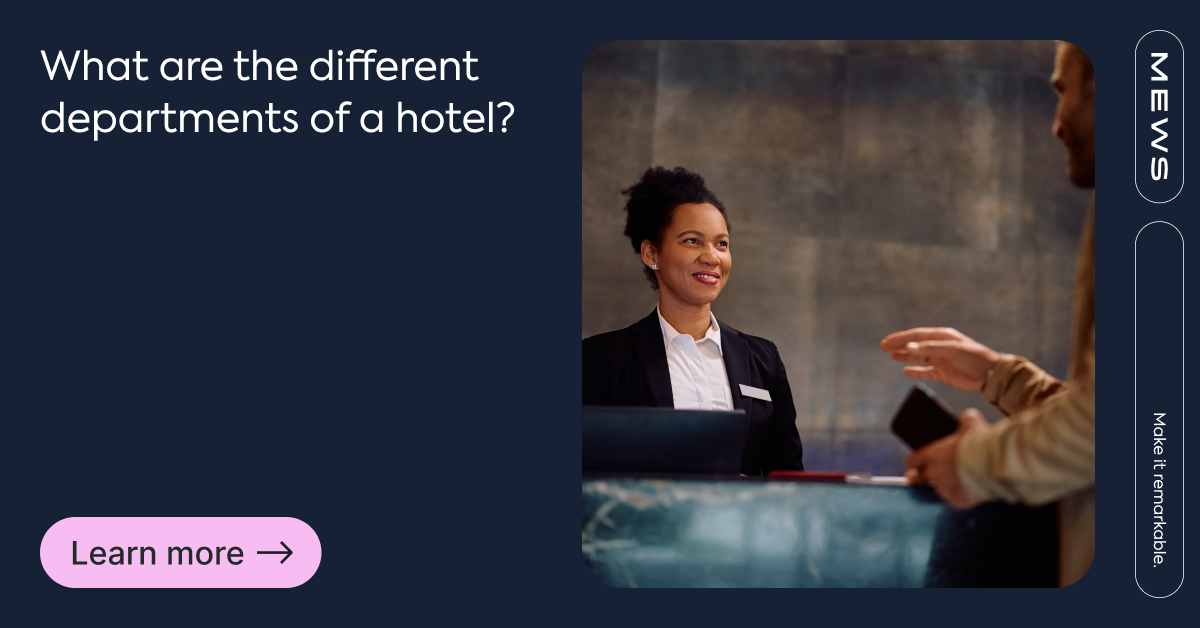
One of the most recognisable features of any hotel is its reception area. It represents the first impression and the beginning of the service, and therefore, it is a very important part of the hotel business.
As the visible face of the hotel, this department is responsible for, among other tasks: welcoming guests (preferably with a smile), managing guests’ check-ins and check-outs, providing hotel information, handling special requests, and acting as a liaison with other departments such as housekeeping.
In addition, this department is responsible for management tasks such as room allocation, booking control, handling issues and payments, among other duties. In larger hotels, the front desk may also have a concierge team responsible for providing additional services such as restaurant reservations, transfers, or tours.
This team is usually made up of front desk staff, front desk managers, management assistants, and, in some cases, bellboys or support staff. It is important to bear in mind that an efficient, thoughtful, and well-organised reception is a key factor in customer satisfaction and, therefore, a critical part of a hotel’s success.
6. Housekeeping Department
Cleanliness is undeniably crucial in any hotel. Not only because it is generally a vital matter in any accommodation, but also because of the large number of rooms, kitchens, halls, and employees involved in coordinating a hotel’s daily cleaning tasks (in record time).
The department is subdivided into three main areas: the housekeeping manager, floor supervisors (including common areas or laundry), and finally their assistants. Depending on the size, some hotels even have staff assigned to specific cleaning tasks, such as cleaning the spa pools.
In addition to cleaning rooms, their duties also include laundry, cleaning kitchens and common areas, and performing quality checks.

7. Maintenance Department
With so many guests, visitors, and staff coming and going, it is essential to have one or several maintenance managers in the hotel who can check, repair, or replace any unexpected technical issues. They are the company’s handymen.
However, something that is often overlooked is that this department not only acts when something happens, it is also responsible for preventing problems in the first place by scheduling preventive maintenance. It’s better to prevent than repair.
8. Food and Beverage Department (F&B)
In addition to offering accommodations, many hotels are also known for their gastronomic services, which include a restaurant, bar, cafeteria, or room service. From breakfast to banquets, cocktails to room service, a hotel could have very busy F&B operations.
This department includes waiters, cooks, head chefs, and, in some cases, bartenders or sommeliers. Although it may sometimes seem like a secondary department, it is actually one of the main sources of income for many hotels and contributes significantly to their identity and reputation.
9. Purchasing Department
At first glance, it may seem that this department is only involved in spending, but its role is key to the hotel’s operations. This department is in charge of overseeing and managing the supply of all resources required for daily operations, from room amenities to toner for the marketing team’s printer.
They are also responsible for keeping track of inventory, performing quality control checks, and negotiating with suppliers. All of this must be done within the hotel’s budget, so their work goes hand in hand with the Management and Finance departments.
10. Event Planning Department
Without a doubt, selling rooms is one of the main purposes of any hotel. However, diversifying and complementing this offering with others is also a significant economic asset that should not be overlooked.
Offering rooms for events (business meetings, private dinners, etc.) is an excellent boost to the hotel’s finances, not only because it is an additional service, but also because it encourages guests (especially those in the MICE segment) to take advantage of accommodation plus event packages, such as conferences or conventions, for example.
This department is responsible for managing all logistical and operational aspects related to holding events within the property. It is usually led by an event coordinator or manager, who is responsible for planning every detail in collaboration with the reservations, food and beverage, reception, and maintenance teams.
Their main job is to ensure that every event runs smoothly, meeting customer expectations and making the most of the hotel’s facilities.
11. Human Resources Department
The hotel industry is known for its high staff turnover, caused both by seasonality and the difficulty of retaining talent. That is why this department plays a key role.
It is usually led by a human resources manager or director, who, in addition to being responsible for attracting and recruiting the best candidates, also manages the daily operations of the team: hires, resignations, shifts, holidays, and any other needs related to the workforce. Their work ensures that the hotel maintains a stable, motivated, and efficient team throughout the year.
12. IT Department
This department has become one of the most important and investment-intensive in recent times. As technology evolves, so do consumer (and work) habits, making it essential to have a department that meets this need for constant management and coordination regarding technology and information.
They are responsible for managing and supervising all of the hotel’s technological systems: from maintaining the Wi-Fi network and ensuring that televisions and electronic locks are working properly, to operating software such as PMS, channel managers, and booking tools. They are also in charge of implementing technological improvements and ensuring cybersecurity, protecting both the hotel’s and guests’ confidential information.
13. Security Department
In many hotels, especially larger or high-end hotels, there is a team dedicated exclusively to ensuring the security of guests, employees, and facilities.
Their tasks range from the supervision of video surveillance cameras, access control, and internal rounds, to coordination in case of emergencies or evacuations. This department may also be responsible for managing lost and found objects and collaborating with the authorities if necessary.

How do hotel departments work together in the daily operations of the hotel?
The day-to-day running of a hotel requires coordination between departments to ensure that everything runs like a well-oiled machine. Although each department has its specific duties, the success of the hotel operations depends on constant and efficient communication between the different teams.
The Management department usually acts as the central hub, supervising and facilitating the flow of information between areas such as Front Desk, Housekeeping, Maintenance, F&B, Sales and Human Resources.
For example, when a large group of guests arrives, it is essential that the Front Desk is aware of the booking details, that Housekeeping has the rooms ready, and that the Food and Beverage team is prepared for an increase in service.
In addition, arranging coordination meetings, generating daily reports, and using the right technology help synchronize the various departments in the hotel’s daily operations.
How technology helps optimise the management of hotel departments
In an increasingly dynamic and competitive landscape, technology has become a key ally in improving the operational efficiency of hotels. In short, having the right digital tools allows you to automate processes, reduce errors and improve coordination between teams.
A property management system (PMS) centralises information and streamlines communication between the different departments. For example, if the housekeeping department updates the status of a room in the system, the front desk staff sees it in real time and can quickly assign it to the next guest. Similarly, the sales team can access up-to-date reports on availability, rates, and performance, enabling them to take better informed decisions.
In addition to the PMS, there are other technological solutions that add value. Revenue management tools help optimise prices according to demand, distribution channels and forecasts.
In addition, digital marketing platforms allow campaigns to be tailored based on guest profiles, and data analytics systems provide a comprehensive overview of hotel operations in real time.
To sum up, adopting a fully integrated technology strategy is no longer optional, but essential to stay competitive in today’s hotel industry.
Conclusion
It is clear that a hotel is a complex structure and, as we have discussed, it is composed of several departments that together offer a comprehensive and coordinated service.
For this to happen, it is important to have a good understanding of the different existing departments, their defining functions, their characteristics, and what each one does, so that we can create a hotel that meets our needs and suits our guests’ tastes.
Keep browsing our blog to stay up to date with the latest news and learn more about the hospitality industry.
Download our guide ‘Empower Your Teams’