The Fallacy of the “Global Average”
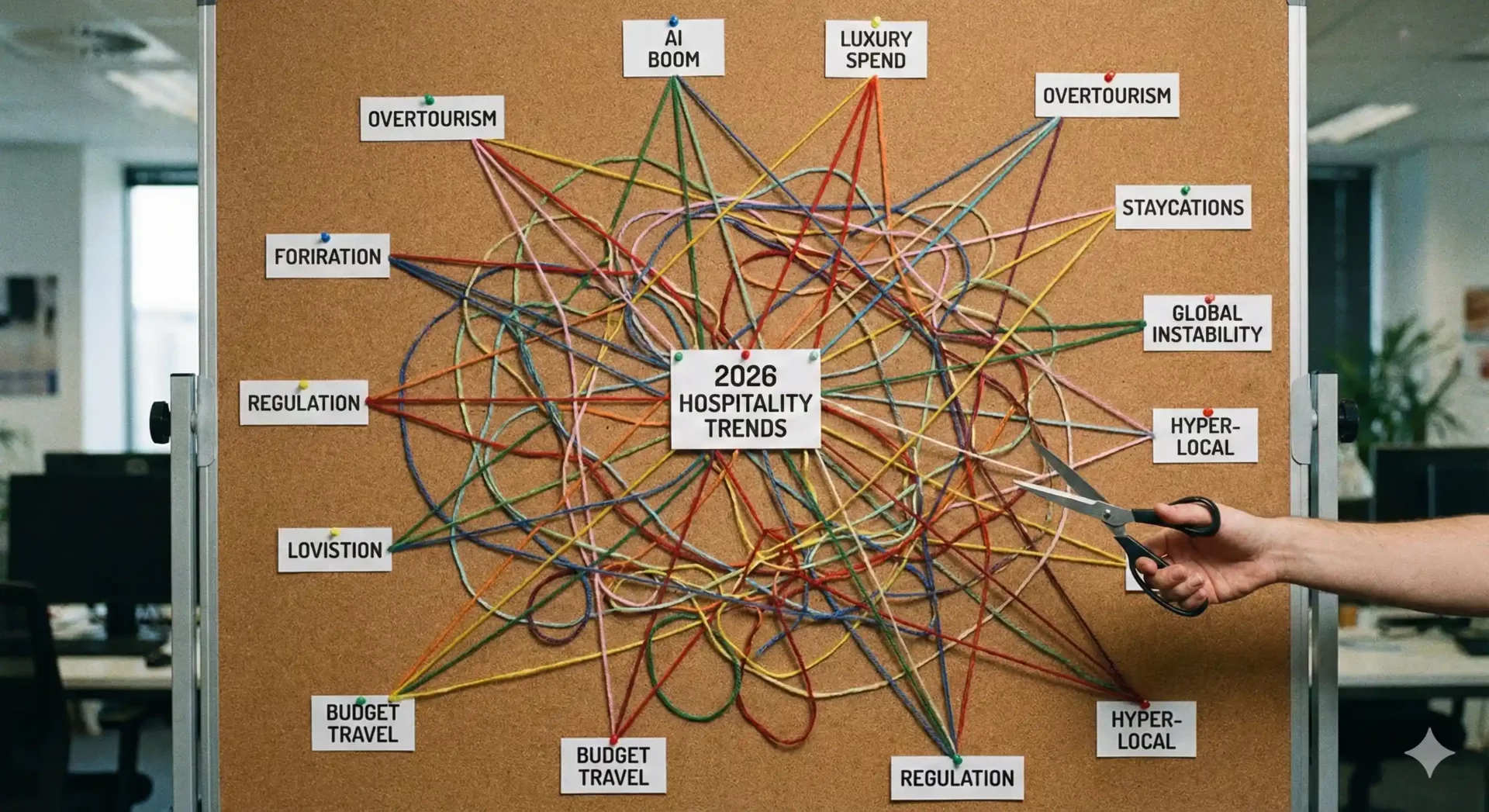
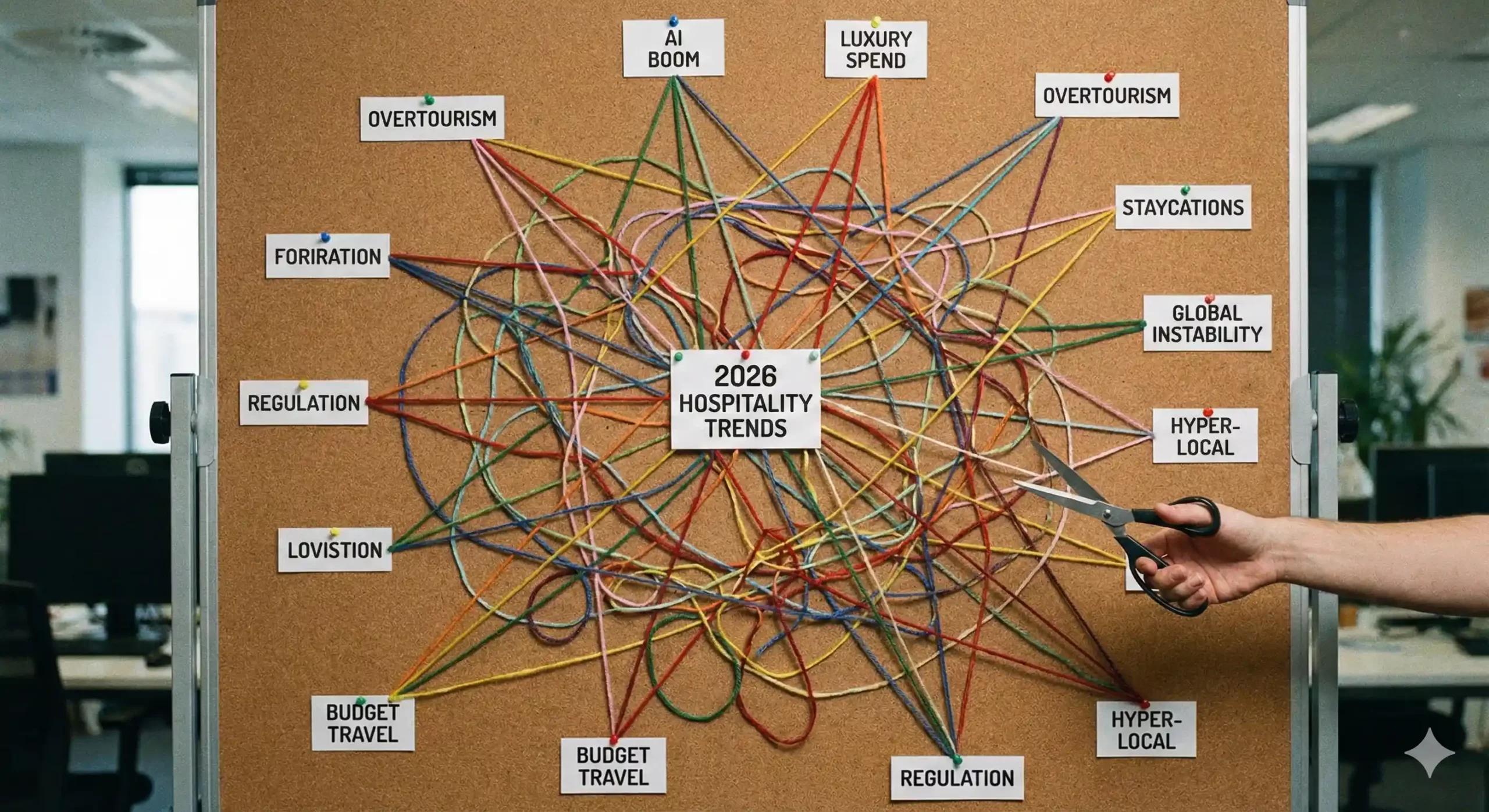
The first few trends in the report are classic examples of the “Global Average” trap.
Trend #1 warns of a “turbulent travel and hospitality environment” amid geopolitical instability. Trend #3 discusses the “dispersion of European seasonal demand,” claiming that travelers are moving to shoulder seasons to avoid crowds.
On the surface, these sound important. But dig into the data provided in the report, and the utility falls apart immediately.
The report notes a 20-percentage-point gap in regional performance: hotels in Asia are seeing prices rise by 9%, while hotels in Oceania are seeing prices decline by 11%.
Think about that for a second.
If you are a General Manager in Sydney (Oceania), a report telling you that “Global Travel is Resilient” is actively misleading—because your reality is an 11% drop. Conversely, if you are in Tokyo, a “Global Caution” report is a distraction from your actual problem: managing a 9% surge in demand.
A global average is a liar.
It’s like telling a person standing in a blizzard and a person standing in the desert that the “average global temperature is a pleasant 15°C (59°F).” It is a statistically accurate statement that is functionally useless to both people.
The same applies to the “Seasonality Shift” (Trend #3). The report claims that high season is softening based on data from five megacities: Barcelona, Istanbul, London, Paris, and Rome.
But your hotel isn’t an average of five capital cities.
- If you run a ski resort in the Alps: Your “season” is dictated by snow, not by a subtle shift in consumer sentiment. No one is booking a ski trip in May just to “avoid the crowds.”
- If you run a business hotel in Frankfurt: Your demand is dictated by the trade fair calendar, which has nothing to do with leisure “shoulder seasons.”
The Takeaway: You don’t need to know if the world is turbulent. You need to know if your specific feeder markets are booking for your specific dates.
Problems You Can’t Fix (So Don’t Worry About Them)
The next cluster of “trends” in the report falls into a category I like to call Gravity Problems. In life, if a problem is actionable, you solve it. If it’s a fact of nature (like gravity), you don’t solve it; you accept it and move on.
The 2026 report asks you to spend valuable brainpower worrying about:
- Trend #2: Traveler taxes set to go upwards.
- Trend #4: Chasing value with currency-driven travel.
- Trend #5: A potential slowdown in global short-term rental supply.
Let’s be honest: Can you change any of this?
The report lists specific tax hikes in Kyoto, Milan, and the Netherlands. It warns of volatile entry requirements into the US. It analyzes fluctuations in the Japanese Yen against the US Dollar.
As a hotelier, you cannot control the outcome of the US election. You cannot set interest rates at the Bank of Japan. You cannot stop your city council from voting to increase the tourist tax.
These aren’t “trends” to strategize against; they are simply the weather conditions of doing business.
- If the Yen is weak and you are in Tokyo, you raise your rates.
- If the Yen is weak and you are in New York, you look for domestic travelers instead of Japanese tourists.
- If the city raises the tourist tax, you update the line item in your PMS and send an email to your upcoming guests.
The same applies to the much-hyped “Slowdown in Short-Term Rental Supply” (Trend #5). The report dedicates paragraphs to the fact that global vacation rental growth slowed from 11% to 6.5%.
Who cares?
Knowing that Airbnb supply is decelerating globally is trivia. It has zero impact on your RevPAR. You only care about one thing: Did the city council in your town just ban Airbnbs?
- If yes, your local compression just went up.
- If no, you are still competing with the 50 listings down the street.
The Takeaway: Don’t confuse “Macro-Economic News” with “Business Strategy.” You don’t read about Earth’s climatic history to decide what to wear today; you look out the window to see if it’s raining. If there’s a tax, collect it. If the currency shifts, yield your rates. But don’t waste 20 minutes reading a report about it.
The “Marketing Buzzword” Distraction
Every year, the hospitality industry invents a new vocabulary to describe things that have existed forever. This year, the report gives us two prime contenders: “Destination Dupes” (Trend #7) and “Blended Booking Channels” (Trend #9).
These aren’t trends. They are marketing buzzwords disguised as strategy.
Let’s start with “Destination Dupes.” The report highlights that travelers are swapping expensive destinations for cheaper, lookalike alternatives, citing Albania as a “dupe” of Greece. They call this a “structural change in how consumers value travel.”
I call it “Price Sensitivity.”
People have been choosing cheaper alternatives since the dawn of commerce. But more importantly, this “trend” is useless because you cannot strategize around it.
- If you are a luxury hotel in Santorini: You cannot pivot to becoming a “dupe.” You are the premium product. Your strategy is to justify your price, not apologize for it.
- If you are a budget hotel in Albania: You already know you are the cheaper alternative. You don’t need a trend report to tell you that your main selling point is value.
You are either the destination or the alternative. No amount of trend-watching will change your geography.
Then we have “Blended Booking Channels” (Trend #9). This section breathlessly explains that social media platforms like TikTok and Instagram are blurring the lines between inspiration and transaction. It warns that hoteliers must “remain alert” to this shifting landscape.
Let’s be real: If you are just now realizing in 2026 that Instagram is a marketing channel, you have bigger problems than reading this blog post.
Calling it a “Blended Booking Channel” makes it sound like a complex new paradigm. It isn’t. It’s just distribution. ten years ago, it was Facebook. Five years ago, it was Instagram. Today, it’s TikTok. Tomorrow, it will be something else.
The Takeaway: Don’t let buzzwords distract you from the basics. If you aren’t a “Dupe,” you can’t force yourself to be one. And you don’t need a “blended strategy”—just put your booking link where your customers are hanging out.
What Actually Matters (The “Anti-Trend” Strategy)
If we throw the macro-trends in the bin, what are we left with? If you shouldn’t be reading about global geopolitical instability or the “World Uncertainty Index,” what should you be reading?
The answer is boring, unsexy, and incredibly profitable: Your own data.
A hotelier in a booming destination can ignore a global recession. A hotelier in a dying destination can’t be saved by a global boom. Your success in 2026 won’t be defined by what happens in the “Global Hospitality Market.” It will be determined by what happens within a 5-mile radius of your front desk.
Here is your “Anti-Trend” reading list for 2026:
- Hyper-Local CompSet Data: Stop worrying about whether demand in Asia is up 9%. Look at the hotel across the street. Are they sold out next Tuesday? If they are pushing rate and you aren’t, you are leaving money on the table. That is the only market signal that matters.
- Pace vs. Last Year: Forget the report’s claim that “booking windows are shortening globally.” Look at your own books. Are you ahead or behind for the upcoming holidays compared to this time last year? If you are behind, drop the rate. If you are ahead, yield up. Your history is a better predictor than a global average.
- Local Event Intelligence: The report warns of “turbulent environments.” For a hotelier, a turbulent environment is when a Taylor Swift concert gets cancelled or a major medical conference books the convention center. These two events will impact your P&L more than any election or currency fluctuation. Keep your eyes on your local city calendar, not CNN.
- Net RevPAR: The report talks about “Blended Channels.” Who cares where the booking comes from if you aren’t making money on it? Stop obsessing over volume trends and start obsessing over profit reality. How much are you actually keeping after the OTA commission? That’s a metric worth tracking.
Conclusion: Be Your Own Trendsetter
The 2026 predictions are in, and the verdict is clear: The world is uncertain, taxes are annoying, and computers are getting smarter.
You probably already knew that.
The danger of these 20-minute trend reports is that they trick you into feeling productive. You feel like you are “strategizing” by reading about the global state of travel. But really, you are just procrastinating on the hard work of managing your own revenue.
A “Global Trend” is just an average that lies to everyone equally.
If a trend is out of your control (like currency, taxes, or war), it’s not a trend—it’s just the weather. Bring an umbrella, but don’t base your entire business strategy on a forecast for another continent.
So, here is my challenge to you for 2026:
Stop looking at the horizon. Stop reading about the “Global Traveler of Tomorrow.”
Start looking at your doorstep. Look at your arrivals list for next week. Look at your rate shop, using Lighthouse, for next month. Look at your bottom line.
That is where the real trends are. And unlike the global ones, those are trends you can actually do something about.