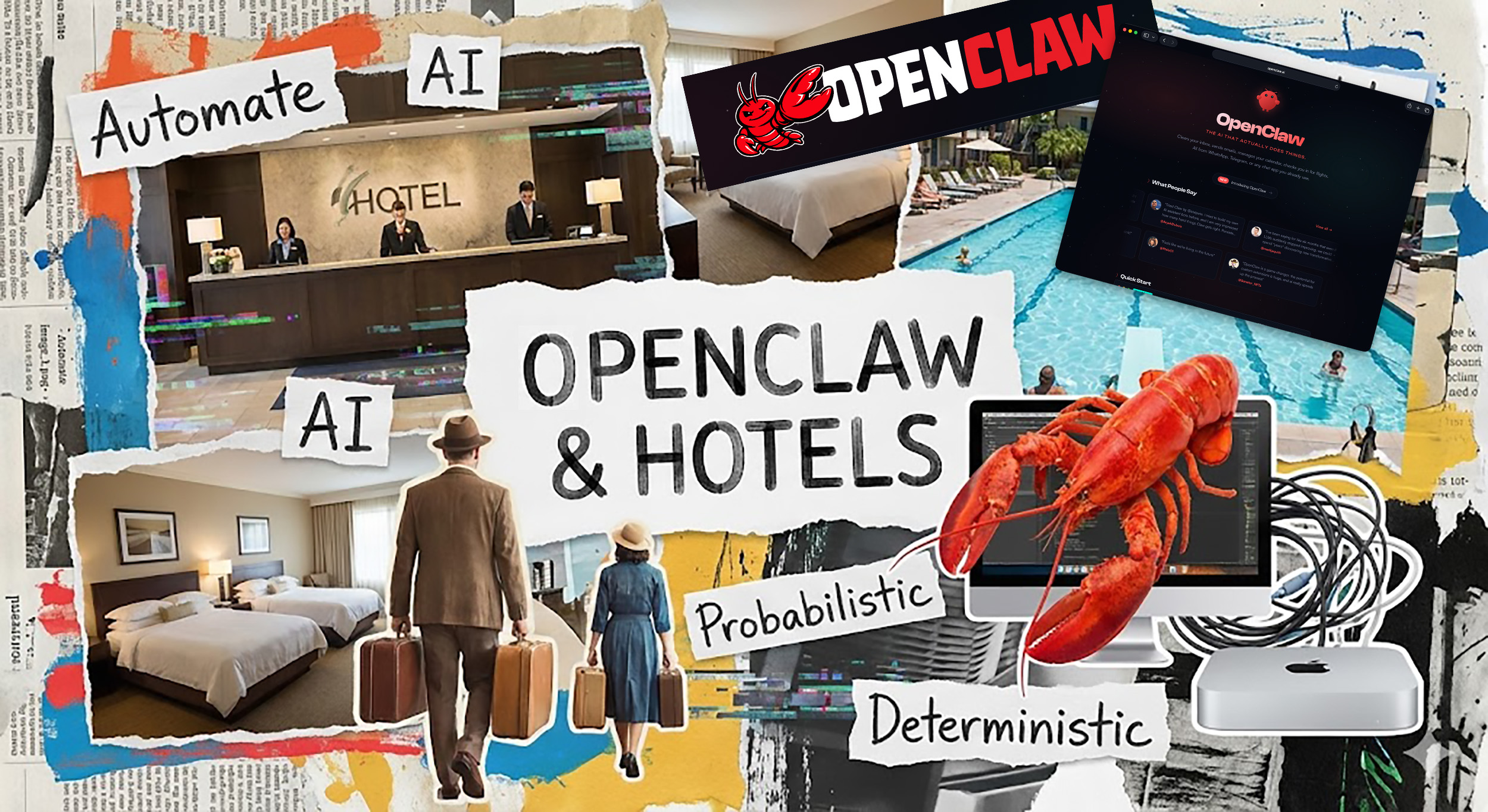
Artificial intelligence is rapidly entering hotel operations, but much of the current conversation is built on the wrong assumptions. Many hoteliers are being told that AI will replace their PMS, automate reservations end to end, or somehow become a new core system of record. That framing is not only inaccurate, it is risky. To understand where AI truly fits in hospitality, one must first understand a fundamental distinction that is often overlooked: the difference between probabilistic AI systems and deterministic hotel software.
Note, this article doesn’t cover the (very large) security risks of using such a system. Considering the amount of PII data that hotels manage it is not advised to give it much access to your existing systems. However that doesn’t negate the many great benefits that could come from it.
Topics covered in this article
- Why core hotel systems such as PMS, CRS, inventory, billing, and payments must remain deterministic.
- Introducing OpenClaw, earlier known as Clawdbot, as an example of a new class of AI agents that operates far wider than usual chartbots.
- How such AI agents work in simple terms. They listen continuously, interpret human language, and act through tools while staying outside mission critical workflows.
- Hospitality use cases, including guest messaging, request triage, reservation inquiries, internal task routing, and marketing coordination.
- The clear boundary between what AI agents like OpenClaw should do and where deterministic automation platforms remain essential.
- A general framework for hotels navigating AI adoption, showing how probabilistic intelligence and deterministic automation can coexist without compromising operational integrity.
This is not an article about replacing hotel systems. It is about understanding how AI agents fit into the modern hotel stack, what problems they are uniquely suited to solve, and how to adopt them without creating risk.

Why Probabilistic Versus Deterministic Systems Matter in Hospitality
Before talking about OpenClaw, AI agents, or automation, there is one fundamental concept every hotelier needs to understand. Not all software behaves the same way, and confusing these differences is where most AI projects go wrong.
prob·a·bi·lis·tic: (adjective) Describing a method, process, or system that involves randomness, chance, or statistical probabilities rather than fixed outcomes. Defined with Lomar DictionaryModern AI systems are probabilistic. This means they work by estimating the most likely answer based on patterns in data. Given the same input twice, they may not produce exactly the same output. They are exceptionally good at understanding language, intent, tone, and ambiguity. They can summarize, classify, draft responses, and reason about messy human inputs.
de·ter·mi·nis·tic: (adjective) Describes a system, algorithm, or process in which operations will always produce the same output from the same initial situation or input, without any randomness. Defined with Lomar DictionaryCore hotel systems, however, must be deterministic. Deterministic software follows strict rules. The same input always produces the same output. If a room rate is 250 euros, the system must charge 250 euros every single time. If a reservation is confirmed, inventory must be reduced in a precise and auditable way. There is no room for interpretation.
This distinction is critical. Probabilistic systems are powerful, but they do not belong at the heart of reservations, billing, inventory, or financial flows. They belong at the edges, where language, interpretation, and human interaction dominate, and where mistakes are recoverable.
Once this distinction is clear, it becomes much easier to understand where tools like OpenClaw fit into a hotel technology stack.
What Is OpenClaw and Why It Is Different
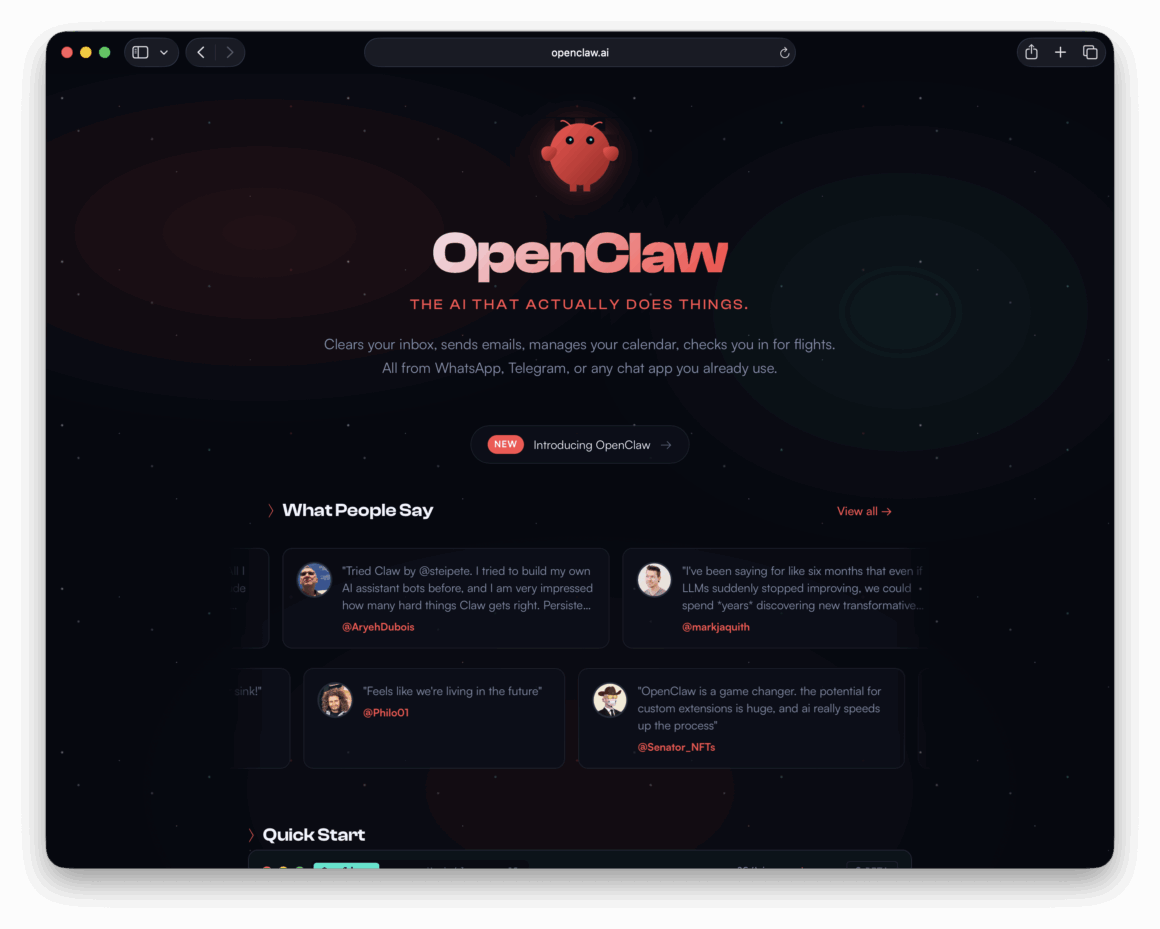
OpenClaw, earlier known as Clawdbot, is not a chatbot in the traditional sense. It is an AI agent framework designed to run continuously in the background, listen for events, and take action using real tools. The architecture and philosophy are clearly explained in the article “OpenClaw Explained” published on Medium by Cham Bandara, which provides a useful mental model for how this new class of software works.
Unlike classic chatbots that wait for a question and return a text answer, OpenClaw behaves more like an assistant that is always on. It can observe multiple inputs at the same time, reason about what is happening, and decide what to do next.
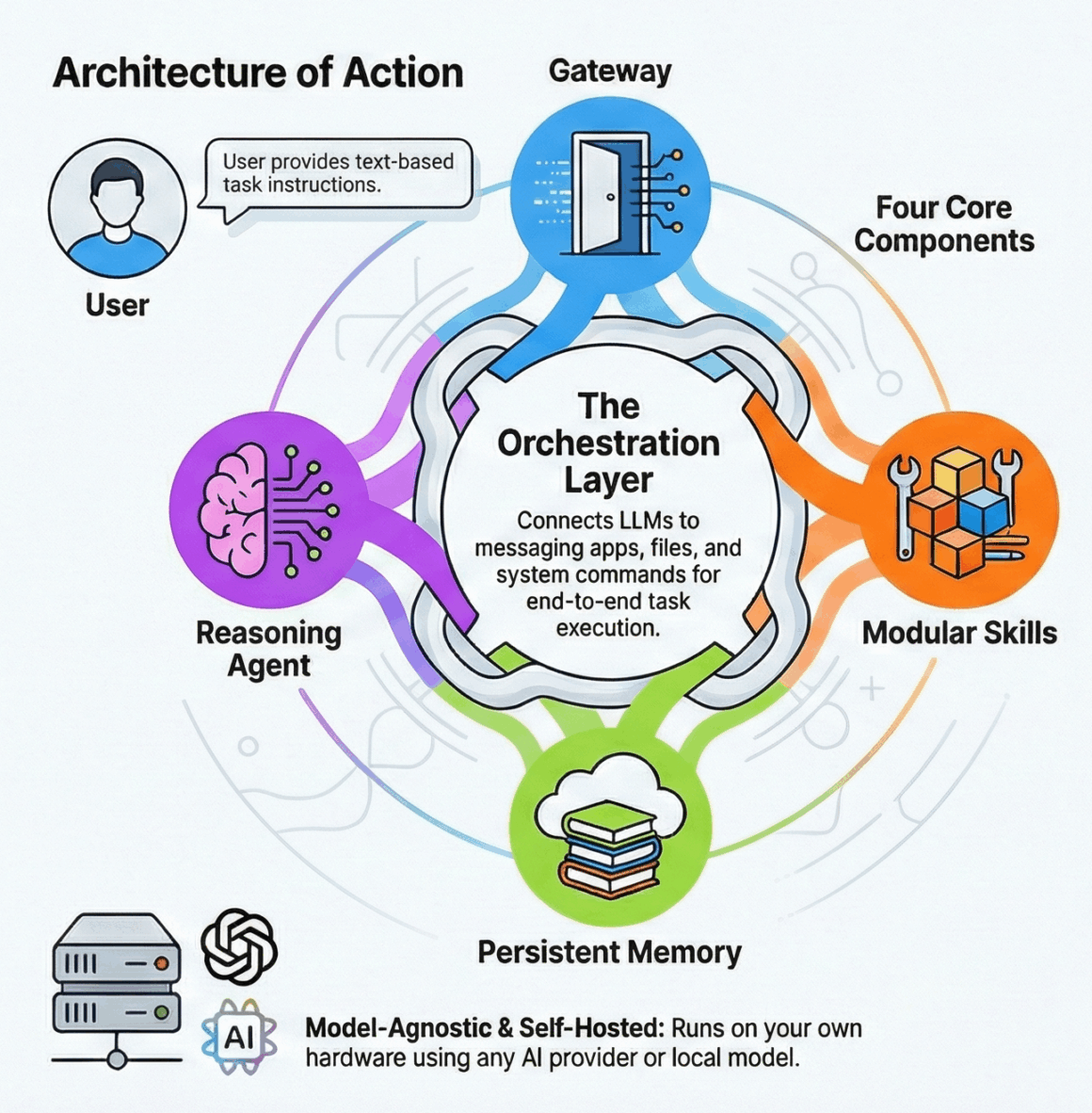
As explained in Cham Bandara’s article, at a high level, OpenClaw is made up of four core ideas.
First, it listens. OpenClaw runs as a background service that can monitor incoming signals such as emails, WhatsApp messages, SMS, website form submissions, files being uploaded, or internal messages. It does not require a user to actively open a chat window and ask a question.
Second, it reasons. Using a large language model, OpenClaw interprets what it sees. It tries to understand intent rather than just keywords. A guest message that says “we arrive early and have two kids” is not just text. It is an early check in request combined with a family context.
Third, it acts through skills. OpenClaw does not just generate text. It can use tools. These tools might include sending messages, checking a website in a browser, querying an API, updating a document, or triggering an automation workflow. This is what turns AI from a talking interface into an operational layer.
Fourth, it remembers. OpenClaw can store context over time. This allows it to behave consistently, follow preferences, and avoid starting from zero with every interaction.
This architecture is what makes OpenClaw interesting for hospitality. Hotels are full of signals, messages, exceptions, and manual work that sit outside core systems. OpenClaw is designed to live exactly in that space.
OpenClaw in a Hotel Environment
In a hotel, the PMS, CRS, or finance systems are deterministic systems. OpenClaw can act as a probabilistic intelligence layer that sits around them.
One of the most immediate use cases could be guest messaging. Many hotels still manage WhatsApp, SMS, email, and contact forms manually, often without a unified messaging platform. OpenClaw can listen to all incoming messages across these channels. It can classify them, identify urgency, and decide what should happen next.
Simple informational questions such as breakfast hours, parking instructions, or check in times can be answered automatically. More complex messages could be routed to the right department with a structured summary instead of a raw message. Responses to guests can clearly state that they are automated and that a team member will follow up if needed. This maintains transparency while dramatically improving response times.
Reservation inquiries are another strong fit. OpenClaw can read an incoming request, extract dates and preferences, check public website pricing or availability, and draft a suggested response. Depending on hotel policy, this response could be sent automatically or reviewed by a reservations agent before sending.
Operational requests also benefit. If a guest reports an issue in their room but does not mention the room number clearly, OpenClaw can infer context from prior messages or reservation data and create a task for maintenance or housekeeping. If it gets it wrong, the cost is limited to a small inefficiency, not a financial error.
Marketing and guest engagement workflows are equally relevant. If a new menu or special offer is created, OpenClaw can help update website content, inform front desk staff, and send targeted messages to in house guests or upcoming arrivals by querying the PMS or CRM. Because OpenClaw can work in a browser based way, it can operate even when systems do not expose modern APIs.
A key factor is that it has memory, much larger memory than a chatbot. So it will theoretically get more and more accurate and better over time. This could also be a problem if it get’s the wrong information and keeps going further and further off.
Where OpenClaw Should Stop
The same probabilistic strength that makes OpenClaw useful is also the reason it must be carefully bounded.
OpenClaw should most probably not directly charge credit cards, modify rates, adjust inventory, or execute financial transactions. These actions require deterministic guarantees. Even a small probability of error is unacceptable in these domains.
This is where deterministic automation platforms come in. Companies such as RobosizeME or Aphy or systems such as N8N or UiPath are designed to move data between systems, enforce rules, and execute workflows predictably. They may use AI to classify or interpret inputs, but once the data is structured, the execution is rule based and repeatable.
In a well designed architecture, one could imagine OpenClaw would handle understanding, language, and decision support. Deterministic automation handles execution, compliance, and financial integrity.
A Practical Way Forward for Hotels
OpenClaw represents a shift in how many people and hotels can view AI assistants. Instead of trying to force ChatGPT or Claude AI into core systems where it does not belong, it allows hotels to place intelligence where humans currently spend time reading, copying, pasting, and rewriting.
Used correctly, OpenClaw becomes a background assistant that listens continuously, reduces friction, and augments staff. It thrives in areas where ambiguity is normal and human language dominates, while leaving mission critical systems untouched.
For hotels navigating the fast moving AI landscape, this separation of roles is not just technical. It is strategic. Understanding where probabilistic AI adds value and where deterministic systems must remain in control is the difference between sustainable progress and expensive mistakes.
More details and fact sheet based on overview articles on the topic.
| Component Feature | Description | Functionality | Technical Requirements | Security Considerations |
|---|---|---|---|---|
| Gateway | A background service that remains online to listen for incoming communications. | Connects OpenClaw to messaging platforms (WhatsApp, Telegram, Discord, Slack) to enable user interaction via chat. | A machine with 24/7 uptime (VPS or local server) and a valid Gateway Token. | Gateway tokens must be treated as passwords; if exposed, they must be regenerated and redeployed immediately. |
| Agent | The core reasoning layer powered by a Large Language Model (LLM). | Interprets user requests, plans execution steps, and determines which tools or skills are required for task completion. | API keys from providers (e.g., Anthropic Claude, OpenAI GPT-4o/Opus) with active billing enabled. | API keys must never be shared publicly; users should be aware of prompt injection risks when the agent reads untrusted content. |
| Persistent Memory | Storage system that retains context and user preferences across various sessions. | Enables the assistant to remember user details, workplace relationships, and patterns to provide a personalized experience over time. | Local or server-based storage capacity for configuration and log files. | Memory is often stored in plain-text; sensitive context is exposed if the host machine’s security is compromised. |
| Heartbeat (Proactive Behavior) | A feature that enables the AI to activate and perform actions independently without a direct user prompt. | Automatically monitors conditions, such as an inbox, and alerts the user to urgent messages or detected problems. | Continuous background processing enabled on the host machine. | Autonomous actions increase risk if the agent has high privilege levels and misinterprets instructions. |
| Skills | Modular capabilities that extend the agent’s reach to external tools and third-party services. | Allows the agent to interact with browsers, files, shell commands, Google Workspace (Gmail, Calendar), and external APIs. | Specific dependencies (e.g., brew), GitHub repository links for installation, and occasionally Docker manager access. | Third-party skills may exfiltrate data; users should only install from trusted sources like ClawHub and review source code. |
| VPS Hosting | Virtual Private Server used to host the OpenClaw orchestration layer in the cloud. | Ensures the assistant remains operational 24/7 without requiring a personal computer to stay on or managing port forwarding. | Recommended specs: KVM plan with approximately 2 vCPU, 8GB RAM, and 100GB NVMe storage (e.g., Hostinger KVM 2). | Provides isolation from personal files; users should enable daily backups and restrict dashboard access to their specific IP. |
| Cron Jobs (Scheduler) | A control panel tool designed to establish recurring automated actions. | Allows users to schedule tasks, such as daily email summaries or meeting briefings, to execute at specific time intervals. | Configuration of system text instructions and a defined schedule (e.g., every 24 hours). | Automated tasks should be monitored to prevent infinite loops or accidental data leaks during execution. |