By Linda Girrbach, Co-Founder & Head of Hospitality Consulting at RobosizeME
Across hotel groups, there’s a conversation happening about automation. It usually revolves around AI, pricing sophistication, guest messaging, and personalization. Boards ask about it. Owners expect it. Vendors promote it.
Yet, one theme surfaced repeatedly during a recent webinar with hotel leaders: teams are overwhelmed by repetition, not by strategy
They’re overwhelmed by the quiet, daily execution that keeps the machine running.
Revenue managers build the same pickup reports every morning. Finance teams reconcile OTA commissions line by line. Operations staff manually route virtual credit cards. Profiles are being cleaned, merged, and corrected. Rate codes are updated across multiple systems.
Individually, none of these tasks feel transformational.
Collectively, they form something far more serious.
And that’s not work. That’s tax on your operation.
What Is an Operational Tax?
An operational tax is work that:
- Must be done
- Follows clear, repeatable rules
- Is performed daily or weekly
- Does not require strategic judgment
- Scales linearly with the number of properties
It is not innovation nor differentiation.
It is mechanical execution.
The reason it goes unnoticed is simple: per property, the time cost feels manageable. Thirty minutes here. An hour there. A few minutes per update. No single task appears significant enough to justify change.
But hotel groups don’t operate one property. They operate ten, fifty, two hundred, or more.
And that’s where the math changes.
When Small Tasks Become Structural Barriers
Consider rate code management. On its own, creating or updating a rate code may take only a few minutes. But multiply that by hundreds of properties and hundreds of updates per year across PMS, CRS, and channel systems.
One large hotel group calculated the impact of automating this single workflow. The result: the equivalent of 312 working days per year saved.
Not because the task was complex, but because the volume was high.
This is the defining characteristic of operational tax: small, repetitive tasks become structural barriers at scale. What feels like routine administration in one property becomes months of human effort across a group.
The same applies to daily pickup reporting. One hour per day per property becomes nearly a full month of labor per year. Multiply that across a portfolio, and you are effectively dedicating full-time positions to extracting, formatting, and emailing data.
The issue, at that point, is no longer efficiency, it is operational design.
The Misallocation of Expertise
The deeper issue is not just time lost. It is expertise misused.
Commercial teams often spend 60 to 70 percent of their time on manual, repetitive tasks. That leaves only a fraction for strategic work: interpreting market shifts, negotiating contracts, adjusting distribution mix, anticipating demand changes.
As we discussed during the session, your expertise is in the decision and not the data gathering.
Pulling data from a PMS, copying figures into a report, or reconciling line items in a spreadsheet does not require expertise
Interpreting why RevPAR is declining despite strong occupancy does. Designing a pricing response does. Repositioning a property in a shifting competitive set does.
This focus on strategic value was a key takeaway for our audience. As one attendee noted, the most valuable part of the session was ‘Affirming the areas automation can help save time’.
The Illusion of Progress
What makes this even more challenging is that, on the surface, the industry appears to be advancing rapidly.
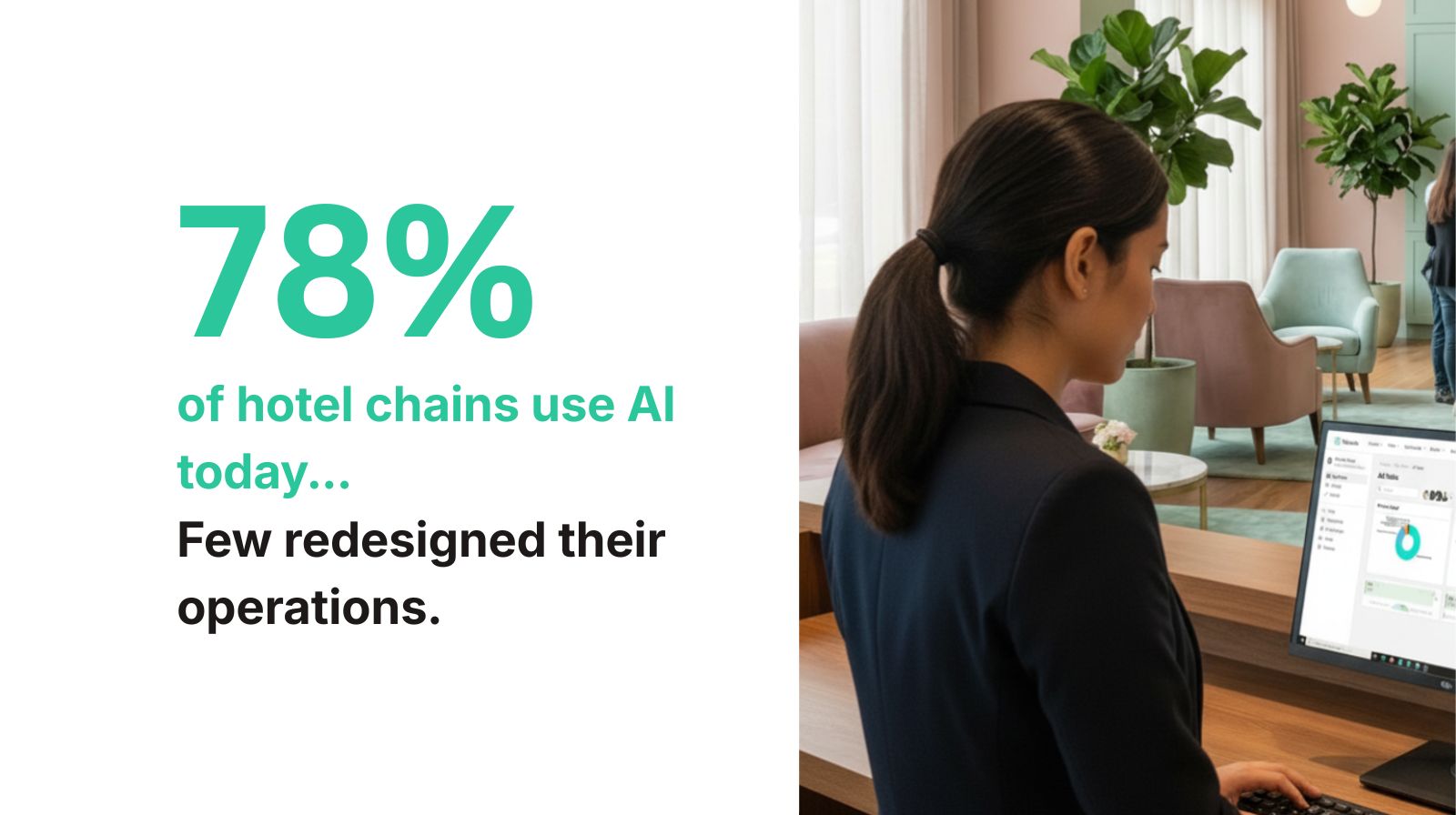
Most hotel groups now report using AI or automation in some form. Revenue Management Systems are widespread. Chatbots are common. Technology stacks are expanding.
Yet adoption is not the same as transformation.
Trust in automation remains moderate. Many organizations are experimenting, but few are redesigning their operations around it. Only a small percentage have a company-wide automation strategy led by senior leadership. A significant portion cannot clearly measure the return on their automation investments.
Automating pricing decisions while leaving execution manual creates an imbalance. Intelligent outputs still rely on fragile, human-driven processes beneath them. Rate changes must still be loaded. Reports must still be compiled. Data must still be reconciled.
The visible layer modernizes. The operational backbone remains unchanged.
And the operational tax continues to accumulate.
Why It Persists
If the math is so clear, why does operational tax continue?
Operational tax persists for structural reasons.
First, it is normalized. Every hotel has “always done it this way.” Tasks are embedded in routines and rarely questioned.
Second, responsibility is fragmented. Revenue automates revenue tasks. Finance optimizes finance workflows. Operations manages operations processes. Rarely does someone step back and assess the total human effort across the group.
Third, readiness varies. Effective automation requires documented processes, reliable data, system integration, and cross-team alignment. Without these foundations, early attempts fail, reinforcing skepticism.
The challenge is rarely technological. It is organizational.
What Removing the Tax Really Means
Removing operational tax does not require a radical overhaul on day one. It starts with one repetitive, rule-based workflow.
A daily report.
A commission validation process.
Virtual credit card routing.
VIP tagging.
When one task runs automatically, reliably, and consistently, confidence increases, time is freed, and the team sees a tangible impact (see also our previous article).
Following the session, a majority of attendees reported feeling ‘Very confident’ or ‘More confident than before’ about where to start their own automation journey, confirming that the path begins with one clear, repeatable workflow.
The goal is not to automate everything.
The goal is to redesign how human expertise is applied.
Experts should make decisions, interpret context, negotiate relationships, and set strategy. Systems should execute predefined rules at scale, 24 hours a day, without fatigue or variation.
That distinction is where operational transformation begins.
A Question Worth Asking
Hotel groups do not lack intelligence, technology nor talent.
What they often lack is visibility into where their human effort is truly going.
So perhaps the most important question is not: What should we automate next?
But rather: Which work inside our organization should no longer exist at all?
Not because it is unimportant, but because it does not require expertise.
When leaders begin to distinguish between decision-making and data gathering, between strategic thinking and mechanical repetition, operational tax becomes visible.
And once it is visible, it becomes a choice.
For hotel groups looking to scale without exhausting their teams, that choice may be the most strategic one they make.
👉 Book a demo with an automation expert, or meet us at ITB
👉 To learn more, download The Executive Guide to Hyperautomation