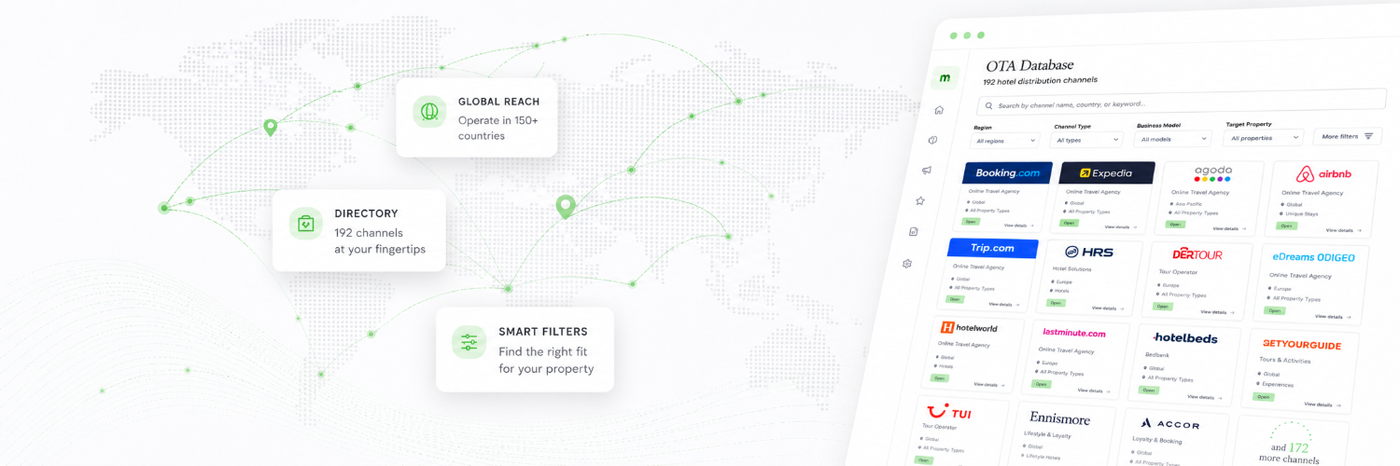
Follow Booking.com without the noise. This hub gathers the latest news, product changes and policy moves around the world’s largest accommodation platform (Booking Holdings, NASDAQ: BKNG), curated by 10 Minutes News. Essential reading for any hotelier who works with the OTA giant.
-

In Eastern Europe, local OTAs beat the giants by going narrow
21 October 2026Booking.com leads accommodation across most of Eastern Europe, but homegrown OTAs are growing faster by localizing hard. Phocuswright’s Eastern Europe Travel Market Report 2026 shows how low-cost carriers forced regional players to build virtual interlining and dynamic packaging, why fragmented hotels remain an OTA stronghold and how two geopolitical shocks are reshaping the forecast through 2029.
-

You Won the AI Recommendation. Expedia Won the Click.
21 October 2026This post was originally published on this site. The hotel industry is currently throwing money at “AI SEO” to ensure their property gets named when a traveler asks a machine where to stay. Picture the scenario. You win the prompt. Your hotel appears in the first paragraph of a generative answer. The marketing agency takes a victory lap. Then the guest clicks the link provided by the AI interface to check availability. They are not taken to your direct booking…
-
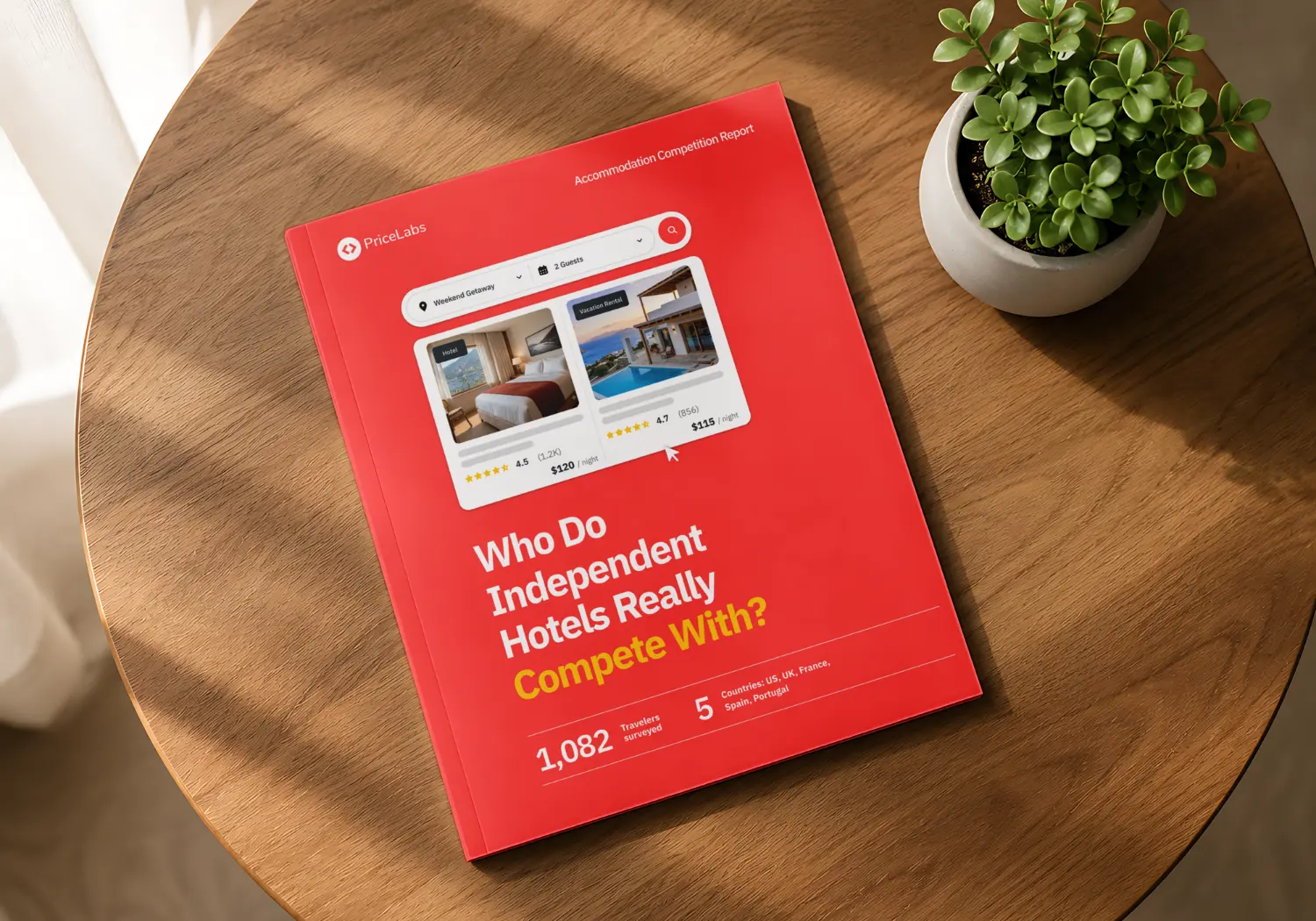
PriceLabs Research: 8 in 10 Hotel Guests Would Switch to a Short-Term Rental at a Similar Price
21 October 2026CHICAGO, IL, 21 October 2026 — New research from revenue management software provider PriceLabs reveals just how fluid the line between hotels and short-term rentals has become for travelers. Eight in 10 guests who stayed at a B&B, inn or small hotel would consider a short-term rental instead if the price was right. PriceLabs surveyed over 1,000 travelers across the US, UK, France, Spain and Portugal for its new report, Who Do Independent Hotels Really Compete With?. The survey found that 82% of guests who booked a…
-

Booking.com’s 2027 Travel Predictions Highlight Demand for Financial Flexibility and Personalized Wellbeing Preferences
21 October 2026🛫 In 2027, Booking.com forecasts key travel trends with insights from 28,230 global respondents. Half of travelers face budget-related group tension, and 56% select companions for financial savvy. Personal wellbeing influences 67% of travel choices, with 58% considering dietary needs. Recovery-maxxing rises, as 85% return more tired from vacations. Local cultural connections attract nearly 74% interested in culinary experiences. Survey in 2026 covered 32 countries, with a margin of error of +/- 0.6%.
-

In 2026, Booking Holdings Collects Payment on 73% of Bookings, Increasing Control Over Guest Pricing.
21 October 2026💸 In 2025, OTAs accounted for 29.9% of European hotel bookings, while direct bookings slightly increased to 51.3%. Expedia’s share rose to 16.6% in Europe. Booking Holdings now collects payments on 73% of its bookings, a rise from 69% in 2024, enabling them to set prices lower than hotels do. Radisson has automated price matching to OTAs, affecting over 1,600 hotels. Expedia’s B2B side saw 21% growth, while consumer brands grew 8%.
-
Booking.com Looks to Compete in India With Its Own Payments System and Business Travel
21 October 2026Booking.com wants more of India’s travel wallet, not just its hotel bookings. Payments and business travel could help it get there, but local platforms will make that a harder sell.
-
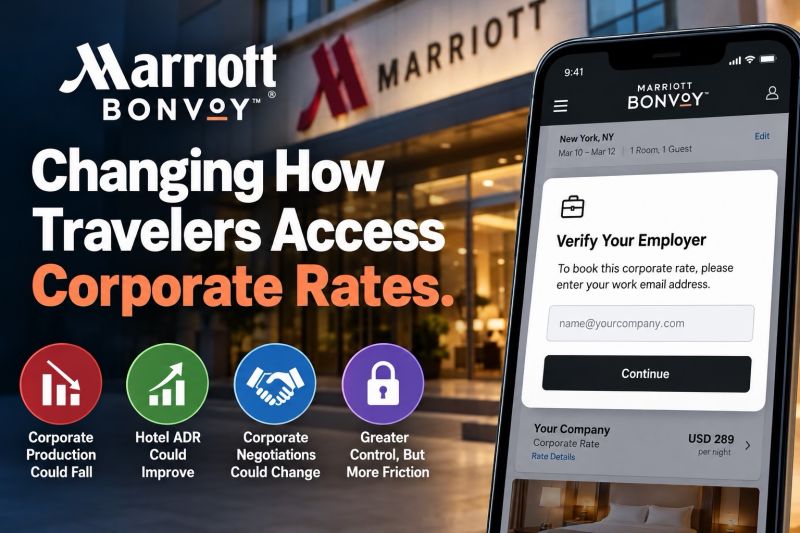
Marriott changes corporate rate access on Marriott.com and app | Louis-Hippolyte Bouchayer posted on the topic | LinkedIn
21 October 2026🚨 Marriott is changing how travelers access negotiated corporate rates. Marriott.com and the Marriott Bonvoy app now ask travelers to verify an …
-

Expedia Group and HotelRunner Launch Autonomous Onboarding, Enabling Hotels to Join Expedia in Under 24 Hours
21 October 2026🏨 Expedia Group’s Autonomous Onboarding™, launched with HotelRunner, allows hotels to join Expedia’s network in under 24 hours. The platform, active since an announcement at the Explore 2026 conference, reaches 75,000+ partners and 200,000+ travel agents. It processes 1 billion+ monthly searches and 415 million+ room nights yearly. Travelers spend 21% more and stay 11% longer than average. HotelRunner, an Elite Connectivity Partner for 2026, integrates existing hotel data seamlessly, boosting growth without added work.
-

Booking Holdings Now Handles Payment for 73% of Bookings, While Expedia Gains Ground in Europe and US
21 October 2026💸 Oct 21, 2026. In Europe, OTAs held 29.9% of hotel bookings in 2025. Booking Holdings collected guest payments on 73% of bookings, up from 69% last year. Expedia’s B2B segment grew 21%, reaching $10.7 billion. Expedia’s market share in Europe rose to 16.6%, while Booking Holdings fell to 68.8%. In the US, Expedia surpassed Booking.com in booking volume for the first time since 2021. Expedia sold 111.5 million room nights, Booking Holdings 325 million.
-

Independent Hotels Consider Joining Soft Brands for Access to AI Booking and Reduced OTA Commissions
21 October 2026📈 Oct 21, 2026: Soft brands, like collection brands, allow hotels to retain their name while joining large chains for global reservation access. In 2026, nearly half of a major chain’s signings in EMEA were existing hotels. Only 10 companies, including 5 OTAs and 5 chains, participated in Google’s AI hotel booking on August 27, excluding independents. Chains negotiate OTA commissions at 10-12.5%, while Booking.com charges independents 15%. Franchise agreements differ from sales pitches and often span over a decade.
-

Google’s AI Now Facilitates Hotel Bookings Through Ten Major Companies, Excluding Independent Hotels, Since August 27
19 October 2026📅 In 2023, AI’s impact on hotel bookings remains limited, with Booking Holdings reporting less than 1% of room nights via AI like ChatGPT. As of August 27, Google’s AI Mode allows hotel bookings through ten major companies, excluding independent hotels. Since September 30, hotels need a direct price feed to advertise on Google. Customized prices, marked by an asterisk in the EU, can vary for different users, affecting a hotel’s competitive edge.
-

Study Reveals Independent Hotels in Barcelona Eight Times More Likely to Be Unknown to AI Than Chains
19 October 2026📑 Who? Carlo Del Mistro and Stiplo team. When? Autumn, presented at Skift’s Data + AI Summit, London. Where? Barcelona. What? Study on AI hotel recommendations: 659 accommodations analyzed; 27,360 AI responses; 4 AI assistants in 3 languages. How? Independent hotels are 8 times less known to AI than chains. About 1 in 5 hotels were never recommended. Only 7% of AI mentions come from hotel websites. Google review volume impacts visibility, not AI optimization tools.
-

Duve’s Digital Guest Experience Platform Increases Hotel RevPAR by 1-2% with Automated Check-Ins and AI-Driven Personalization
19 October 2026📱 Founded in 2016, Duve focuses on digitizing guest experiences in hospitality. From 2016 to 2019, they catered mainly to holiday rentals, including Check My Guest and Staycation. By 2019, they expanded to hotels, allowing guest check-ins via personal devices. AI integration personalizes journeys, improving RevPAR by 1-2% and boosting online check-ins to 70%. AI automates 75-80% of messages and supports upselling. Duve aims to fully automate personalization, turning impressions into loyalty.
-

Google’s AI Now Facilitates Hotel Bookings for Ten Major Companies, Independent Hotels Excluded from New Feature
19 October 2026📈 October 19, 2026: AI assistants like ChatGPT contribute under 1% to Booking Holdings’ room nights. Google’s AI now books hotels via ten companies, including Booking.com and Hilton, but excludes independent hotels. As of September 30, hotels need a direct price feed for Google ads; otherwise, their rates disappear. Google’s AI suggests hotels and books for US users, excluding independent ones. Customized rates appear lower than hotel rates in the EU, marked with an asterisk.
-

Booking.com Reveals 11th Annual Travel Predictions: 79% of U.S. Travelers Seek Out-of-Character Vacations
16 October 2026📅 Last night, Booking.com shared its 11th annual Travel Predictions, revealing that 79% of U.S. travelers want vacations that are out of character, while 82% choose destinations based on feelings. Moreover, 72% are interested in paranormal experiences, and 65% prefer AI to manage work during vacations, with 51% willing to take an extra day. Celebrating 30 years, Booking.com uses these insights to develop AI tools for personalized travel experiences. Full report available online.
-

PriceLabs Survey Finds 82% of B&B Guests Would Consider Short-Term Rentals at Comparable Prices
16 October 2026📈 PriceLabs’ survey found that 82% of guests who booked a B&B, inn, or small hotel would consider a short-term rental at the same or slightly lower price. Guest consideration of short-term rentals is 30% for small hotels compared to 16% for large brands. Independent hotels face challenges due to less flexibility, with 20-50 rooms, as opposed to large brands with more supply. AI assists in processing data to track market trends beyond traditional competitors.
-

HBX Group Launches Growth Accelerator for Hotels, Offering Visibility and Discount Tools Without Disclosing Costs
16 October 2026🏨 Oct 15, 2026, HBX Group launched Growth Accelerator in Partner Portal, allowing hotels to manage growth via three tools: Visibility Campaigns, Incentive Booster, and Market Groups. The cost remains unpublished. In the first half of 2026, Super, trivago, and Billabook undercut hotel prices in two out of three searches. Super.com’s price was €224 at Nossek, compared to €256 on the hotel’s website. Booking.com sold below hotel rates in 22.6% of searches, while Super did in 71.4%.
-

Booking Holdings Launches Vayo, a New AI Travel Agent, with $100 Million Planned Investment in Private Beta Phase
16 October 2026✈️ Booking Holdings launched Vayo on October 14, 2026, with a $100 million investment plan. Based in Seattle, Vayo, led by CEO Mike Fridgen, reads travel confirmations and monitors bookings for price changes. It’s currently in private beta, open by invitation. A study on 2 million bookings at 327 Mallorca hotels shows that a €10 price drop increases cancellation likelihood by 4.7%. Vayo targets frequent leisure travelers responsible for 27%-30% of travel spending.
-
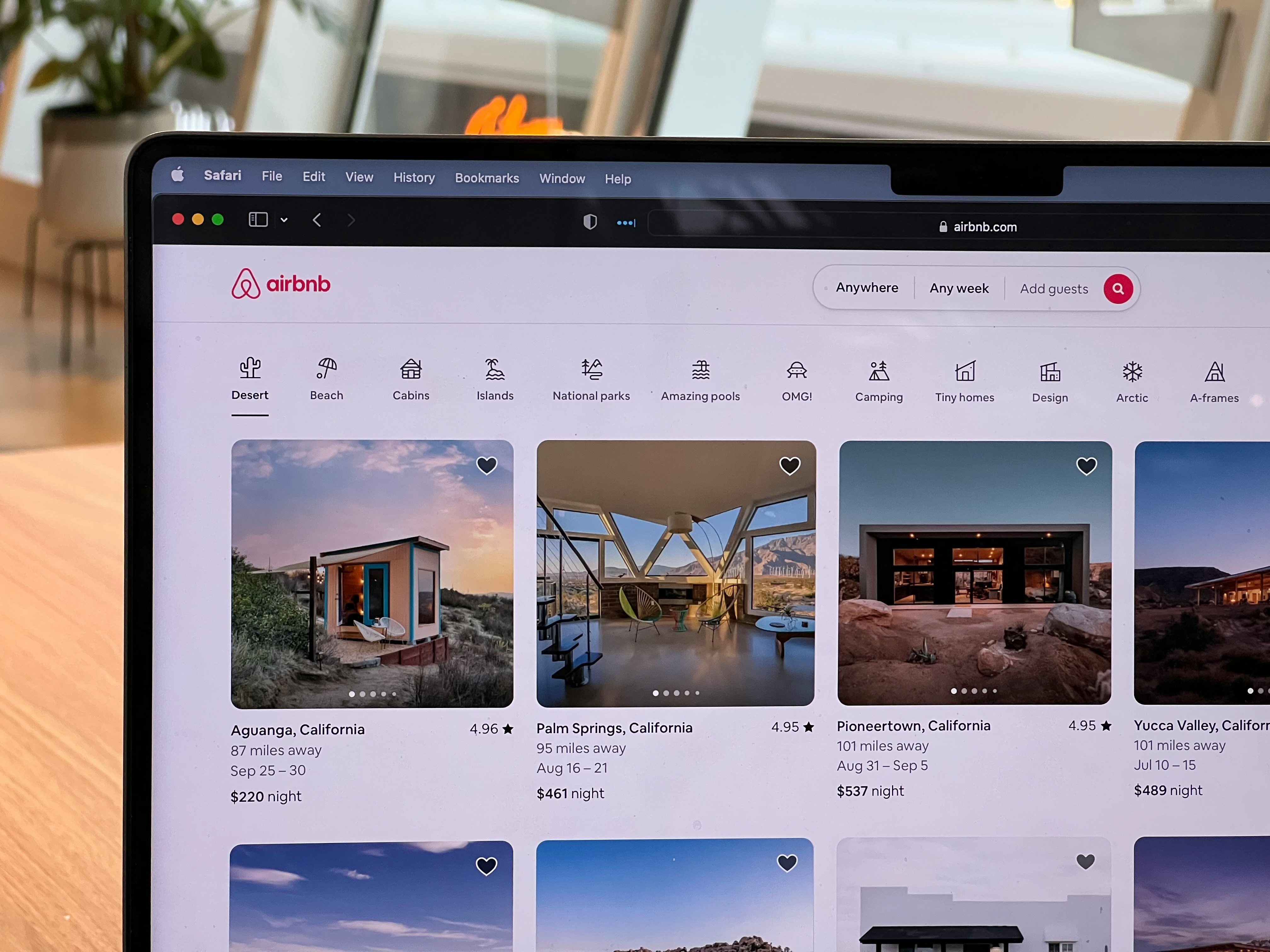
Airbnb Faces Competition from Over 27 Global and Regional Vacation Rental Alternatives in 2026
15 October 2026🏡 Airbnb, founded in 2007, connects 5.5 million hosts in 220+ countries, allowing unique stays and local experiences. Hosts can earn up to $25,000/month and benefit from AirCover insurance. Airbnb charges guests a 14.1%-16.5% service fee; hosts pay ~3%. Competitors include Vrbo with 2 million listings, Booking.com in 227 countries, and TripAdvisor with 7.3 million listings. Airbnb’s 2026 updates added Airbnb Experiences, AI features, and boutique hotels, enhancing guest services and options.
-
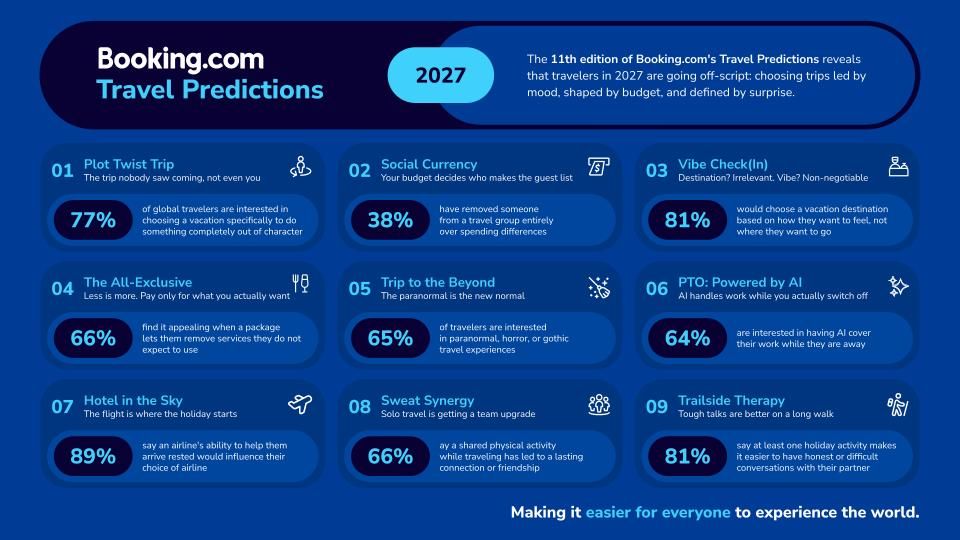
Travel in 2027 Driven by Mood and Budget with 77% Seeking Out-of-Character Experiences, Says Global Survey
14 October 2026✈️🧐 In 2027, travel goes “off-script” with insights from over 28,000 global travelers across 33 countries. Key trends: 77% want vacations out of character; 64% would use AI for work during trips; 65% seek supernatural experiences. Budget is crucial as 50% reconsider travel partners due to budget issues, and 61% of parents prefer child-free trips. Travel will be led by mood, budget, and unexpected experiences. How will you travel next year? 🌍
-

Booking.com Reveals 2027 Travel Trends: 81% of Travelers Choose Destinations Based on Mood, Not Location
14 October 2026📅 In 2027, 81% of travelers globally will select destinations based on mood, while 76% would use mood-based search tools. 77% are interested in trips that are out of character, and 89% favor long-haul flights for rest. Travelers prefer flexible packages, with 66% liking customizable bundles and 67% influenced by health changes. Among solo travelers, 52% are drawn to fitness events, and 47% consider trips for conflict resolution. Booking.com celebrates 30 years of innovation, focusing on mood-centric travel.
-

UK short-term rental rates rose in every region in Q3, with December RevPAR pacing 6% ahead of last year
14 October 2026KeyData’s UK Autumn Index shows higher rates helping to offset softer occupancy, with short-term rentals outperforming hotels on RevPAR across England, Scotland and Wales Santa Rosa Beach, Fla., 14 October 2026 — UK short-term rental operators increased rates in every region during the third quarter of 2026, keeping revenue close to last year’s level even as occupancy softened, according to KeyData’s UK Autumn Index. Looking ahead, December is the standout month of the final quarter, with occupancy, rates and revenue per available…
-

Generator Plans to Double European Property Footprint to 30-40 Cities by 2030 Backed by Brookfield
14 October 2026🏨 Milan hotels achieved their second-highest ADR and RevPAR in September 2026, at €310.04 and €261.17, driven by the Italian Grand Prix and Fashion Week. Xavier Mufraggi’s Generator plans to expand to 30-40 cities by 2030. WTTC members pledged $2 billion in Malta, which led Europe with 16.8% tourism GDP growth in 2025. AIHA released a practical guide on AI protocols for over 100 use cases. Booking.com’s 2027 report highlights mood-based search trends.
-
Booking.com’s 2027 Travel Predictions Reveal 81% of Travelers Choose Destinations Based on Desired Emotions.
14 October 2026📅 In 2027, 77% of global travelers want vacations out of character, while 36% aim to surprise friends and family. Half reconsider trip invitations due to spending differences, and 61% of parents prefer child-free travel to spend more on themselves. Emotional state now dictates destinations for 81%, with 76% open to AI managing work while away. Solo travel evolves with 66% valuing shared activities for lasting connections. Paranormal travel attracts 65%, with 48% seeking contact from “the other side.
-

McKinsey and Skift Study Reveals 78% of Travelers Continue Researching After Booking Hotel Rooms
14 October 2026🏨 In September, McKinsey & Company and Skift revealed that 78% of travelers continue researching post-booking. In the newer study, 65 digital touchpoints were identified, suggesting a longer buying journey. 74% revisit the same sites, and 49% say trust in a supplier’s website drives direct bookings. Hotels are urged to engage guests post-booking, as almost half switch hotels after booking. AI plays a role in inspiration, with 71% open to its use, but trust remains crucial.