By Linda Girrbach, Co-Founder & Head of Hospitality Consulting at RobosizeME
In many hotel groups, automation is discussed as a question of intelligence.
Are our prices optimized?
Are we using AI to predict demand?
Are guests getting instant answers through chatbots?
These are valid questions. But they often distract from a more fundamental one: why are so many basic operational tasks still done manually, every day, across every property?
The assumption seems to be that automation is about making better decisions. In practice, the biggest gains come from something far more mundane: removing work that should never have required human effort in the first place.
The Automation Conversation Starts in the Wrong Place
When hotel leaders talk about automation, the conversation almost always starts at the front of the house or the top of the funnel.
Pricing algorithms. Personalization. Guest engagement.
What’s missing from that conversation is execution.
Rate codes still need to be created and maintained. Payments still need to be routed and reconciled. Reports still need to be built and distributed. Guest profiles still need to be cleaned, merged, and flagged correctly. None of this is strategic. None of it is creative. Yet it consumes a disproportionate share of human time.
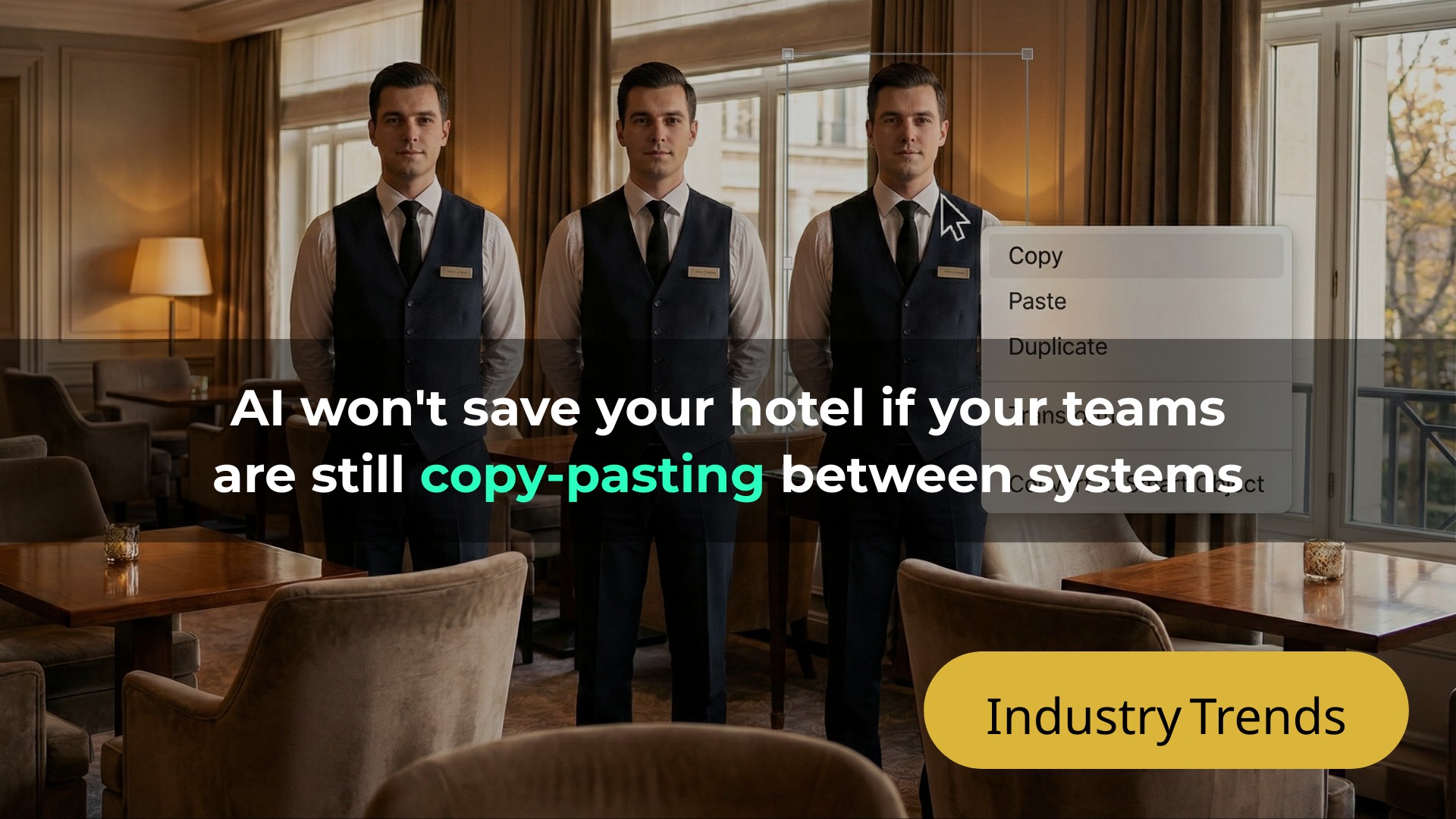
Automation, in many hotel groups, has been layered on top of manual execution rather than replacing it. The result is a strange imbalance: advanced systems making sophisticated decisions, supported by fragile, people-dependent processes underneath.
Why This Misunderstanding Is So Common
This isn’t because hotel leaders don’t understand operations. It’s because automation has been framed incorrectly for years.
Technology vendors tend to showcase what’s visible and impressive. Dashboards. AI models. Interfaces that demonstrate intelligence. Back-office automation, when done properly, is almost invisible. Nothing “happens” on screen. Tasks simply stop existing.
There’s also an organizational reason. Revenue, operations, and finance teams often automate within their own silos. Each function optimizes locally, but no one steps back to ask how much total human effort is being spent across the organization, or how much of that effort is actually necessary.
As a result, manual work becomes normalized. Not because it’s efficient, but because it’s familiar.
Manual Work Scales Poorly, But Grows Quietly
Most manual workflows in hotels start small.
A report that takes ten minutes.
A rate update that’s “quick to do.”
A reconciliation that’s manageable when volumes are low.
Individually, these tasks don’t trigger alarm bells. Collectively, they become structural.
A daily pickup report that takes one hour per day doesn’t feel dramatic, until you realize that’s nearly a full month of work per year, per property. Multiply that across a group, and you’ve built an invisible workload that grows linearly with scale.
The same applies to rate code maintenance, commission reconciliation, VIP identification, or guest profile cleanup. These processes don’t break suddenly. They erode capacity gradually. Teams compensate by working harder, cutting corners, or delaying improvements.
Over time, leaders see the symptoms: slower execution, inconsistent standards, staff fatigue, without always seeing the root cause.
Automation as Overwork Removal
The most effective automation initiatives in hotel groups don’t start with AI ambitions. They start with a much simpler question:
Why does a human need to do this at all?
If a task is:
- Rules-based
- Repetitive
- Predictable
- Required across every property
Then it’s a strong candidate for automation.
This is where some of the largest gains are hiding. Not in replacing judgment or experience, but in removing mechanical execution from human hands.
When rate code maintenance is automated, revenue teams don’t become less important, they become more strategic. When reconciliation runs automatically, finance teams spend less time investigating errors and more time understanding performance. When guest data is handled consistently, service teams stop reacting and start anticipating.
Automation doesn’t make organizations smarter. It makes them calmer.
Why This Reframing Matters for Leaders
For senior leaders, the real risk isn’t missing the next AI trend. It’s allowing manual work to define how the organization operates at scale.
Manual processes introduce variability. Variability undermines standards. And once standards slip, consistency becomes impossible to enforce, no matter how good the SOPs look on paper.
Reframing automation as execution, rather than intelligence, changes the conversation. It shifts focus from tools to work. From innovation theater to operational reality.
And it opens up a more honest discussion: not about what technology can do, but about what human time is actually being spent on today.
Why This Conversation Needs Space
The challenges described here aren’t solved by a single tool or new system.
They require clarity: about where time is lost, why it’s lost, and which types of work no longer make sense to do manually.
That’s why we’re hosting a practical webinar on 23 February 2026 — not to pitch a product or specific solution, but to step back and examine how hotel work is really executed today, and what could change if automation were approached as a way to remove friction, rather than add intelligence.
For leaders who feel their teams are working harder without gaining ground, this conversation is an invitation to pause, reflect, and start reframing automation as a way to restore capacity.
👉 Register for our practical webinar, hosted on Monday, February 23, 2026, at 1:00 PM GMT