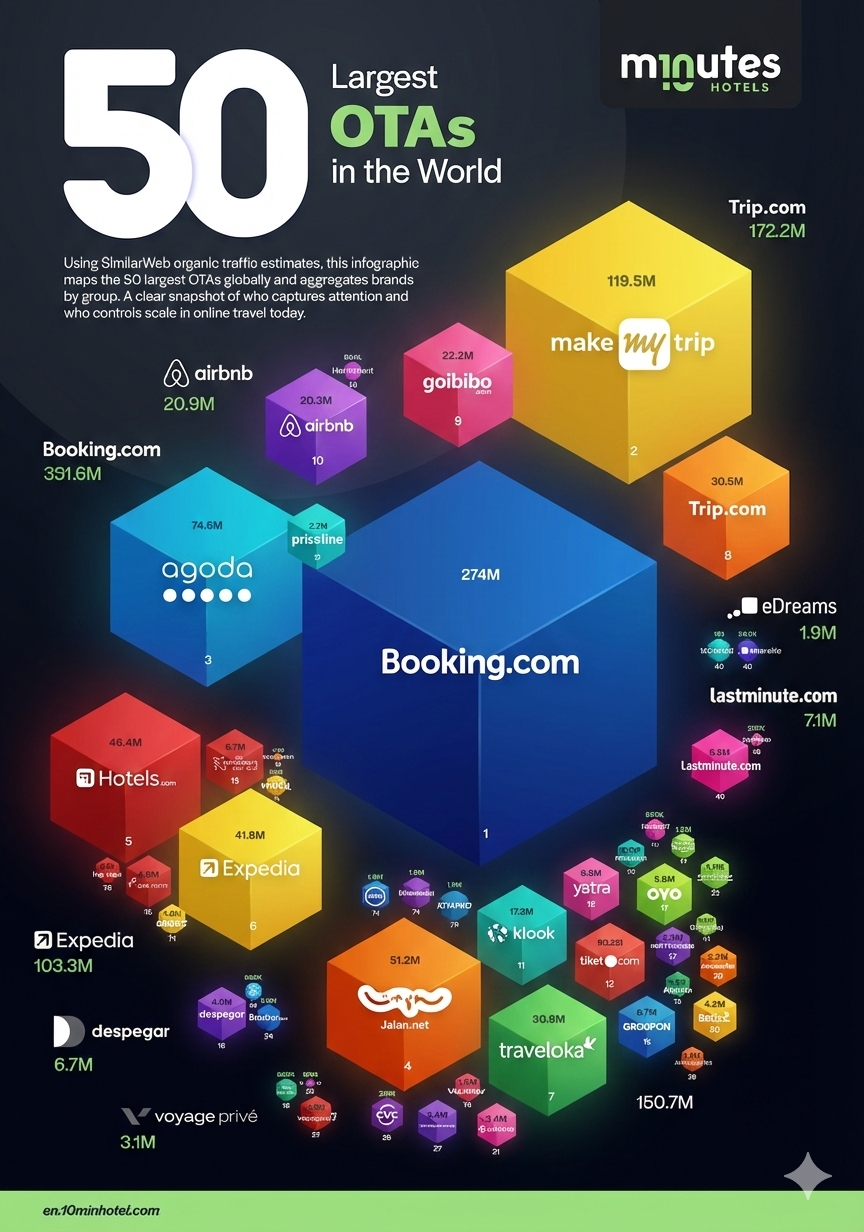
This page focuses on OTA news in the hotel industry. Online Travel Agencies such as Booking.com, Expedia, Agoda, MakeMyTrip, Trip.com and more play a central role in hotel distribution, pricing visibility, and guest demand worldwide. This page brings together curated news related to these OTAs from trusted and reputable sources, including leading industry publications, official company announcements, and expert analysis. By aggregating these perspectives in one place, it gives readers a clear and up to date view of how OTAs are evolving, from platform strategy and product innovation to partnerships, regulation, and the broader market trends shaping the hospitality ecosystem.
-

Rethinking value creation in travel through the perspective of Mauricio Prieto
In the travel industry, scale, visibility, and product breadth have traditionally been used as proxies for value. Yet, as the sector matures and customer expectations evolve, these indicators are increasingly insufficient to explain performance or long-term differentiation. Mauricio Prieto , founder of Travel Tech Essentialist and co-founder of eDreams, brings a different lens. Drawing on his experience building one of Europe’s largest online travel agencies and his ongoing work with operators and investors, his perspective centers on how value is…
-
Strategic alliance between Barceló and Kempinski to build the commercial firepower of a global group
This article was written by HospitalityOn. Click here to read the original article The pursuit of critical mass — increasingly necessary to optimize management tools and achieve global distribution reach
-

The Two Problems in the Travel Value Chain We Never Solved
For twenty years, the hotel industry has gotten very good at selling rooms. Search became seamless. Pricing became dynamic. Booking became instant. What once required a travel agent and a phone call can now be completed in seconds. From the outside, it looks like the problem has been solved. It hasn’t. Because this was never just a distribution issue. It is a travel value chain issue. And two of the most important parts of that value chain were never fully…
-
Why OTAs struggle to scale in experiences — and what it means for hotels
This article was written by Hospitality Today. Click here to read the original article The real opportunity lies not in market size, but in what can actually be distributed Apr
-
Chinese OTAs scale globally through AI-driven innovation
This article was written by Hospitality Today. Click here to read the original article Domestic tech advancements are now shaping international travel distribution and competition Apr 10, 2026 Chinese online
-

Rethinking value creation in travel through the perspective of Mauricio Prieto
This article was written by Shiji Insights. Click here to read the original article In the travel industry, scale, visibility, and product breadth have traditionally been used as proxies for
-

Different Types of Hotel Room: Classifications Explained
Inventory remains the most perishable asset in hospitality, yet hotel room type classification is often the most underutilized lever for growth. In the modern landscape, room categorization has transcended its origins as a back-of-house administrative setup to become a core revenue strategy. The way a property defines, segments, and markets its rooms now directly dictates its distribution efficiency, bottom line, and long-term asset value. This transition from legacy room types to a dynamic, attribute-driven model reflects a broader industry move…
-

Pack Up + Go Gains Popularity by Offering Surprise Travel Experiences, Creating Joy and Remarkable Stories
🛳 In Scotland, a 4,350 km journey from a Canadian ferry concluded with a message in a bottle found by a dog. Pack Up + Go offers mystery trips, shared widely for their surprise and joy factor, not utility. Seth Godin emphasizes brands with a clear point of view. Eli Strick highlights customer experience basics. Dara Khosrowshahi of Uber notes the potential for hotels to convert referred guests into loyal customers. Brands should focus less on targeting and more on…
-
Brand.com Expected to Lead U.S. Hotel Bookings in 2026, Surpassing Direct Reservations Amid Changing Patterns
🏨 2025 saw over 55% of U.S. hotel bookings made online. In 2026, World Cup events are expected to boost OTA bookings, while ongoing changes in U.S. government policies introduce uncertainty. Brand.com is projected to grow in dominance, with loyalty member bookings aiding its rise. OTA growth is supported by the integration into bank/credit card portals. Voice and property direct bookings continue to decline, while GDS bookings struggle post-COVID due to reduced corporate travel.
-
199 – Social Success Series: Arlo Hotels
This post was originally published on this site. In this special episode of the Social Success Series Podcast, host and Travel Media Group Brand Ambassador, Cassady Quintana, sits down with
-

The Silent Build of the Agentic Web and the Coming Shift in Travel Distribution
TL;DR The agentic web isn’t stalled — it’s being built quietly beneath the consumer surface. Protocols like MCP (97M+ monthly SDK downloads, adopted by every major AI platform in under a year), Google’s A2A for agent-to-agent coordination, and payment infrastructure like AP2 are filling in fast. Most builders will never make the headlines. 56% of U.S. travelers already use AI for some part of their travel journey, up from 33% a year ago. The operating model looks like metasearch: agents…
-
Dida and Tsinghua strike five-year travel tech alliance
This article was written by Travolution. Click here to read the original article Five-year pact to accelerate travel AI and talent Dida has formalised a multi-year agreement with Tsinghua x‑lab,
-

Google’s DMA Compliance Shifts Hotel Search Visibility Toward OTAs as ChatGPT Steps Back from Booking
Distribution power is shifting through regulatory and platform decisions rather than technological advances. Google’s response to EU antitrust regulation is restructuring how hotels appear in search results, while OpenAI’s decision to redirect bookings away from ChatGPT surfaces the operational complexity of closing transactions within conversational interfaces. The gap between AI experimentation and execution continues to widen. Hotel Search Visibility Tilts Toward OTAs Under Google’s DMA Compliance Google’s implementation of Digital Markets Act requirements is restructuring visibility in hotel search results,…
-

A lifetime of leisure
This article was written by New Dog PR. Click here to read the original article We hear a lot about the value of the lifetime consumer and the reason for
-

Google’s Hotel Search Changes in Europe Under DMA Pressure Impact Direct Booking Visibility and Favor Intermediaries
📈 In recent months, Google has adjusted hotel search results in Europe due to the Digital Markets Act. These changes emphasize intermediaries over direct hotel listings, risking hotel direct booking visibility. While this aims to ensure fair competition, it may shift advantages among intermediaries and make guest journeys more complex. Google is reacting to regulatory pressure to avoid fines. Hotels need a diversified distribution strategy beyond just optimizing Google, as visibility is fragmenting.
-

62% of Customers Demand Personalized Restaurant Experiences, Essential for Brand Loyalty in 2024, Reports NRN
🍽 In 2024, a report by NRN highlighted that 62% of customers would lose loyalty to a brand without a personalized experience, necessitating restaurants to cater to individual preferences. This includes using technology like POS systems, self-serve kiosks, and AI to enhance service and maintain efficiency. These tools help manage customer interactions, provide strategic insights, and streamline operations, aiming to create personalized dining experiences and drive consumer loyalty.
-
TPConnects unifies GDS, NDC and low-cost in Iris
This article was written by Travolution. Click here to read the original article Four GDS and 60+ airlines, one workflow TPConnects Technologies has expanded Iris, its air content aggregation platform
-
AI pushes travel brands into commerce media ecosystems
This article was written by Hospitality Today. Click here to read the original article Shrinking digital funnels are forcing airlines, hotels and OTAs to monetize data and capture demand closer
-
Travel distribution is shifting behind the scenes
This article was written by Hospitality Today. Click here to read the original article The real competition is moving from otas to the B2B infrastructure layer controlling how hotel inventory
-

Independent Hotels Can Boost Profitability and Loyalty by Prioritizing Direct Bookings Over Third-Party Platforms
📈 Independent hotels often lose guest relationships to OTA platforms, limiting long-term loyalty and brand strength. Direct bookings enhance communication, personalized marketing, loyalty program participation, and brand recognition. Prioritizing direct booking strategies, such as offering incentives and improving brand visibility, strengthens guest retention and profitability. Building direct relationships drives sustainable demand and revenue growth. For hotels seeking to reduce OTA dependency, strategic measures are essential. Discover more strategies here: [RevOptimum](https://www.revoptimum.com/ota-independence-direct-revenue-strategy).
-

Google Develops AI Tool Enabling Direct Hotel Bookings, Challenging Booking.com’s $7.3 Billion Ad Spend Strategy
📖 In 2023, Booking.com spent $7.3 billion on Google ads. Google is developing a tool allowing travelers to book hotels directly via AI Mode, bypassing OTAs like Booking. Collaborations include Marriott, Expedia, and Wyndham. OTAs spent $17.8 billion on marketing in 2024, competing for visibility on Google. Google’s new system shifts transactions closer to its platform, reducing OTAs’ roles. While hotels may see hope, Google retains control, questioning OTAs’ future value.
-
AI-Powered Personalization Tools Transform Hotel Marketing by Reducing Campaign Creation Time From Days to Seconds
📈 US hotel RevPAR jumped 8.3% nationally, with San Francisco’s remarkable 121.1% surge driven by the RSA Conference. AI tools now allow hotel marketers to create website campaigns in seconds, replacing weeks of manual work. This advancement helps smaller teams match OTA sophistication by generating complete campaign assets rapidly. The RSA Conference created a supply-demand imbalance, elevating pricing power and illustrating the temporary impacts of major events on hotel markets.
-
Chinese OTAs deploy AI for big global push
This article was written by a Hotel Marketing Flipboard. Click here to read the original article Please click here to access the full original article.
-

AI Directs Over 50% of Hotel Searches to OTAs, Boosting Booking.com Citations on ChatGPT and Gemini
💻 In 2025, OTAs are projected to hold 63% of online hotel bookings for independents, with AI tools like ChatGPT and Gemini citing OTAs over 50% of the time, primarily Booking.com. While hotels can secure 56% of direct AI-assisted bookings by controlling their content, most miss out due to lack of visibility. OTAs currently hold 55% of global online bookings. The challenge is mastering structured content to bypass the 15–25% commission channels.
-

Hotels Should Focus on Building Brand Preference Instead of Attempting to “Own” the Guest
🏨 In hospitality, guest ownership is a myth. The real battle is for influence, which is fragmented across platforms like Instagram, ChatGPT, TripAdvisor, and Booking.com. Hotels often err by focusing on control through direct bookings, CRM, and loyalty programs, missing the fact that decisions form much earlier. Successful hotels build preference, clarity, and trust before booking, ensuring they become the obvious choice rather than a mere commodity. The key question: “Where are we losing the decision?