Follow Priceline in one place. This hub gathers the latest news and product moves around the Booking Holdings brand, curated by 10 Minutes News. Stay informed on a major US online travel platform.
-

Marriott Integrates AI Booking on Fliggy, Surpassing 800% Growth in China’s Holiday Travel Bookings
9 October 2026📱 In China, AI agents on Alibaba’s Fliggy processed 200 million orders during the February Spring Festival, including 55 million milk tea cups. Hotel AI bookings rose over 800%, with Marriott using a dedicated “door” in Fliggy for easy hotel and package access. In the US, Google enabled hotel bookings in AI Mode with 10 companies, including Marriott. On Fliggy, Marriott’s AI commands extend beyond rooms to offerings like afternoon tea, enhancing direct sales.
-

Expedia Faces Federal Lawsuit Over Alleged Price Parity Practices Affecting U.S. Hotel Bookings Since 2022
9 October 2026🛈 Three guests sued Expedia on October 2, 2026, in Seattle, claiming overpricing due to Expedia’s pricing policies since October 2022. Expedia requires hotels to maintain equal or better rates on their website, except in Australia since 2019. Expedia’s search rankings depend on rate competitiveness, affecting 62% of clicks. Guests allege Expedia controls 70-78% of U.S. hotel bookings. A similar case was dismissed a decade ago but focused on collusion, whereas this targets Expedia’s dominance.
-

Marriott Introduces Exclusive AI Booking Access on Alibaba’s Fliggy, Expanding Sales Beyond Room Reservations
9 October 2026📈 Oct 9, 2026: In China, Marriott has integrated with Alibaba’s Fliggy, offering a dedicated access point for AI agents to sell hotel packages, unlike other hotels that use a shared search. During February’s Spring Festival, Alibaba’s Qwen AI app processed 200 million orders. Fliggy AI bookings soared by over 800%, yet hotel figures remain undisclosed. Marriott established its Fliggy presence through collaboration with Alibaba since 2017, allowing AI-driven sales of packages, unlike other hotel chains on the platform.
-
McKinsey Report Reveals 78% of US Travelers Continue Planning Trips Despite Confirmed Hotel Bookings
9 October 2026📅 Oct 9, 2026: McKinsey’s report states 78% of US travelers keep planning after booking, with only 18% stopping after the main reservation. Cancellation policies, highlighted by Marriott’s CIO Naveen Manga, keep decisions open until deadlines. The survey involved over 1,000 US travelers, with 49% swapping hotels for better options. Hoteliers holding bookings have details like dates and rates but need proactive communication during the free-cancellation window to secure bookings.
-
Rapid Adoption of AI in Travel Industry Raises Concerns Over Accountability During Booking Disruptions
7 October 2026✈️ Agentic AI in travel is advancing rapidly. Companies like Priceline and Agoda are integrating AI for booking, with Instinct claiming $1 billion in transactions. Despite AI’s efficiency, human oversight remains crucial when disruptions occur, such as flight delays or hotel overbookings. The challenge is determining responsibility when AI decisions fail, as travel is a significant expense for families. The true test will be when AI seamlessly resolves complex travel issues beyond mere bookings.
-

Agentic is Booking Travel, But…
7 October 2026Just like the CIO of Hilton, I may have underestimated how quickly people would trust AI with their credit cards. My assumption was that agentic AI in travel would arrive gradually. It took the internet years to build enough trust for people to comfortably put in a credit card and book a holiday online. But with AI everything goes a lot faster. Meta has Muse. Instinct is claiming $1B in transaction. Priceline has made Penny agentic and is adding Lola.…
-

Booking Holdings Controls 70% of European OTA Bookings Despite Claims of Hotel Independence from Single Platforms
7 October 2026📈 Booking Holdings, including Booking.com, controls 70% of European OTA bookings, contrary to claims of no platform dependency. AI referral traffic has quadrupled but remains under 1% of hotel site visits. European hotel investment reached €11.7 billion in H1 2026, up 19.5% from the 10-year average. AI governance frameworks and Bain’s warnings on AI’s impact on direct bookings are highlighted. Japan’s hotel rates surged up to 31% during autumn foliage season, with domestic travel offsetting reduced inbound tourism.
-

Booking Holdings Dominates European OTA Market with 68.8% Share, Overseeing 20.6% of Total Hotel Bookings
7 October 2026📈 On September 22, Booking.com’s public affairs head claimed the European hotel distribution market is competitive, citing a 2026 HOTREC study. Booking Holdings, owning brands like Agoda and Priceline, holds 68.8% of OTA bookings, translating to 20.6% of total bookings. The EU General Court, on September 9, confirmed Booking’s dominant market position. The study found 51% of hotels say OTAs underprice their rooms without consent. Direct bookings account for 51.3% of the market.
-
EU Court Upholds Booking.com’s Dominance in Online Hotel Sales, Representing 20.6% of European Market
7 October 2026💸 September 22, 2026, Europe: Booking.com’s Peter Lochbihler claims balanced hotel distribution, citing HOTREC study. Online travel agencies account for 29.9% of bookings, with Booking.com taking 66.1% of that, or 19.8% overall. Booking Holdings, including Agoda and Priceline, reaches 20.6%. The EU court upheld Booking’s market dominance claim on September 9. Direct bookings stand at 51.3%. Independent hotels see Booking Holdings at 69.4% of OTA bookings. HOTREC urges Digital Markets Act enforcement.
-

Instinct AI Assistant Approaches $1B Annualized Transaction Volume, Over $500M in Travel-Related Sales
2 October 2026🚀 Instinct’s personal AI agent, led by 23-year-old Noah Shinn, nears $1 billion in annualized transactions, with over $500 million in travel-related sales. This data reflects early adopters, not typical consumer behavior. The agent enables users to book travel via simple text. AI’s role in travel evolves, emphasizing invisible interfaces and automated intent matching. Meanwhile, CollabsMap aids brands in using AI for visibility. Via.ai reports 3-5x conversion lift and 30% larger baskets through AI in real deployments.
-
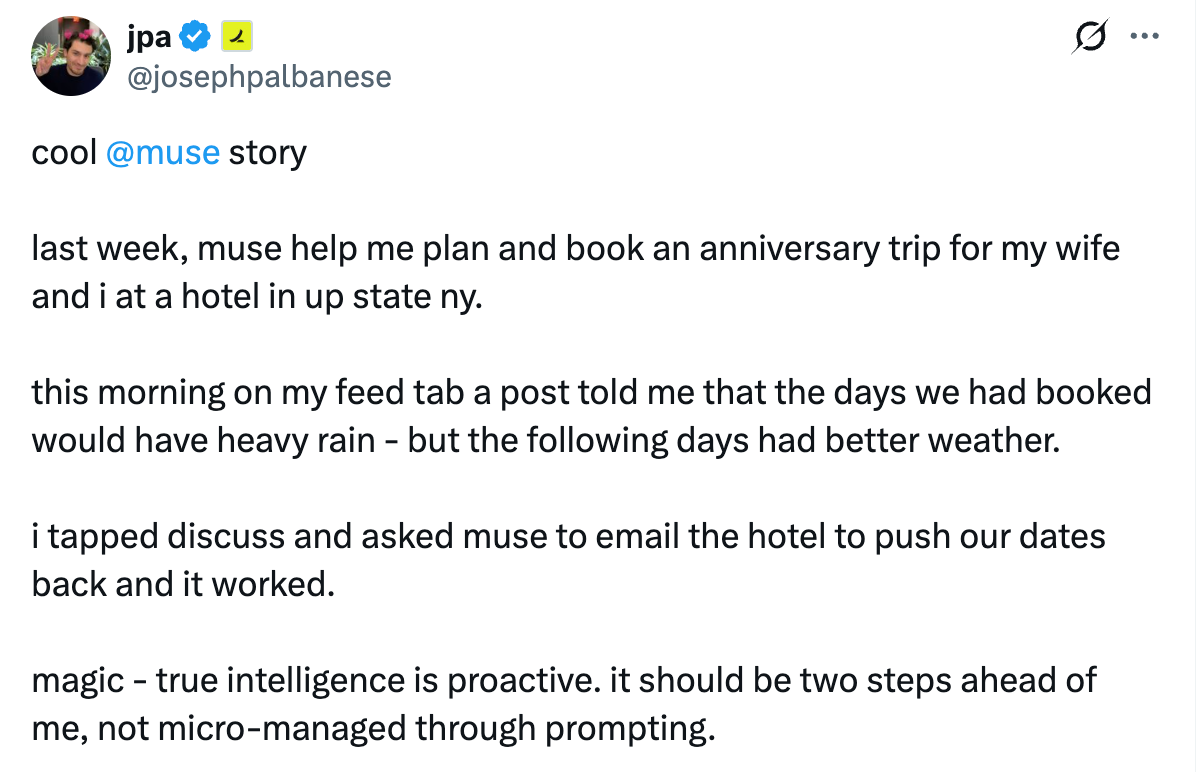
Meta’s Muse AI Agent Blocked by Hilton, Redirects Booking Attempt to Expedia in Washington, D.C.
2 October 2026📅 On September 29, 2026, Gaurav Sharma used Meta’s AI, Muse, to book a Hilton hotel in Washington, D.C., for under $250, but was blocked by Hilton’s site. In September 2026, over 70% of travelers used AI for research, yet less than 16% booked with AI. Google’s AI Mode began hotel bookings with major partners. AI referrals to hotel sites grew fourfold, though AI bookings remain low. Younger travelers, especially Gen Z, lead AI usage.
-
Rapid AI Integration in Travel Industry Raises Accountability Concerns Over Booking Errors and Customer Trust
1 October 2026📰 Meta’s Muse, Priceline’s agentic Penny, and Agoda’s AI Assistant are accelerating AI in travel. AI agents in finance could move funds from 0.1% to 3.3%-5.0% yields. AI’s role in travel, such as booking, raises questions of responsibility during issues like flight delays. Hyatt’s survey indicates loyalty plans affect 40% of travel costs, while ChatGPT cites publishers 74.6% in travel queries. U.S. OTA bookings form about 20% of the market, prompting shifts in AI and human travel roles.
-

ChatGPT and Google Prioritize OTA Prices, Impacting Independent Hotels’ Visibility and Pricing Control
30 September 2026📱 ChatGPT, on June 25, examined 240 hotel price queries, reading OTA sites like Booking.com and Expedia 46% of the time, yet linking to them only 11%. Booking.com held 62.57% of US ad space in July. Google, requiring hotels to provide price feeds, stops its auto-rate identification on September 30. In the EU, Google’s search results now separate reseller prices from hotel prices. Late August saw Google introducing bookings via AI Mode using 10 partners, excluding independents.
-

Former KAYAK CEO Steve Hafner Launches AI-Powered Platform Lola with Backing from Booking Holdings
30 September 2026💻 Steve Hafner and Paul English, former KAYAK co-founders, launched Lola, an AI-powered discovery and booking platform. Lola offers hotel, restaurant, activity, and premium airport service bookings. Partnering with KAYAK and Booking.com, among others, it operates on a membership model with free and paid tiers at $5 and $25 per month. Lola targets high-end travel markets, offering personalized itineraries and consumer loyalty independent of payment methods, enhancing access with exclusive rates and benefits.
-

Booking Holdings Launches Lola, an AI Travel Assistant, Offering Members Up to 15% Hotel Rate Discounts
30 September 2026💻 Sep 30, 2026: Booking Holdings launched Lola, an AI assistant that books hotels, tables, and tickets through chat, with membership fees up to $25/month. Members save up to 15% on hotel rates via Booking.com and partners. Created over five months by Kayak co-founders, it offers three membership tiers: Free, Plus ($5/month), and VIP ($25/month). Lola earns from membership fees and commissions from hotels, with VIP discounts reaching 21% at places like The Plymouth South Beach.
-

ChatGPT and Google Display Hotel Prices from OTAs, Undermining Direct Rate Control by Hotels
30 September 2026💵 September 30, 2026, worldwide: ChatGPT retrieves hotel prices primarily from OTAs like Booking.com and Expedia, shown in over 46% of 240 queries. It cites these sources only 11% of the time. Google, since September 30, requires hotels to send their rates if they wish to advertise. In Europe, Google’s changes from September 8 result in separate blocks for hotels/resellers, while in the U.S., Google’s AI books through ten partners, excluding independents.
-

Google AI Mode Streamlines Hotel Booking, Impacting Visibility for Independent Hotels with No Direct Listings
21 September 2026💻 In 2009, Chris Anderson’s Cornell study found a 9-26% increase in direct hotel bookings when listed on Expedia. A 2011 follow-up showed for each Expedia booking, hotels got 3-9 more on their sites. Google’s AI booking system launched in August, involving 10 companies like Booking.com and Expedia, omitting independent hotels. Research by Tharro (June 23) noted hotels’ own sites as sources in under 10% of AI-assisted bookings. The focus remains on direct-booking strategies for loyalty.
-

Google’s AI-Powered Hotel Booking Mode Launches with Major Chains, Excludes Independent Properties from Initial Offering
21 September 2026📑 Sep 21, 2026, Markus Busch reports a shift in hotel bookings due to Google’s AI Mode launched in August. Ten companies, including Booking.com, Expedia, and Marriott, feature, excluding independents. Tharro’s June study found under 10% of 695 searches cited hotel websites. Chris Anderson’s 2009 and 2011 research showed a 9-26% increase in direct bookings during Expedia listings. AI reduces comparison shopping, impacting brand recall and loyalty. The return guest, once a soft metric, becomes crucial.
-

Booking.com Counts Separate Bookings as Connected Trips, Leaving Hotels to Handle Customer Service Issues
16 September 2026🛫 Sep 16, 2026, a guest arrived at a hotel late due to a 6-hour flight delay in Frankfurt. She booked a Connected Trip via Booking.com, expecting seamless service. However, she made two separate bookings, leading to service issues. Booking.com reported low double-digit percentage of connected transactions in Q2 2026. The lack of unified service falls on hotels, as travelers expect coordinated service, while hotels see no backend integration or alerts for connected trips.
-
Google Introduces AI Mode Booking Capabilities in the U.S., Streamlining Hotel Discovery and Booking Process
11 September 2026📈 On August 27, 2026, Google launched its AI Mode booking feature in the U.S., enabling travelers to explore hotels and book through a conversational interface. This move aims to streamline the booking process by collapsing discovery, comparison, and transaction into one conversation. Significant partners include Booking.com, Expedia, Hilton, and Marriott. AI recommendations depend on accurate hotel data. Accurate content, rates, and availability are crucial for hotels to capitalize on this AI-driven discovery and booking trend.
-
Google Introduces AI Mode Booking Capabilities in the U.S., Revolutionizing Hotel Discovery and Booking Processes
11 September 2026📱 On August 27, 2026, Google announced AI Mode booking in the U.S., allowing travelers to discover, compare, and book hotels via a conversational interface. Major brands like Hilton, Marriott, and OTAs such as Expedia and Booking.com are involved. AI compresses the travel booking process but raises questions about who controls guest relationships. Hotels need accurate content and direct booking paths to compete effectively in AI-driven environments.
-

Meta Launches Muse AI Agent for Seamless Travel Booking on iOS, Android, and Web in the U.S.
10 September 2026🗺️ Meta launches Muse, an AI travel agent, in the U.S. on iOS, Android, and web platforms for users 18+. It organizes and pays for travel, using Stripe’s Link for payments and 1Password for secure credentials. Muse operates even when closed, requiring user approval for purchases. A Travelport study shows 72% of users experience stress when bookings are handled by AI. Muse Confidential VM will be introduced later, with future plans for AI glasses integration.
-
Anthropic Releases Blueprints for Building Commerce Agents with Claude, Used by Priceline, Shopify, Intuit, Wix, and Square
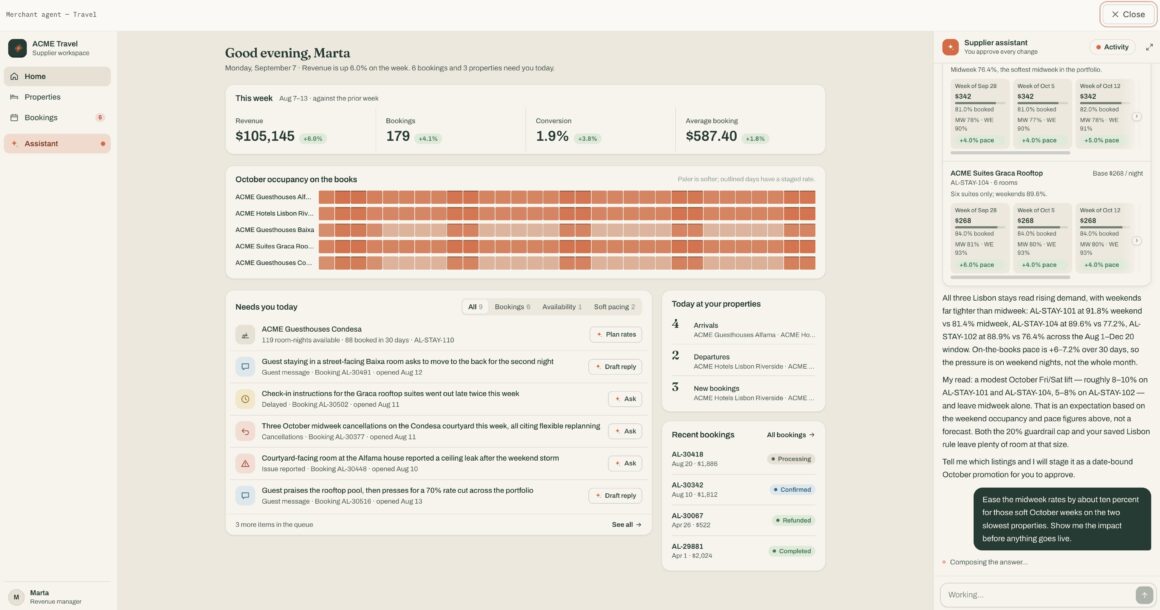
7 September 2026💻 Anthropic has released blueprints for building commerce agents using Claude, utilized by Priceline, Shopify, Intuit, Wix, and Square. A demo featuring a fictional company, ACME Travel, shows a revenue management system analyzing demand and recommending pricing changes. The evolving ease of building business software could impact hotel technology, reducing costs and development time, and enabling smaller teams to create specialized tools. Major companies like Priceline are already integrating this technology into production.
-
Claude Just Built a Revenue Management Tool
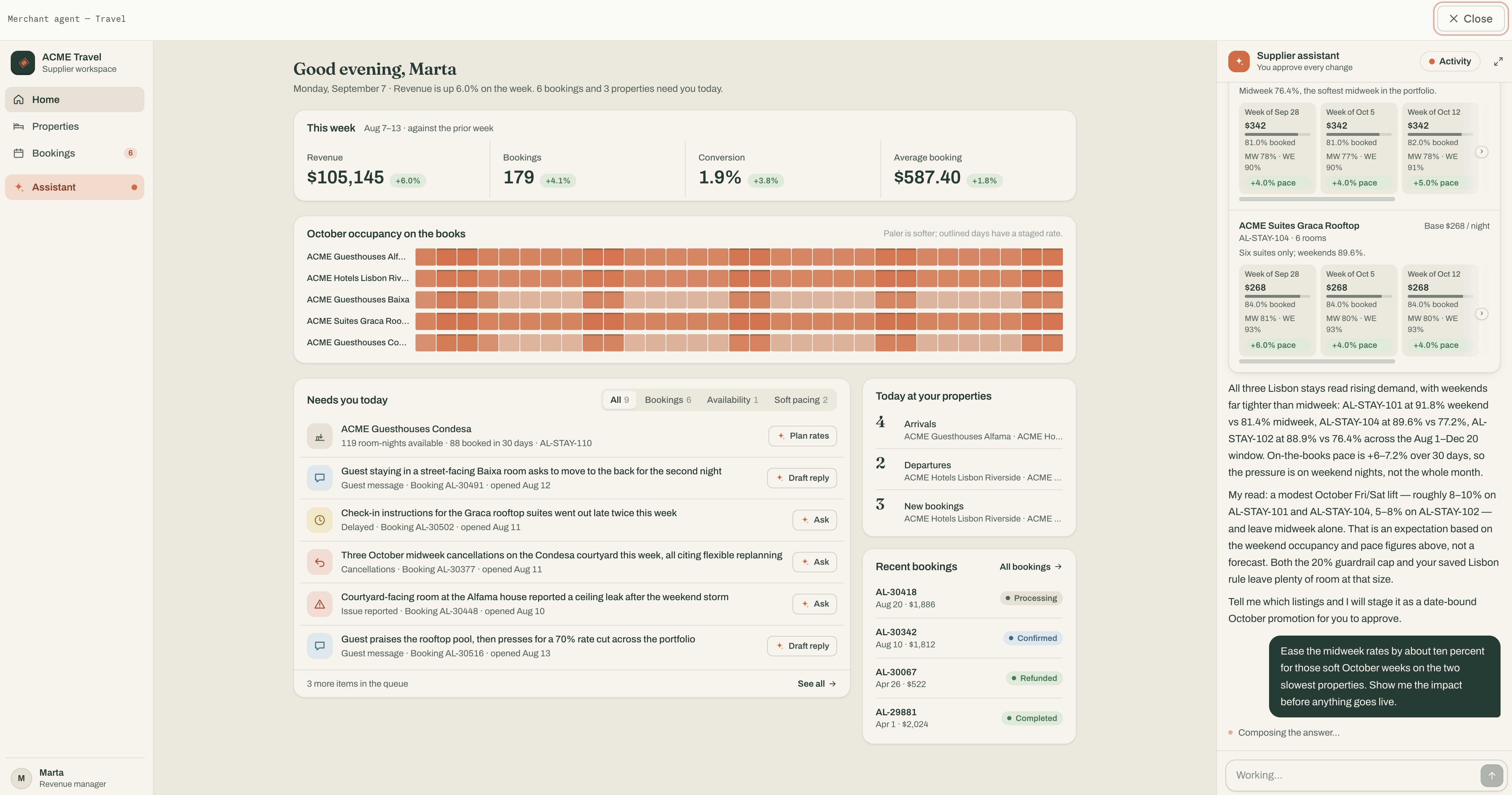
7 September 2026Anthropic recently released a set of blueprints showing how companies can build commerce agents with Claude. Companies including Priceline, Shopify, Intuit, Wix and Square are already using Claude to build agents that can help customers search, make decisions and take actions. But one of the more interesting examples for the hotel industry is Anthropic’s own demo. They created a fictional travel company called ACME Travel and built what looks remarkably like a lightweight revenue management system. It shows occupancy, revenue,…
-
Rocket Travel’s Consolidation on Agoda’s Engine Impacts Visibility of Rates in Wholesale Travel Agreements
7 September 2026💰 Sep 7, 2026, by Markus Busch. The wholesale contract now permits resale via Rocket Travel, an Agoda arm, affecting how hotel rooms are distributed. The static rate model is outdated, replaced by APIs, with Booking Holdings consolidating B2B arms under Agoda. Rooms are sold invisibly through closed user groups, making it hard to track final rates and buyers. The only control is at contract renewal, questioning downstream seller details and closed-channel policies.