Artificial intelligence is changing the way travellers search, compare and book hotels. Guests are now asking questions directly to AI assistants. They want instant answers about prices, room types, availability and policies. They want to book from within the same conversation. For a hotel, this sounds attractive, but there is a problem. AI assistants cannot easily talk to a PMS or CRS. Every system has its own structure, its own rules and its own way of exposing data. This is where the MCP idea becomes interesting.
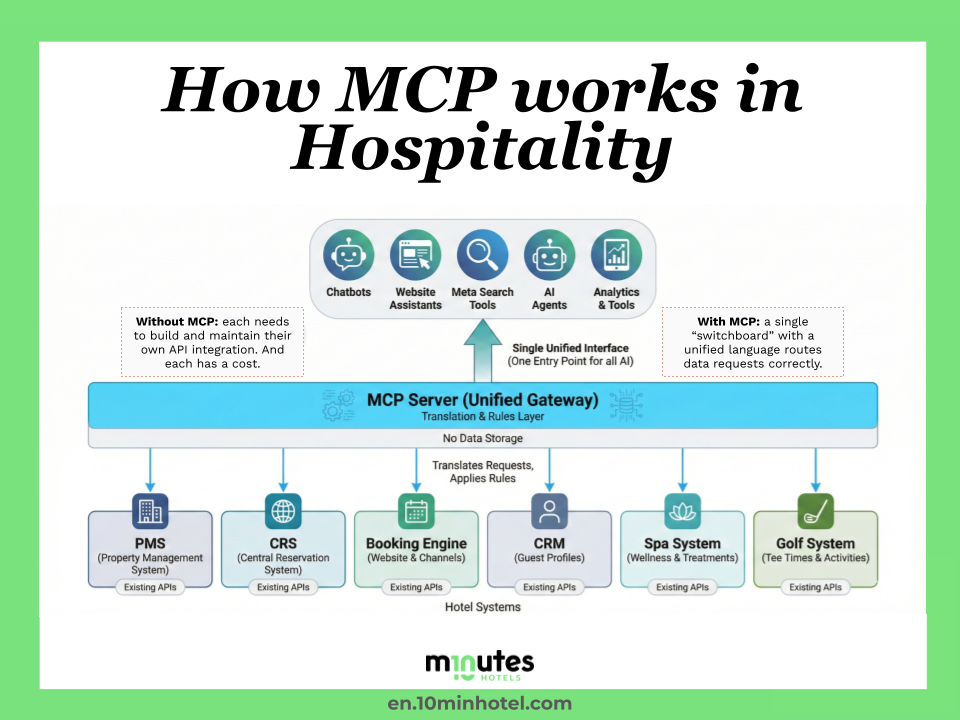
MCP stands for Model Context Protocol. In simple words, it is a small layer that sits beside your hotel systems and acts as a translator. It does not store data. It does not replace anything. It only listens to requests from an AI assistant and forwards them to the right system in the correct format. Then it returns a clean answer that the AI can understand.
Here is a simple example. A guest writes to an AI assistant. They ask for available rooms at your hotel on specific dates. The AI sends the question to your MCP server. The MCP server forwards that request to your CRS, because the CRS is the system that knows availability and rates. The CRS answers with the correct room types and prices. The MCP server sends that answer back to the AI assistant in a clean format. The assistant then replies to the guest in natural language.

Another example. The guest decides to book. The AI sends a booking request to the MCP server. The MCP server calls your CRS or booking engine to create the reservation. The hotel’s official system of record writes the booking exactly as usual. The MCP server only passes the message. The confirmation goes back through the MCP server and then to the guest. Nothing new is introduced inside your existing stack. Everything works as expected, just with a new entry point.
These examples show the benefit for hotels. Instead of building one integration for each new AI channel or chatbot, the hotel exposes one clean interface. Any AI tool can connect to it without learning the details of each system. For a hotel group with many brands or many systems, the MCP layer can even talk to several PMS or CRS systems at once and present a uniform view to the outside world.
This raises important questions. Where should the MCP server sit. Is it something created by your website agency. Is it part of your booking engine. Is it owned by your CRS vendor. Could your PMS vendor host it. Or will a new generation of third party companies host MCP servers for many hotels and keep all API connections healthy. At this stage the market has not settled on one answer. All options are possible and different vendors are experimenting in different ways.
The important point for hoteliers is the concept. MCP gives hotels a simple and controlled way to let AI assistants access the right information and perform the right actions without opening the door too widely. It is a clean, understandable and secure method to connect your systems to a world where guests expect instant answers from conversational agents. It is worth exploring now, because the behaviour of travellers is already changing and hotels that prepare for this shift will have a strong advantage.