I recently wrote about preparing for AI that hotels should build the infrastructure to prepare for it. There is a layer to this that I think will become increasingly important: ontology. It’s the latest AI-buzzword so I figured let’s try to decrypt it for a hotel.
The word isn’t new, it comes from the Greek words “onto-” meaning “being” or “existence,” and “-logy” meaning “study of.” It was first used in philosophy to talk about the study of existence, and now used in AI to mean a structured way to describe knowledge. More definitions at Lomar Dictionary
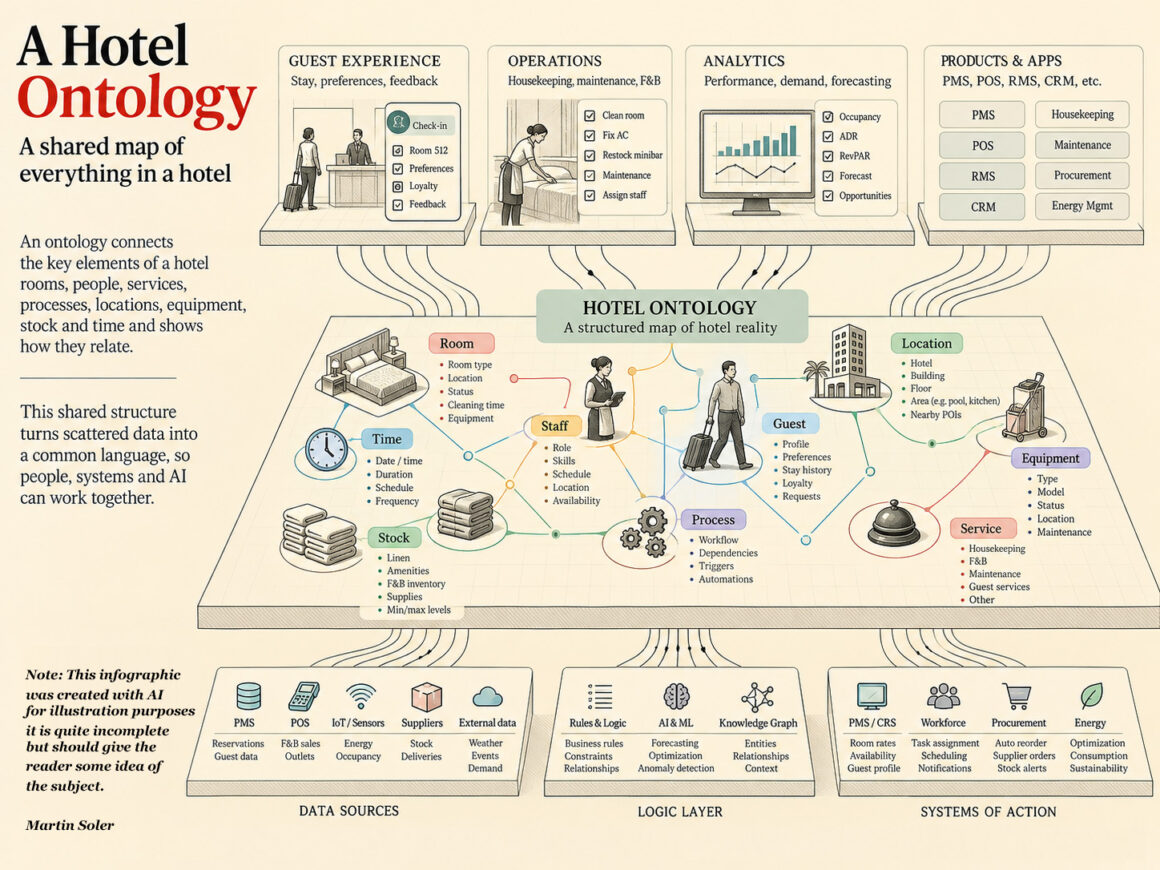
The basic concept isn’t as complex as it sounds (someone building such system will accuse me of blasphemy here). For a hotel, it essentially is a description of what actually exists in the hotel, how those things relate to each other, and what can happen between them.
For example: Room 407. It is a Deluxe King. It can connect to 408. It normally takes 31 minutes to clean. The AC was repaired two weeks ago. The building plans know it is 75 metres from the main linen store.
Add to this the human knowledge. The executive housekeeper knows that 407 often takes longer because of its layout. The housekeeper knows the vacuum cleaner stored on that floor is terrible. Then add the SOPs on how to clean it, what products to use. etc. An ontology connects them so they’re not just a series of disrelated facts but facts related to objects, rules, SOPs etc.

This becomes particularly interesting for AI because AI needs context before it can meaningfully optimize anything. Take all SOPs, all floor-plans, approved products, etc. and then add to it dynamic data (stock levels, arrivals, departures, reservations, rates etc) you have an AI system that can start optimizing.
Perhaps the system discovers that housekeepers spend 18 minutes per shift walking back to get supplies. Perhaps it finds that certain room sequences consistently take longer because employees are moving between floors. Or that linen organization creates dozens of tiny delays every week.
If you’ve cleaned rooms you understand that saving two minutes per room is meaningful. But importantly, saving those two minutes by making a physically demanding job a tiny bit easier is better than telling them to clean two minutes faster.
Start thinking about ontology now. Not necessarily by buying an “ontology platform” or embarking on a three-year data project. Start small. List the important elements in your hotel: rooms, employees, tasks, equipment, and physical spaces. Identify which systems has which data that you might need. Gather the SOPs. Find out what is not documented and just “everybody knows”. Bring this together. Start structuring it with Claude, Gemini or whatever your AI of choice is.
And don’t collect everything simply because you can. A 40-room hotel probably doesn’t need centimeter-level tracking of everything.
My previous argument was that hotels need to build infrastructure so they are ready for whatever AI brings next. Gathering all this data and making it available for AI is a great place to start. It will tell a system how all the parts work together and then when you start feeding live data in there and you’ll probably get great insights.
And btw, a lot of that data can even help in AI discovery.
— Martin
Bonus definitions hotel hoteliers:
Ontology: The structure and language of how your hotel works. It defines what things are, such as rooms, guests, staff, tasks and inventory, and how they relate to each other. For example, a room belongs to a floor, a cleaning task belongs to a room, and a housekeeper performs that task.
Knowledge graph: The connected picture of what is actually happening in your hotel. It takes those definitions and connects real information. For example: Room 412 is on the fourth floor, Guest Smith checks out at 10:30, the room needs cleaning, Maria is assigned to it, and she is currently cleaning Room 410.
Semantic model: The meaning behind your hotel data. It helps different systems and AI understand that information from the PMS, housekeeping system, POS and other tools refers to the same things. For example, “Room 412” in the PMS and “412” in the housekeeping app are understood as the same physical room.