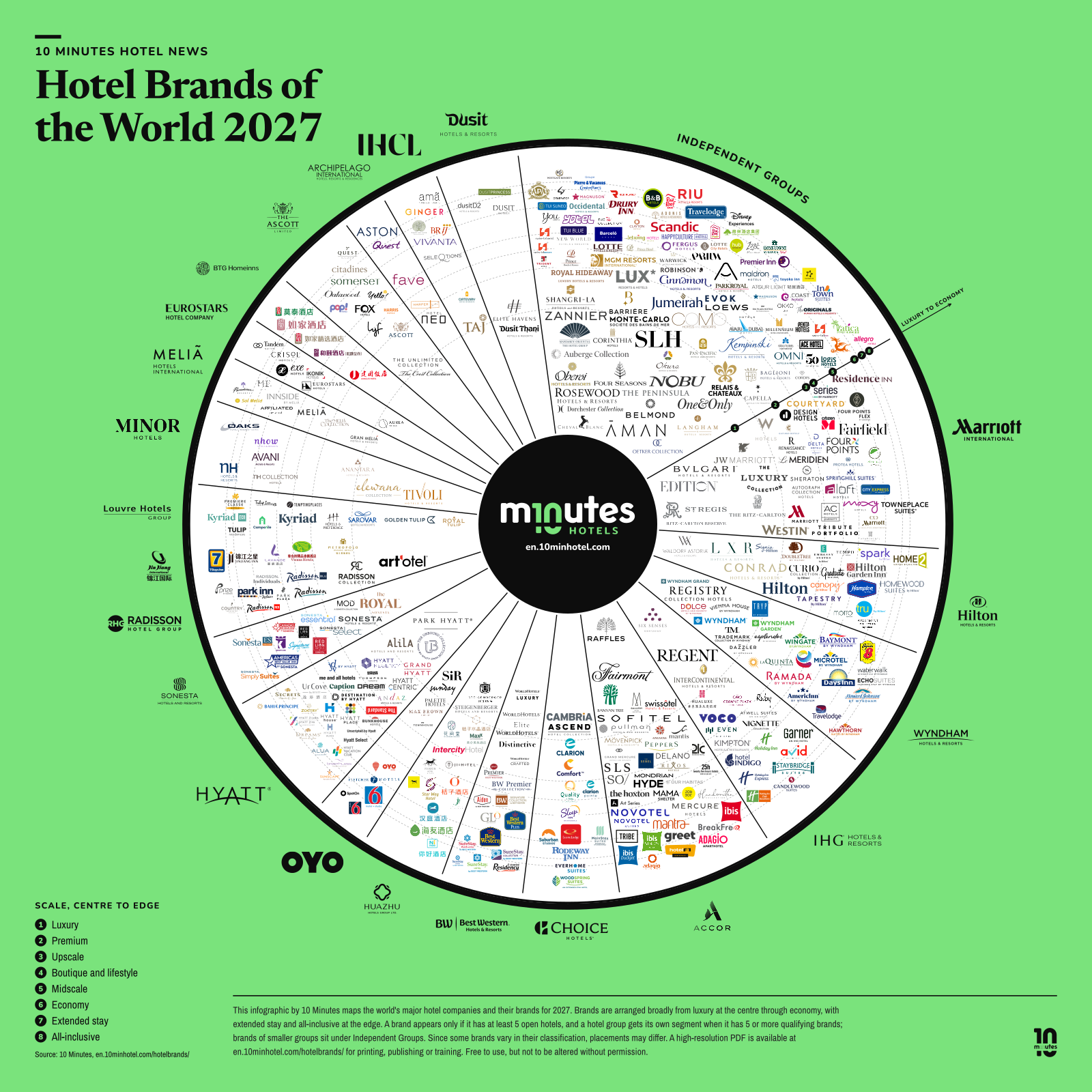
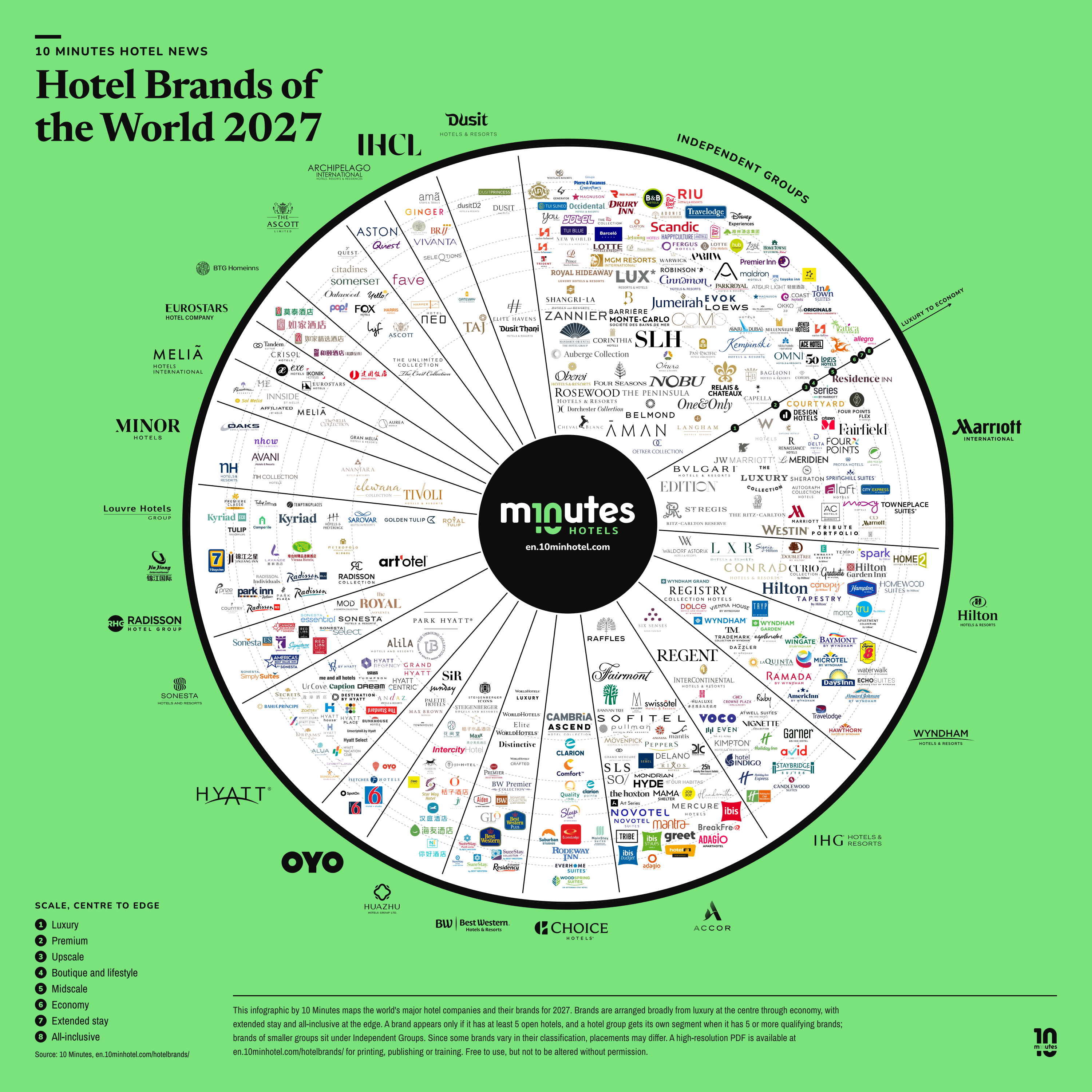
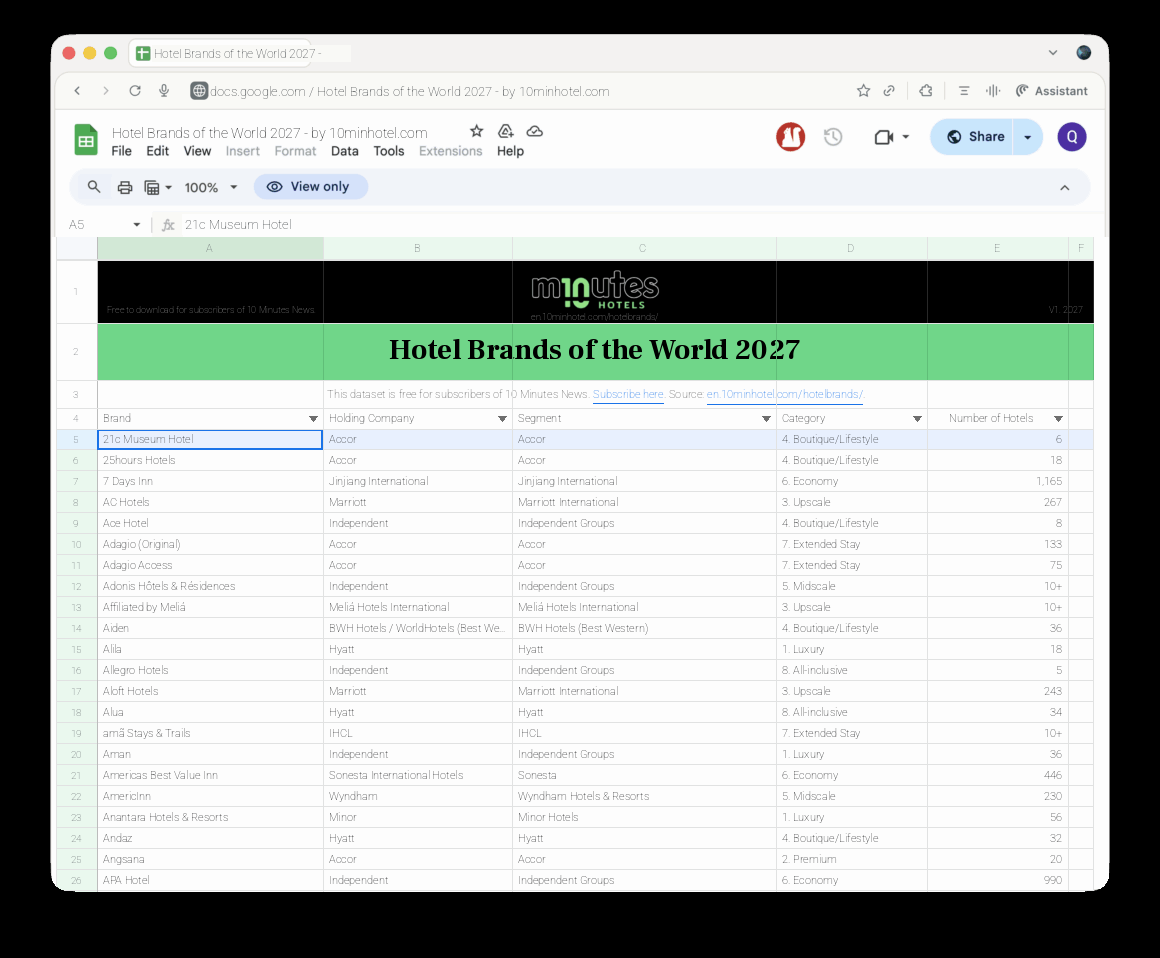
The 2027 edition of our Hotel Brands of the World infographic features 421 hotel brands, up from 387 entries in last year’s database. As hotel groups continue launching new brands, acquiring competitors, and expanding their portfolios, one question keeps coming up: how many hotel brands does the world actually need?
The infographic maps the major hotel brands and the companies that operate or franchise them, from luxury at the centre to economy, with extended stay and all-inclusive concepts around the edges. It illustrates an industry increasingly dominated by large distribution networks, loyalty programmes, and franchise platforms. But why do hotel groups keep adding brands when their portfolios already cover almost every market segment?
Hotel brands are products for investors
Hotel brands are traditionally seen as promises to travellers, defining the experience, service, and price guests can expect. But they also serve another important customer: the hotel owner.

As 10 Minutes News co-founder Martin Soler recently wrote on LinkedIn, “Hotel brands don’t sell rooms, they sell loyalty cards and franchises.” Loyalty programmes attract guests, while individual brands such as Moxy, Pullman, and Crowne Plaza offer owners different investment models, operating standards, and market positioning.
In 2023, Skift estimated approximately 1,000 hotel brands worldwide, noting that many were designed to appeal more to owners than travellers. Cornell professor Chekitan Dev offered another explanation: “Hotel brands are not over-created but under-destroyed.” Once owners sign long-term franchise agreements, retiring a brand becomes complicated.
The 629,000 independent hotels everyone wants
The opportunity becomes clearer when looking at global hotel supply. According to the 10 Minutes News Global Hotel Supply 2027 research, the world has approximately 856,000 hotels and 42 million rooms. Around 227,000 hotels are chain-affiliated, while 629,000, or 73%, remain independent. These figures combine verified data and estimates.
For major hotel groups, those independent properties represent enormous growth potential. New conversion brands offer owners access to global distribution and loyalty networks with fewer renovation requirements and more flexible operating standards.
This is the attraction of the asset-light model. Hotel companies collect franchise and management fees while owners provide most of the capital.
In a July 2026 interview with T. Rowe Price, Hilton CEO Chris Nassetta explained that Hilton had expanded from eight brands to 28, with a pipeline of 540,000 rooms representing more than $70 billion in investment. Hilton itself spends approximately $150 million to $200 million annually. “We can continue to grow without the use of much of any capital,” he explained.
More brands, but better performance?
Conversion brands are accelerating this expansion. Hilton’s Spark generated more than 200 deals in negotiation within weeks of launching, while IHG’s Garner attracted over 100 owner inquiries on its first day.
CBRE’s Hotel Brand Performance 2025 report found that middle-tier conversion and extended-stay brands had increased by more than 40% over five years. Soft-brand room growth was nearly ten times that of traditional brands over a decade.
But more brands do not necessarily mean better performance. CBRE found that the brand family expanding fastest by brand count, at 15% annually, recorded median RevPAR growth of just 0.3%.
The challenge is increasingly one of differentiation. With approximately 200 brands across seven major hotel groups, travellers may struggle to distinguish between similar offerings. For owners, however, each additional brand represents another way to join a global network.
As long as new brands help hotel groups attract owners and expand their franchise networks, the number of hotel brands will likely continue growing.
What changed in the 2027 edition?
The new infographic features 421 brands, compared with 387 entries in the previous database. The team added 91 brands, removed 22 entries, and excluded another 42 that fell below the new minimum threshold of five operating hotels.
Meliá, Eurostars, BTG Homeinns, and Dusit now have their own segments. H World includes 15 brands, while Radisson and Louvre are consolidated under Jinjiang International. Independent Groups is the largest category, with 102 brands.
Recent transactions also reshaped the chart. PRISM (OYO) took a significant stake in Sircle Collection and announced its acquisition of Fletcher Hotels, pending completion. Scandic acquired Dalata’s hotel operations, while Hilton’s YOTEL agreement remains a franchise partnership rather than an acquisition. Sonder has been removed following Marriott’s termination of its licensing agreement.
The complete infographic, methodology, and previous edition are available on the Hotel Brands of the World page.
[DOWNLOAD THE 2027 INFOGRAPHIC PDF]