One of the advantages of working closely with hotel operators is occasionally getting a glimpse into how they think.
Not the polished version that appears in presentations or on websites. The real operational thinking that happens behind the scenes. The habits, observations, and frameworks that experienced operators use every day to identify problems before they become complaints.
During a recent campaign with Paris-based hotel management company EnSuite Gestion, we had the opportunity to preview some of the methods their team uses when evaluating hotel performance. The company, led by Hesam Kasbkar, specializes in the operational management of hotels and works directly on property with owners and investors to improve performance, profitability, and guest satisfaction.
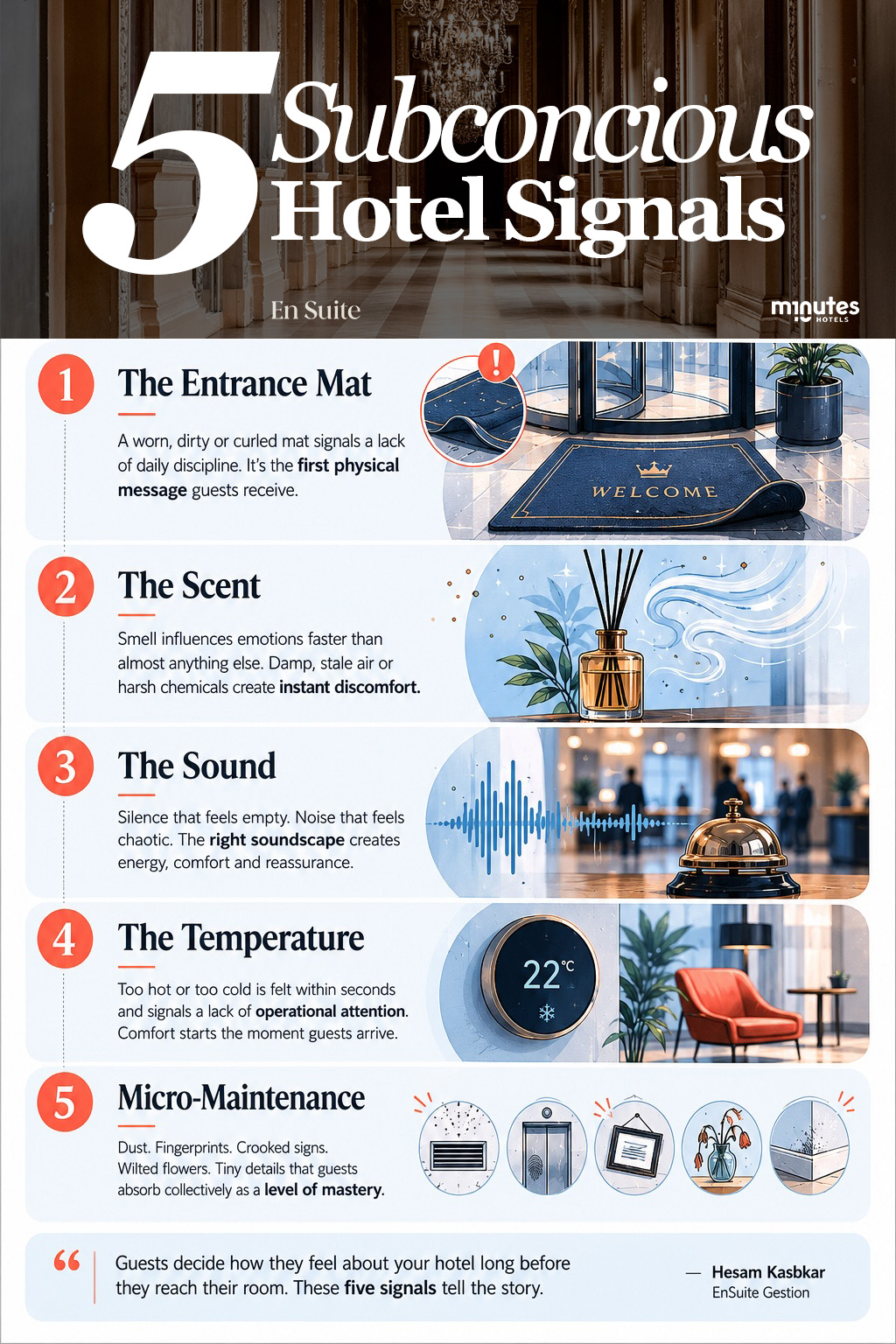
Among the insights shared with us was a surprisingly simple framework built around five subconscious signals that guests notice before they ever reach their room.
What makes these five signals interesting is that none of them are revolutionary. Most experienced general managers know them instinctively. Walk any strong GM through a lobby and they will often know within minutes whether a hotel is being well managed. They may not immediately explain why, but they can feel it.
The value of the EnSuite framework is that it puts structure around that intuition. It turns something experienced operators sense into something every employee can learn to observe.

According to Hesam and his team, guests begin forming opinions about a hotel within seconds of arriving. By the time they reach the elevator, they have often already started deciding whether the experience feels premium, professional, and trustworthy.
The first signal is the entrance mat
It sounds trivial until you think about what it represents. A worn, dirty, curled, or poorly maintained entrance mat is rarely an isolated issue. More often, it signals that small daily details are escaping attention. Guests may never consciously mention the mat, but it becomes part of their first impression of how carefully the property is managed.
The second signal is scent.
Few things influence perception faster than smell. A beautifully designed lobby can instantly lose its appeal if guests encounter dampness, stale air, excessive cleaning chemicals, or lingering odors. Unlike visual imperfections, which can sometimes go unnoticed, scent creates an immediate emotional response. Before guests have checked in, they are already forming feelings about comfort, cleanliness, and quality.
The third signal is sound.
Many hotels invest heavily in visual design while paying less attention to the acoustic environment. Yet guests react strongly to sound, even when they do not realize it. A reception area that feels unnaturally silent can seem cold and empty. Excessive noise creates stress. A well-managed sound environment helps create energy, comfort, and reassurance before a single interaction with the front desk has taken place.
The fourth signal is temperature.
Guests rarely compliment a perfectly conditioned lobby because they expect it. They notice immediately when it is wrong. A space that is too warm or too cold creates discomfort within seconds and often suggests that daily operational controls are not being actively monitored. Temperature is one of the most invisible elements of hospitality when it works well and one of the most obvious when it does not.
The fifth signal may be the most important of all: micro-maintenance.
A dusty ventilation grille. Fingerprints on an elevator door. A crooked sign. Wilted flowers. A damaged skirting board. Individually, none of these issues matter very much. Together, they create a narrative.
Guests do not consciously audit every detail they encounter. Instead, they absorb dozens of small signals and use them to form a judgment about the overall quality of the property. Every small defect becomes evidence. Every well-maintained detail becomes reassurance.
This is where the framework becomes particularly powerful. It is not really about mats, smells, sounds, temperatures, or maintenance. It is about operational control.
Well-managed hotels leave visible signs of mastery everywhere. Poorly managed hotels leave clues too.
What we found most interesting about Hesam’s approach is that these observations are not reserved for executives or department heads. They are intended to be understood by everyone. Housekeepers, receptionists, maintenance teams, managers, and supervisors all walk through the same spaces every day. If every hotel employee learns to recognize these five signals, quality control becomes a shared responsibility rather than a management task.
In an industry that often focuses on technology, amenities, and room renovations, it is refreshing to be reminded that guest perception is still heavily influenced by the smallest operational details.
The room matters.
The service matters.
But according to Hesam Kasbkar and the team at EnSuite, guests often begin deciding how they feel about a hotel long before they open the door to their room.
And the first clue is sitting right beneath their feet.