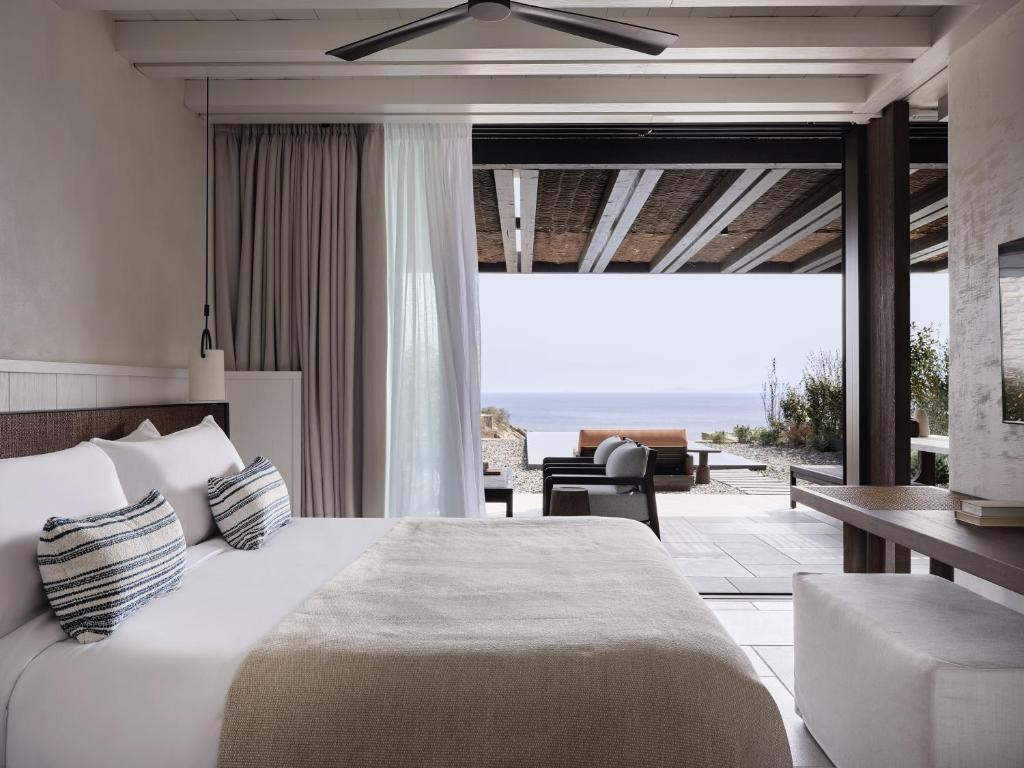
From Junior Suites to private villas, LASUITE.COM analysed 30,000 suites across 4,500 hotels and resorts in 45 countries. The study reveals a hospitality category with no universal standards, making suites difficult for travellers to compare, just as AI begins to transform the way people search for accommodation.
Paris, September 2026 — What really distinguishes a Junior Suite from a standard suite? How large should a Penthouse be? And why is it still so difficult to find a suite with two bedrooms, a terrace or a private pool?
LASUITE.COM has published the Hotel Suite Report 2026, a study dedicated to a still relatively under-documented segment of the hospitality industry. Based in part on an analysis of 30,000 suites across 4,500 hotels and resorts in 45 countries, the report explores the different categories of hotel suites, changing traveller expectations and the growing role of artificial intelligence in travel search.
From 40 sqm to more than 1,000 sqm: the word “suite” covers very different realities
The first finding is striking: there is no precise international definition of what constitutes a hotel suite.
Junior Suite, Executive Suite, Penthouse, Presidential Suite, Villa or Residence: terminology varies considerably from one hotel and destination to another.

LASUITE.COM’s analysis identifies indicative size ranges of 40–60 sqm for a Junior Suite, 65–120 sqm for a One-Bedroom Suite, 150–350 sqm for a Penthouse, and more than 1,000 sqm for some villas and residences.
For travellers, this lack of standardisation makes suites difficult to understand — and even more difficult to compare.
Families, privacy and space: why suites are responding to changing traveller expectations
Luxury travel trends are also supporting demand for this type of accommodation. According to Virtuoso’s 2026 Luxe Report, cited in the study, family travel is the leading luxury travel trend for 2026/27, followed by multigenerational travel.
Among ultra-luxury travellers, privacy is also one of the most sought-after experiences.
Separate bedrooms, living areas, terraces, private pools and the ability to accommodate several guests mean that suites increasingly respond to practical travel needs that go far beyond luxury alone.
Finding a hotel has become easy. Finding the right suite is much harder.
Travellers today can use Google, Booking.com, Expedia, hotel websites and social media to plan where to stay.
But the search becomes considerably more complicated when specific requirements come into play: two bedrooms, a separate living room, a minimum size, a private pool, a terrace or a particular view.
Suites are often displayed after numerous other room categories, while their characteristics are not standardised, making meaningful comparisons difficult.
“Today, it is very easy to find a hotel in Paris, Greece or the Maldives. But finding a two-bedroom suite with a private pool and a sea view remains surprisingly complicated. This observation is what led us to take a closer look at the world of hotel suites.”
Xavier Bentes, Founder of LASUITE.COM
AI could change the way travellers search for suites
Artificial intelligence offers a very different approach to travel search. Instead of working through a succession of filters, travellers can simply describe what they are looking for:
“I’m looking for a two-bedroom suite in Greece, with a private pool and a sea view.”
According to research cited in the Hotel Suite Report 2026, 67% of travellers have already used AI for some aspect of their trip, while 89% would like to use AI for future travel planning.
But AI has yet to replace trust when it comes to actually making a booking: 68% prefer to book with a trusted travel brand rather than through an AI chatbot or agent.
This could lead to a new travel journey: using AI to discover and compare options, then turning to a trusted travel provider to make the booking.
When the suite becomes part of the journey
Family holidays, honeymoons, multigenerational trips, business and bleisure stays, private villas and urban penthouses: the ways in which travellers use suites are becoming increasingly diverse.
Television is also helping to put them in the spotlight. The White Lotus has placed luxury hotels and their suites at the heart of its universe, from Hawaii to Sicily and Thailand, with France — including Saint-Tropez and Paris — providing the backdrop for the next chapter.
A suite is therefore no longer simply a larger hotel room: for some trips, it becomes an integral part of the experience and sometimes a reason for choosing the hotel itself.
About the Hotel Suite Report 2026
The Hotel Suite Report 2026, published by LASUITE.COM, explores how travellers discover, choose and book hotel suites.
It draws in particular on LASUITE.COM’s analysis of 30,000 suites across 4,500 hotels and resorts in 45 countries, alongside international research into luxury travel, traveller behaviour and artificial intelligence.
About LASUITE.COM
After founding MyBoutiqueHotel.com and co-founding Dayuse.com, Xavier Bentes launched LASUITE.COM, a platform exclusively dedicated to discovering and booking hotel suites.
The platform currently features 30,000 suites across 4,500 hotels and resorts in 45 countries and is developing an AI-powered search engine that allows travellers to search for suites using naturally expressed criteria.
Travellers can then book directly with the hotel or through Booking.com.