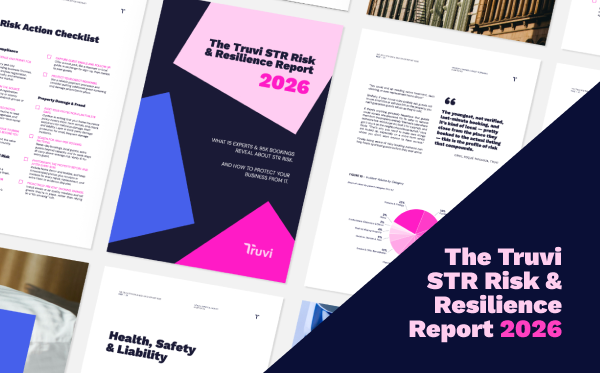
New data from the Truvi STR Risk & Resilience Report 2026 shows that where a guest lives, when they book, and the property they choose can reveal more about booking risk than identity alone.
LONDON, October 20, 2026 – A guest booking a short-term rental within 20 miles of their own home is 72% more likely than average to be involved in a damage incident, while those traveling 1,000 miles or more are among the safest guests, according to new research from Truvi, the trust layer for short-term rentals.
The finding comes from the Truvi STR Risk & Resilience Report 2026, which analyzes a sample set of more than 95,000 bookings protected by Truvi between January and September 2026. Across the dataset, how far a guest travels, how far in advance they book, and the type of property they choose all emerge as important indicators of booking risk, showing why identity checks alone cannot give operators the full picture.
Same-day bookings are a warning sign
A booking made the same day it starts is 60% more likely to end in a damage incident, with risk falling steadily the further in advance someone books. Together with the proximity finding above, this suggests hosts and platforms should be most alert to a nearby guest booking at the last minute, whatever a guest’s profile looks like on paper.
A detached house needs more care than an apartment
Houses are around 2.4 times as likely as apartments to end in a damage incident. One plausible explanation is that an apartment comes with neighbors who notice problems sooner, while a standalone house doesn’t.
Going direct is worth it, when protected
Direct bookings have moved from 1.34 times to 1.85 times average risk since Truvi’s last analysis in May, the biggest shift in the entire dataset. Truvi’s Head of Data, Oriol Roqué Paniagua, offers one possible explanation: operators taking bookings outside an OTA may have less access to the screening signals and review history available through established platforms. The finding underlines the importance of building equivalent safeguards into the direct booking journey, allowing operators to retain the margin and control of going direct while managing the additional risk.
The party house signature
Properties advertising five or more group-entertainment features, such as a pool table, hot tub, sauna or barbecue, carry more than twice the average risk of a damage incident, and are still around 60% more likely to see one when compared only with houses of the same size. Hosts offering these features may want to look more closely at who is booking.
Kayla Perez, VP of Operations at Truvi, said: “Two guests can pass exactly the same identity checks and still present very different levels of risk. Where they’re traveling from, how far in advance they book and the type of property they’re staying in can all tell us something important. For property managers, the challenge is knowing which bookings need a closer look before the guest arrives. This is particularly important as more operators look to grow their direct bookings, where they need to take greater responsibility for assessing risk themselves. Understanding these patterns helps managers put the right checks in place, protect their properties and make more confident decisions about who they welcome.”
The full Truvi STR Risk & Resilience Report 2026 is available at https://truvi.com/guides/str-risk-report-2026/.
About Truvi
Truvi is the trust layer for short-term rentals, helping property managers and owners make it safer to hand their keys to a guest they’ve never met, on any channel. Truvi screens guests and bookings before the stay, protects the property if something still goes wrong, and works with more than 800 property management companies and a network of over 25,000 operators worldwide. Learn more at https://truvi.com/.