Track Google Hotels in one place. This hub aggregates the latest news and best practices around Google’s hotel search and booking products, curated by 10 Minutes News. Follow the platform increasingly central to hotel demand.
-

Samsung Launches AI-Powered The Frame Hospitality TV Model in U.S. for Luxury Hotels with Enhanced Guest Experiences
9 October 2026💻 Samsung Electronics America launched The Frame hospitality model in the U.S., available in 55-, 65-, and 75-inch sizes. This AI-powered TV offers personalized experiences, integrating art and hotel services. LYNK Cloud provides digital concierge services and content management, enhancing guest engagement. The TV supports Google Cast and Apple AirPlay, improving entertainment accessibility. Samsung Knox Security ensures data protection, making it ideal for luxury hotels. The Frame blends seamlessly with hotel decor, offering a unique visual focus.
-
Top 6 GDS Platforms for Hotels in 2027
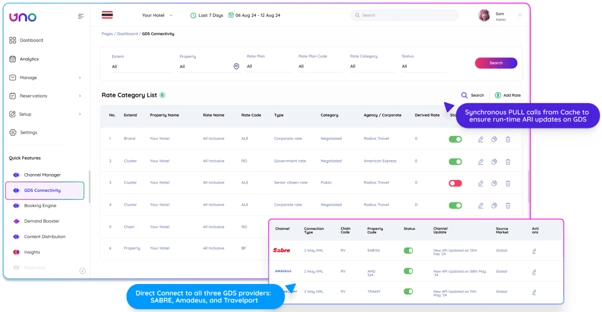
9 October 2026A GDS (global distribution system) is a network that connects hotel inventory, rates, and availability to travel agents, corporate travel management companies, and online booking tools, letting them search and book directly against live hotel data. Loading corporate rates by hand across multiple GDS extranets is slow, error-prone, and quietly costs you high-yield bookings from […] The post Top 6 GDS Platforms for Hotels in 2027 appeared first on RateGain.
-

Marriott Integrates AI Booking on Fliggy, Surpassing 800% Growth in China’s Holiday Travel Bookings
9 October 2026📱 In China, AI agents on Alibaba’s Fliggy processed 200 million orders during the February Spring Festival, including 55 million milk tea cups. Hotel AI bookings rose over 800%, with Marriott using a dedicated “door” in Fliggy for easy hotel and package access. In the US, Google enabled hotel bookings in AI Mode with 10 companies, including Marriott. On Fliggy, Marriott’s AI commands extend beyond rooms to offerings like afternoon tea, enhancing direct sales.
-
Gen Z and Trailing Millennials Redefine U.S. Travel Preferences, Influencing Hotel Strategies with Digital and Social Media Trends
9 October 2026🌐 Gen Z and Trailing Millennials, aged 24-37, are reshaping travel in the U.S. and globally, with over 78 million in the U.S. and more than a billion worldwide. They prioritize experiences, with median incomes from $55,000 to $95,000. Nearly 50% identify as non-white. This “Emerging Experience Generation” relies on digital tools, spending intentionally on meaningful experiences, valuing sustainability, and driving trends in hospitality. Hotels adapting to this dynamic see growth in bookings, particularly through social media engagement.
-
Six of 17 Independent Hotels in European Cities Missing Direct Price Listings on Google Maps After Update
9 October 2026📖 Oct 9, 2026, Zurich: Google Maps now excludes hotel rates unless a direct feed exists. Out of 17 hotels in Zurich, Bern, Vienna, Munich, and Lisbon, 6 showed no direct price, relying on resellers like Booking.com. Hotel Wellenberg’s lowest rate was CHF 215 via EaseMyTrip. Rössli and Boutique Hotel Kugel retained their prices, CHF 171 and CHF 92, respectively. Hotels should connect a price feed via Google Ads to maintain visibility.
-

Marriott Introduces Exclusive AI Booking Access on Alibaba’s Fliggy, Expanding Sales Beyond Room Reservations
9 October 2026📈 Oct 9, 2026: In China, Marriott has integrated with Alibaba’s Fliggy, offering a dedicated access point for AI agents to sell hotel packages, unlike other hotels that use a shared search. During February’s Spring Festival, Alibaba’s Qwen AI app processed 200 million orders. Fliggy AI bookings soared by over 800%, yet hotel figures remain undisclosed. Marriott established its Fliggy presence through collaboration with Alibaba since 2017, allowing AI-driven sales of packages, unlike other hotel chains on the platform.
-

As AI travel discovery moves, Who keeps the booking?
8 October 2026I go down the rabbit hole of AI & Travel so you don’t have to! One email each week keeps you up to date.
-

Samsung Brings The Frame Hospitality Model to U.S. Market
8 October 2026This article was written by Lodging Magazine. Click here to read the original article Photo Credit: Samsung Electronics America Samsung Electronics America announced that The Frame hospitality model (HL03H model) is now available in the U.S. market, bringing Samsung’s art-inspired display design to luxury hotels and premium hospitality environments. Available in 55-, 65-, and 75-inch sizes, The Frame hospitality model offers Smart TV functionality, including entertainment, personalized content, and hotel services. The Frame hospitality model offers features that deliver unique…
-

174 – Humans, already serving machines
8 October 2026This article was written by Martin Soler. Click here to read the original article Out of all the tech stuff that is happening. I think we need to do some work on making people care. Care to deliver great service. Care to thank someone who gave great service. It’s something machines can’t honestly do (even though some people at Anthropic are wondering if AIs have feelings). PS: If you haven’t filled out my survey, I’d love to have your reader…
-
Booking Holdings Controls 70% of European OTA Bookings Despite Claims of Hotel Independence from Single Platforms
7 October 2026📈 Booking Holdings, including Booking.com, controls 70% of European OTA bookings, contrary to claims of no platform dependency. AI referral traffic has quadrupled but remains under 1% of hotel site visits. European hotel investment reached €11.7 billion in H1 2026, up 19.5% from the 10-year average. AI governance frameworks and Bain’s warnings on AI’s impact on direct bookings are highlighted. Japan’s hotel rates surged up to 31% during autumn foliage season, with domestic travel offsetting reduced inbound tourism.
-

AI Platforms Quadruple Share of Hotel and Rental Website Traffic, Prompt Urgent Strategy Shift for Travel Operators
7 October 2026📈 In 2025, 70% of travel bookings are projected to be online, a rise from 43% in 2011. AI-driven traffic to travel sites has quadrupled for hotels and doubled in other categories this year. In the US, 49% of travelers rely heavily on AI tools for bookings, compared to 41% in the UK, France, and Germany. As AI refines the booking process, travel operators must adapt to AI’s growing influence to maintain direct bookings and stay competitive.
-

AI-Sourced Traffic to Hotel Websites Quadruples in One Year, Yet Remains Below 1% of Total Traffic
7 October 2026📈 In July 2026, AI-assisted visits to hotel websites quadrupled compared to the previous year, but still accounted for less than 1% of total traffic, as reported by Bain & Company on September 30. In the US, 56% of leisure travelers used AI in 2025, rising from 43% in late 2025. By July 2026, AI-based site traffic increased by 119%, with conversion rates nearly matching non-AI visitors, a stark improvement from a 47% gap in 2025.
-
AI-Driven Hotel Website Visits Quadruple, Yet Remain Below 1% of Total Traffic According to Bain Report
7 October 2026💻 October 7, 2026: AI-driven visits to hotel websites quadrupled between July 2025 and July 2026, still under 1%. Phocuswright found 56% of US travelers used AI for trips in the past year. Adobe reported a 119% increase in AI-sourced traffic to US travel websites, with conversion rates improving from 47% lower in 2025 to almost equal by July 2026. Bain & Co. noted travel spending booked in advance rose from €1.1 trillion in 2011 to €2.4 trillion in 2025.
-

Google’s AI Hotel Booking Standard Merged by Council with Three OTAs, Excludes Post-Purchase Management
7 October 2026🏨 On September 24, 2026, the Universal Commerce Protocol merged its AI lodging booking draft, a standard initiated by Google in January. This draft defines booking elements like room type and pricing but excludes post-purchase management, such as modifications. The council includes Google, Amadeus, Booking.com, Expedia, Hilton, Marriott, and Trip.com. The draft’s focus ends at confirmation issuance, and while it aims for broader accessibility, independent hotels must engage via platforms like OTAs or reservation systems.
-

Google Adopts Universal Commerce Protocol for AI Hotel Bookings, Excluding Travel Agency Intermediary Functions
6 October 2026🏨 Universal Commerce Protocol, adopted by Google for AI hotel bookings, excludes travel agency terms. Phocuswright’s August research shows 69% of travelers trust AI for booking, yet 72% want human access. Aven Hospitality reports inaccurate AI content costs travelers $1,900 per trip. Italian hotel investments hit €1.3 billion, up 53% from the ten-year average, with RevPAR up 11.3% in H1 2026. Greater Paris hotels’ RevPAR reached €116, rising 3.7%, with investments at €845 million.
-

Americas Great Resorts Offers Fixed-Price Email Campaigns to Luxury Hotels for Direct Bookings Without OTA Commissions
6 October 2026📧 1 hour ago, Andrew Paul from Americas Great Resorts (AGR) discussed hotel marketing strategies. AGR uses email marketing to reach over 5 million verified travel enthusiasts, offering a fixed price per thousand emails. Unlike OTAs, AGR does not charge booking commissions. Their campaigns yield significant ROI: Montage Palmetto Bluff saw a 27:1 return from 65,000 emails, while Windstar Cruises achieved a 36:1 return with 200,000 emails. AGR focuses on acquiring new guests, not just retaining past ones.
-

Monitor your blind spots: Is AI getting your hotel right?
6 October 2026By Rick Posey, Vice President, AI at Cendyn AI is already deciding how travelers see your hotel. Is it getting you right? As AI becomes part of the hotel discovery journey, visibility isn’t enough. Hotels need to know what AI is saying about them, and who it’s sending their way. Everyone has been asking, “Are we in AI search?” But that’s not the only question we should ask. More importantly: “What version of your hotel is AI search presenting?” AI…
-

Understanding Average Daily Rate (ADR): Key Metric for Hotel Revenue and Performance Optimization
6 October 2026💸 ADR, or average daily rate, is a crucial metric for hotels, indicating the average revenue earned per occupied room. It’s calculated by dividing total room revenue by rooms sold, excluding complimentary and staff use. For example, a hotel with $20,000 revenue and 100 rooms sold has a $200 ADR. Factors like market demand, location, and amenities influence ADR. Tools like Lighthouse’s AI-driven pricing can optimize rates up to 365 days in advance, helping hoteliers boost their ADR.
-

AI Panel at Expo Real Discusses Impact on Hotel Industry: Differentiation Key as AI Alters Guest Experience
6 October 2026💻 October 2023, Expo Real’s “Funneling the Guest” panel in Munich discussed AI’s impact on the hotel industry. Participants included Katherine Doggrell, Navneet Bali, Asli Kutlucan, and Gregory Naidoo. The discussion highlighted AI’s role in personalizing choices, moving from numerous options to a few tailored suggestions. AI pricing strategies were compared to personalized pricing models in retail. The importance of genuine differentiation in hotels was emphasized as AI amplifies either uniqueness or uniformity, affecting asset value and pricing power.
-

Google to Adopt Open Standard for AI Hotel Booking, Excluding Traditional Agency Features and Group Business
6 October 2026📅 September 2026: Universal Commerce Protocol’s lodging draft was merged, missing travel agency fields. Google plans to adopt it for AI-powered hotel bookings. The draft, created by a 16-member council, lacks group bookings, which constitute roughly 25% of Marriott’s room nights. The protocol doesn’t account for commissions or post-purchase modifications. AI assists in venue sourcing, but group business remains complex. Industry needs standardized group terms for future integration. Four council seats are open for new members to address these gaps.
-

Americas Great Resorts Offers Fixed-Price Email Marketing, Yielding Up to 36:1 ROI for Luxury Hotels and Cruises
6 October 2026📦 When working with Americas Great Resorts (AGR), hotels rent access to over 5 million verified email records of affluent travelers, targeting specific demographics. AGR charges a fixed price per thousand recipients, unlike OTAs which charge a commission per booking. Success stories include Montage Palmetto Bluff with a 27:1 ROI from 65,000 emails, and Windstar Cruises with a 36:1 ROI from 200,000 emails. AGR offers no commissions and maintains bookings on the hotel’s website, ensuring data control.
-

Independent Hotels Bear the Cost as New Travel Distribution Layers Shift Financial Burden Away from OTAs and Brands
5 October 2026🏨 In 2026, Google introduced hotel booking within its AI system. Booking Holdings spends about $22 million daily on marketing, influencing hotel commissions. By 2025, 75% of Marriott’s US and Canada room nights were by members. Airlines, unlike hotels, managed to reduce OTAs’ share to 13% of their online revenue. In 2025, Delta earned $8.2 billion from American Express for loyalty perks. Franchise fees range from 9.6% to 12.9% of room revenue. Conversions were 40% of Marriott’s 2026 openings.
-
AI and OTAs Like Booking.com Are Taking Control of Hotel Upselling and Pricing Decisions, Industry Warns
5 October 2026📱 Three days before arrival, hotels send emails with offers like sea-view rooms at $45 extra. Booking Holdings’ August 2023 call revealed that over 50% of Booking.com bookings involve Level 2 and 3 members, pre-deciding upgrades. Delta, despite denying, aims for individual pricing by November 2024. Revolut, with over 70 million users, advances in AI bookings. On August 4, a Senate hearing discussed surveillance pricing, raising concerns about dynamic, personalized pricing strategies in the travel industry.
-
Cornell Study Reveals AI Recommends Nonexistent Restaurants, Prompting Google and Reddit to Tighten Spam Rules
5 October 2026📑 On May 22, 2026, Cornell researchers tested AI’s vulnerability by planting a 12-word fake restaurant recommendation on Reddit. AI cited the made-up “Sol Azteca” in 38-51% of reports. Google updated spam rules on May 15, 2026, to curb such manipulation, affecting rankings from June 24, 2026. On July 6, 2026, Reddit began using AI to detect fake behavior, blocking 23 million spam views daily. The Cornell study is preprint, affecting open-source tools, not ChatGPT or Gemini.
-

Independent Hotels Bear the Financial Burden of New Travel Distribution Layers, Unlike Airlines and Chains
5 October 2026🏨 Oct 5, 2026, the travel industry is evolving. Booking Holdings invests $22 million daily in marketing. In 2025, Delta’s pre-tax profit was $5 billion, while American Express paid them $8.2 billion for loyalty perks. Only 13% of airlines’ online revenue involves OTAs. Marriott reports 75% of U.S. and Canada room nights are by members. Independent hotels face 69.4% commissions from Booking Holdings, unlike chain hotels. Conversions formed 40% of Marriott’s 2026 openings. Franchise fees are 9.6% to 12.9% of…