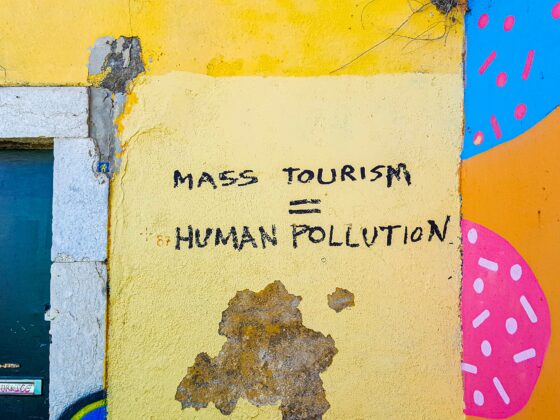
Last year, after the summer holidays, I wrote about overtourism and why it is a dumb word, solving the wrong problem. When destinations become crowded, the quick response is usually some version of restriction, but there are better ways.
A recent Google Maps experiment is a perfect example of a better way. Researchers looked at highly congested roads across 10 US cities and changed the recommended routes for fewer than 2% of the trips. The result was around a 2% increase in speeds on those congested roads and an improvement in travel times across the network. The point is there was no restriction, just re-distribution.
This is engineering solving a problem. Politics and regulation mostly have a limited set of tools. When something creates a problem, restrict it, tax it, regulate it or make it more difficult (don’t get me wrong this is a critical function, we need boundaries, but as the saying goes when all you have is a hammer every problem becomes a nail).
Engineers have another set of tools: inventing a better solution.
Most “overtourism” is a congestion problem. Visitors arriving in the same few months to the same attractions at roughly the same time. I remember speaking to someone who worked in the famous town of Positano on the Amalfi Coast, he explained that for 2 month a year he had work, the year of the year he didn’t. So he moved to Sorrento. I drove by the town in one of those two month, I didn’t stop because it was so full.

We have sophisticated technology for pricing airline seats and hotel rooms, targeting advertising and predicting what someone wants to buy. What if we focused solutions on distributing demand better? Making it so much more interesting to travel at a different time and routes. Making it OK to travel off season etc.
The Google Maps congestion problem is much simpler than tourism, I know. But the principle is interesting: congestion does not necessarily mean you have too much demand and that restricting is the solution. It can mean that it is just too focused on the same paths.
What if twice as many Americans, Europeans, Chinese, Indians, Arabs and everyone else spent time in each other’s countries, ate together, worked together and understood each other a little better? How much good could that bring?
So maybe we should ask technology and engineers to solve for double the volume of tourism. Between better marketing, better technology and some real problem solving maybe we can grow the pie in a sustainable way.