For years, the hospitality industry has been experimenting with conversational commerce. Chatbots have appeared on hotel websites, AI concierges have been added to mobile apps, and startups have raised millions promising to let guests book rooms through messaging platforms. The vision has always been compelling: instead of navigating websites, comparing room types, and filling out booking forms, travelers would simply have a conversation.
At Meta’s Conversations conference in London, that vision moved significantly closer to reality.
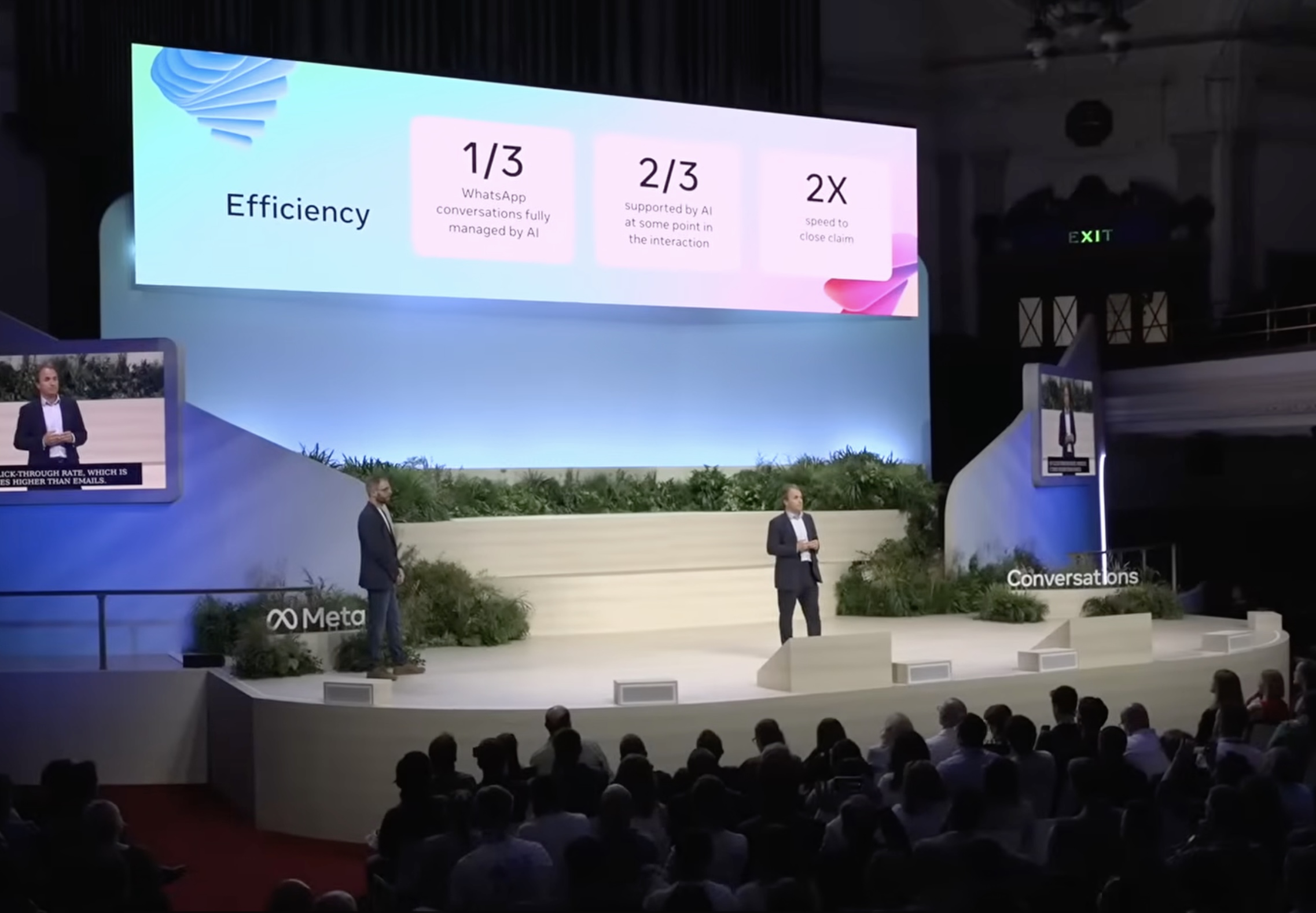
The company unveiled its new Meta Business Agent platform, an AI-powered system designed to operate directly inside WhatsApp, Messenger, and Instagram. While the event featured examples from retail, telecommunications, aviation, and car rental companies, the implications for hotels were impossible to miss. What Meta is building is not simply another chatbot. It is attempting to create a platform where customer discovery, customer service, transactions, reservations, and ongoing relationship management can all happen within a single conversation.
As Naomi Gleit, Meta’s Head of Product, explained during the event, messaging has evolved far beyond simple communication.
“There are over 1 billion conversations between people and businesses every day on our messaging apps,” she told attendees. According to Meta, those conversations increasingly serve as the storefront, support desk, sales floor, and customer relationship channel for businesses around the world.
The company’s belief is straightforward. Businesses once needed physical stores. Then they needed websites. Now they need messaging.
For hospitality professionals, that statement may sound ambitious, but the underlying trend is already visible. Many luxury hotel brands, including Four Seasons Hotels and Resorts, have spent years encouraging guests to communicate through WhatsApp during their stay. Guests use messaging to request airport transfers, order room service, contact concierge teams, report maintenance issues, arrange spa appointments, or simply ask questions without picking up the phone. In many properties, WhatsApp has quietly become one of the most effective guest service channels available.
What Meta now appears to be pursuing is the next logical step.
Instead of limiting messaging to guest support, the company wants the entire customer journey to happen within the conversation itself.
Throughout the presentation, executives repeatedly demonstrated how Meta Business Agents can connect directly to existing business systems, including CRM platforms, product databases, ecommerce systems, payment platforms, and customer records. The agents can answer questions, process transactions, qualify leads, make bookings, and transfer conversations to human staff whenever necessary. Most importantly, the agents can access real-time information from the systems businesses already use.
For hotels, the potential integration points are immediately obvious.
But instead of just redirecting the guest to a website, the AI agent could connect directly to the hotel’s CRS, check inventory, rates, answer questions, and complete the reservation without the guest ever leaving the conversation. Once the booking is confirmed, the same conversation could continue throughout the guest journey, handling pre-arrival requests, check-in information, upselling opportunities, and post-stay engagement.
The technology required to accomplish this already exists. Numerous hospitality technology startups have been building versions of this vision for several years. What makes Meta’s announcement noteworthy is not necessarily the capability itself, but the distribution.
Billions of consumers already use WhatsApp, Messenger, and Instagram every day.
Rather than convincing travelers to download a new application or learn a new interface, Meta is embedding these capabilities directly into platforms where users already spend their time.
One of the strongest demonstrations during the event came from Brazilian car rental giant Movida. The company showcased a fully integrated reservation experience operating entirely through WhatsApp. Customers can search for available vehicles, select rental dates, choose insurance packages, complete bookings, and soon make payments directly within the conversation. The system is connected to Movida’s internal reservation and customer management systems, allowing information to flow seamlessly between the AI assistant and operational platforms.
Movida CEO Gustavo Moscatelli described the company’s goal as creating “a fully personalized rental experience, 100% in WhatsApp.” During the live demonstration, a customer searched for a vehicle in São Paulo, selected an SUV, added insurance coverage, and completed the reservation entirely within the messaging thread.
For anyone familiar with hotel booking engines, the parallels are obvious.
Replace vehicle inventory with room inventory. Replace rental dates with arrival and departure dates. Replace insurance with breakfast packages, spa treatments, upgrades, or late checkout offers. The underlying workflow is quite similar.
Perhaps the most interesting hospitality-adjacent example came from Air France-KLM, which has already spent several years transforming WhatsApp into a central customer communication channel.
Speaking at the event, Air France-KLM UK and Ireland General Manager Jérôme Salemi explained how the airline moved beyond traditional communication methods after recognizing that customers were becoming increasingly difficult to reach through email and conventional channels.
“We needed to meet our passengers where they already are,” he explained.
The airline’s WhatsApp strategy began with customer service but rapidly expanded. Today, passengers receive check-in reminders, gate updates, baggage information, loyalty program notifications, upgrade offers, lounge access promotions, destination inspiration content, and customer support through the platform. The channel has become deeply embedded across the entire customer lifecycle.
Air France exchanged 33 million messages with passengers in a single year through WhatsApp. Marketing messages achieved a 72% open rate and a 10% click-through rate, significantly outperforming traditional email campaigns. Customer satisfaction scores also remained exceptionally high.
Most importantly, Salemi framed WhatsApp as something much larger than a communication tool.
“It’s not just a communication channel. It’s a lifeline throughout the entire travel experience,” he said.
The hospitality industry has traditionally treated messaging as a support channel, while booking engines, CRSs, PMS platforms, loyalty systems, and CRM tools have operated separately. Meta’s vision would be to move them to a single conversational interface. The guest no longer interacts with multiple systems. Instead, they interact with a conversation that can access all of those systems behind the scenes.
Meta executives repeatedly emphasized that future business agents will be capable of accessing customer records, loyalty information, inventory databases, payment systems, and operational workflows. They will be able to summarize conversations, identify customer preferences, recognize emerging trends, and provide recommendations to business owners. The company is also building an ecosystem of connectors and APIs designed to integrate with existing enterprise platforms.
Whether Meta ultimately succeeds remains to be seen. Hotels still face challenges around integrations, privacy, security, compliance, and operational control. Human interaction will continue to play an essential role, particularly in luxury hospitality where service differentiation remains critical.
If travelers can already receive flight updates, manage loyalty accounts, rent cars, complete purchases, make reservations, and interact with brands through a single messaging thread, then booking and managing a hotel stay through the same channel feels quite possible.