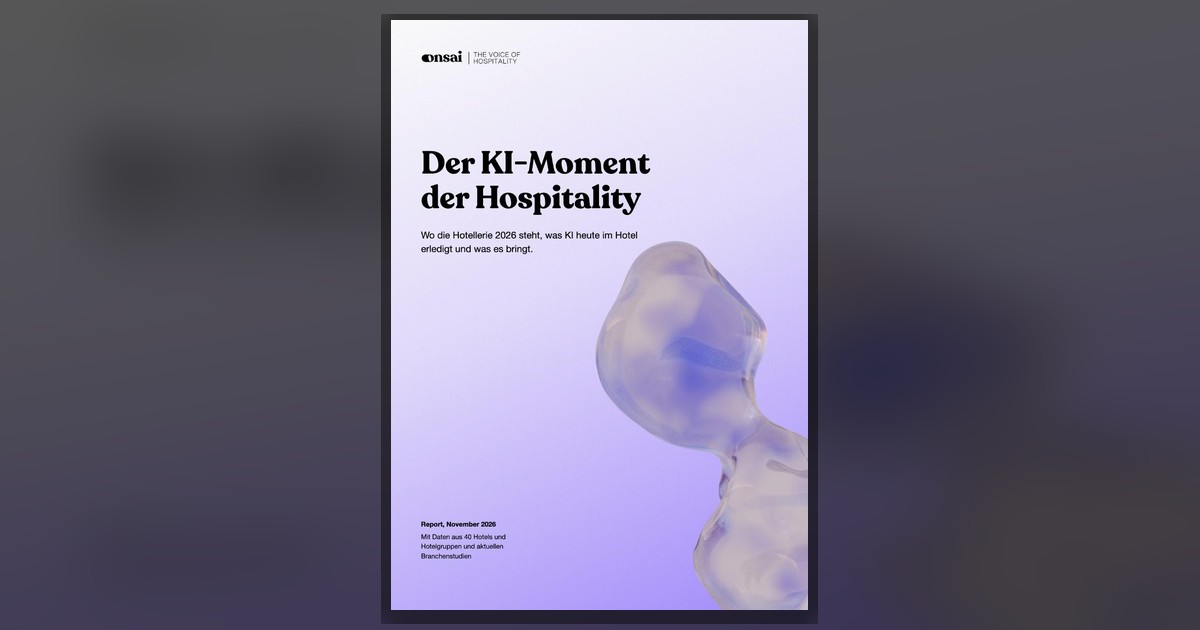
A new German study analysing more than 1.5 million AI conversations across 40 hotels and hotel groups reveals what happens on hotel phone lines, how often guests call, what they want, and how much business those conversations generate.
I have the impression that almost every time I walk up to a hotel reception desk, the receptionist is on the phone. Sometimes there’s a queue of guests waiting while the receptionist tries to finish a conversation. It feels like the phone never stops ringing.
But how many calls does a hotel actually receive? And what are all these people calling about?
It’s quite interesting to finally see some actual research into something so “old-tech” but critical in hotels.
Just 25 calls a day for a 100-room hotel
According to Onsai’s analysis, a typical 100-room city hotel receives approximately 25 phone calls per day, equivalent to 0.25 calls per room. That’s around 750 calls per month.
Twenty-five calls sounds surprisingly manageable. Spread across a ten-hour working day, that’s just 2.5 calls per hour. Of course, calls aren’t distributed evenly, and the report finds that 27% arrive outside the hours of 8 a.m. to 6 p.m.
Interestingly, 21% of calls arrive during weekends, while 8% come between 10 p.m. and 6 a.m.

This helps explain why receptionists always seem busy on the phone. Calls arrive while they’re checking guests in, handling complaints, processing payments, or answering questions from people standing in front of them.
And unlike emails, phone calls demand immediate attention.
What are guests actually calling about?
Perhaps the most interesting finding concerns the reasons people call.
40% of calls are purely informational. Guests want to know about breakfast, check-in times, parking, directions, or spa facilities. These are relatively straightforward questions, often answered repeatedly throughout the day (I think these calls will dissipate over time as hotels start to build proper data feeds into AI, with daily updates of real information on conditions in the hotel. Such as spa is closed for the season or such info).
The report also identifies an interesting relationship between parking enquiries and bookings. Parking questions represent just 2.8% of calls but are associated with 8.2% of bookings. The research suggests that someone asking about parking may already have decided to stay and simply needs one final detail. This is commercially interesting because phone calls remain an important booking channel.
According to the HOTREC European Hotel Distribution Study cited in the report, 13.8% of German hotel overnight stays were booked by telephone in 2023, compared with 15.1% through hotel websites. This is amazing.
How long does a call last?
Onsai reports that its AI-handled telephone conversations last an average of 108 seconds, or 1 minute and 48 seconds.
At 25 calls per day, that would represent approximately 45 minutes of daily telephone time if every conversation lasted that long.
Of course, this is an AI conversation average, and human conversations may take longer. The report doesn’t provide a comparable average for calls handled by receptionists. Separately an anecdotal information by a competing solution to Onsai reported to us that outside big cities, frequently when the caller hears it is an AI bot, they hang-up (see below with more info on that).
Onsai estimates that a 100-room hotel could save approximately 375 hours annually through AI telephone automation.
Its data shows that AI completely resolves around 50% of calls, with the best-performing hotels approaching 70%.
The commercial impact is potentially significant
Between January and August 2026, monthly telephone bookings handled by the system increased from 26 to 353.
The report attributes €169,000 in commission-free room revenue to telephone bookings and calculates an average of €5.41 in revenue per answered call.
These are figures from Onsai’s own customer base, so they should be interpreted in that context. Nevertheless, they demonstrate why telephone operations deserve more attention.
And there’s another interesting development. When Onsai initially introduced its AI telephone system, between 30% and 35% of callers immediately requested a human. That proportion has reportedly fallen to between 18% and 25%. The report doesn’t specify how many city hotels vs non-city hotels. But, guests appear to be becoming more comfortable speaking with AI.
We should probably measure the telephone better
According to the h2c Hotel Chain Tech Report 2026, cited by Onsai, 91% of hotel chains now use AI, up from 78% in 2025. Yet only 13% can demonstrate measurable benefits.
The Onsai report makes a compelling case for measuring something that has traditionally received relatively little analytical attention: the telephone.
How many calls does your hotel receive? When do they arrive? What are guests asking? How many result in bookings? And how many are missed?
These are relatively simple questions, but the answers could tell us quite a lot about how reception teams actually spend their time.
Personally, I would love to see this type of research expanded to other front desk activities. We have enormous amounts of data about hotel distribution, revenue management, and guest satisfaction, but surprisingly little about what happens during an ordinary shift at reception.
And perhaps my impression that receptionists are always on the phone is simply because I tend to arrive at precisely the wrong moment.
Source: Onsai, Der KI-Moment der Hospitality, November 2026. The report is available in German from the company’s website.