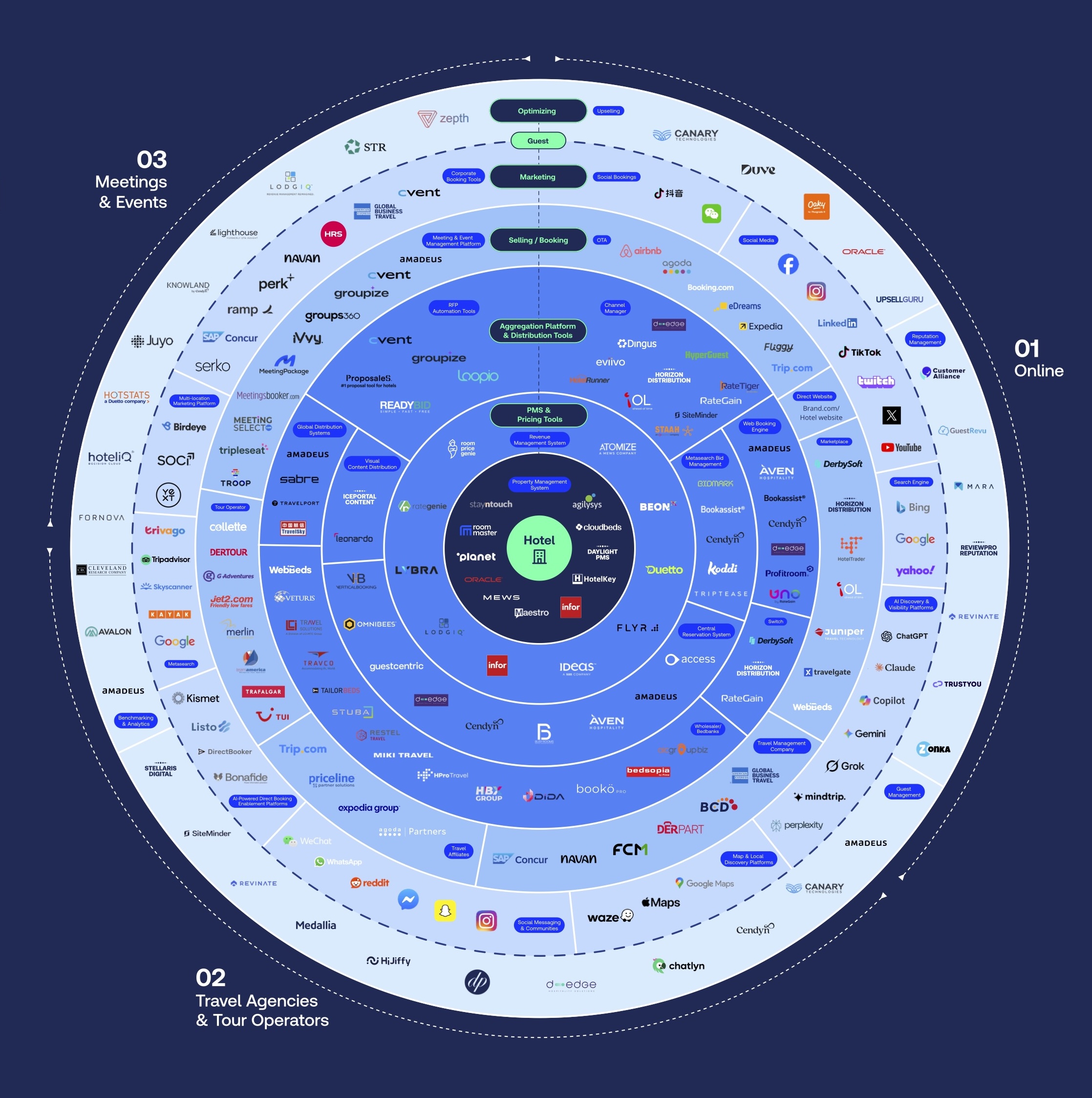
Every year, the release of Shiji Horizon Distribution’s Hotel Distribution Technology Chart sparks conversations across the hospitality technology industry. What has become one of the most recognizable visualizations in hotel tech is much more than a directory of vendors. It is a snapshot of how hotels operate, sell, market, and engage with guests in an increasingly connected world.
The latest 2026 edition is particularly striking when compared to one of the earliest versions of the chart, published by Snapshot in 2015.
Back then, the hospitality technology landscape looked complex. Looking at it today, it almost appears simple.
A comparison between the two charts suggests the number of companies represented has grown from roughly 120 companies in 2015 to somewhere between 250 and 300 companies in 2026. In just over a decade, the ecosystem has more than doubled in size.
Yet the real story is not the number of logos. It is what those logos represent.
The 2015 chart was largely focused on distribution. The core layers revolved around PMS platforms, CRS providers, channel managers, booking engines, GDS networks, OTAs, tour operators, and travel management companies. The objective was relatively straightforward: help hotels distribute inventory and capture bookings through a growing number of channels.

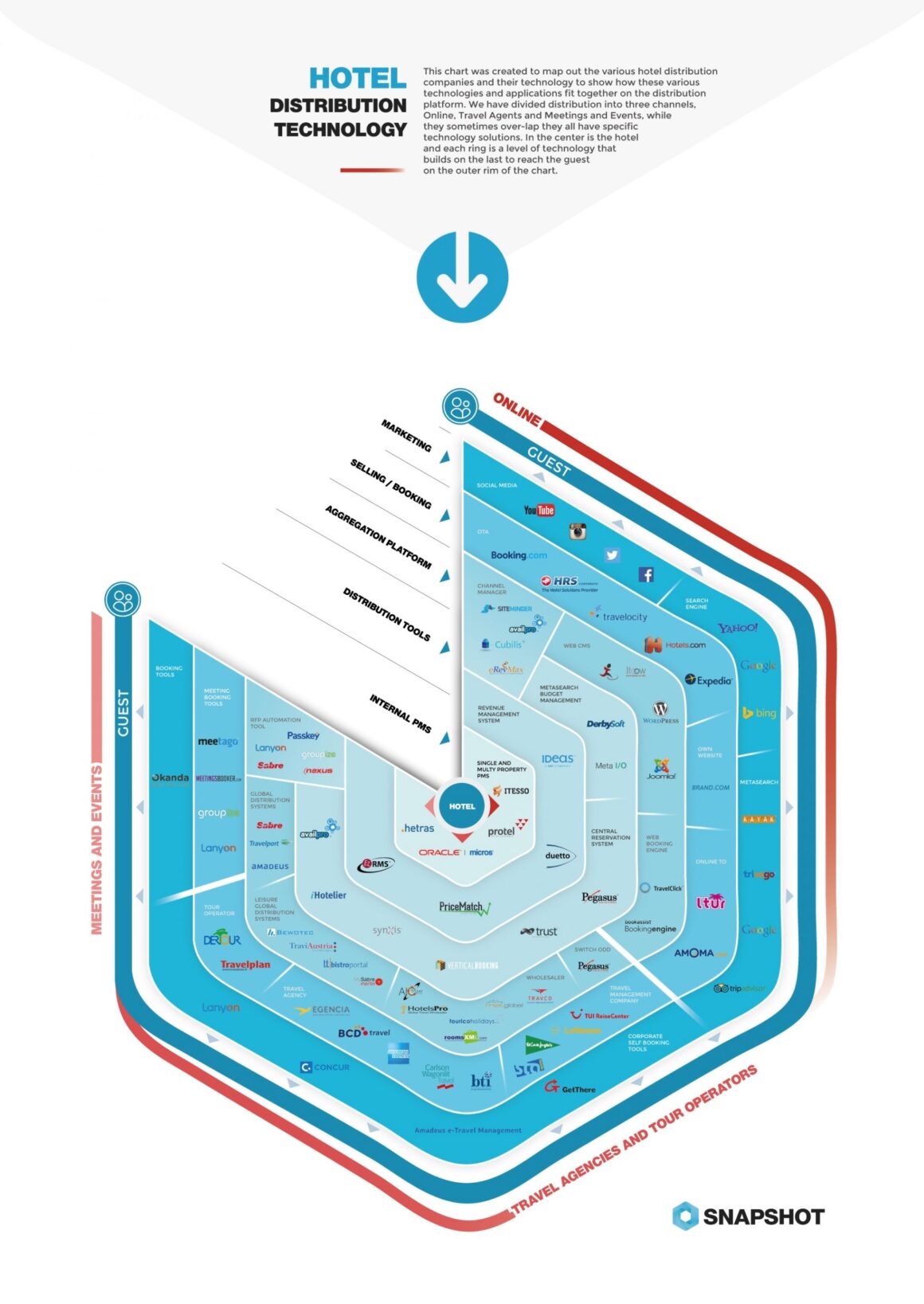
The 2026 chart tells a very different story.
While distribution remains at the heart of the ecosystem, entire categories have emerged that barely existed a decade ago. Revenue management systems have become a major technology segment. Guest messaging platforms, upselling tools, reputation management solutions, digital check-in providers, customer engagement platforms, content distribution tools, payment technologies, and marketing automation vendors now occupy significant portions of the landscape.
Most notably, artificial intelligence has arrived.
The 2015 version contains virtually no AI-related companies. In the 2026 edition, AI is visible throughout the ecosystem. General AI platforms such as ChatGPT, Claude, Gemini, Copilot, Grok, and Perplexity now appear alongside hospitality-specific AI providers. What was once an emerging concept has become a fundamental layer of modern hotel technology.
The chart also helps explain one of the industry’s most persistent challenges: integrations.
When hotel technology professionals discuss integration projects, this ecosystem is what they are talking about. A modern hotel may operate dozens of interconnected systems. Revenue management platforms require data from the PMS. Booking engines depend on inventory and rate information. CRM systems need guest profiles. Marketing platforms rely on customer data. Payment providers must connect with reservation systems. Guest messaging tools need access to stay information.
Each connection creates another point where information must flow accurately and in real time.
The challenge is not unique to hospitality. Every major industry struggles with system integration. Healthcare, aviation, retail, and financial services all face similar issues. Hospitality, however, is particularly dependent on these connections because the guest experience often relies on multiple systems working together behind the scenes.
What is perhaps most surprising is that despite years of acquisitions and industry consolidation, the technology landscape has not become simpler.
Many observers expected mergers to reduce the number of vendors. Instead, innovation has consistently outpaced consolidation. As some categories merged, entirely new categories emerged. Every year new solutions appear to address operational challenges, guest expectations, revenue opportunities, or advances in technology.
The result is a technology ecosystem that continues to expand.
In many ways, the growing complexity reflected in the chart is a sign of the industry’s maturity. Hotels today have access to specialized tools capable of solving highly specific challenges that would have required significant manual effort just a decade ago.
The annual release of the Hotel Distribution Technology Chart has therefore become more than an industry infographic. It is a visual record of hospitality’s digital transformation.
And if the progression from 2015 to 2026 reveals anything, it is that hotel technology is becoming more interconnected, more intelligent, and more specialized every year. The hotel remains at the center of the ecosystem, but the number of technologies required to reach, serve, and understand the guest has grown dramatically.
The chart keeps getting bigger. That is unlikely to change anytime soon.