Over the past two years, dozens of companies have appeared promising to rethink how we discover, plan and book travel. Some generate itineraries in seconds. Others want an AI agent to handle the entire transaction. Another group believes AI works best alongside professional travel experts. And perhaps most interestingly, a fourth group is using AI to make the traditional travel advisor dramatically more scalable.
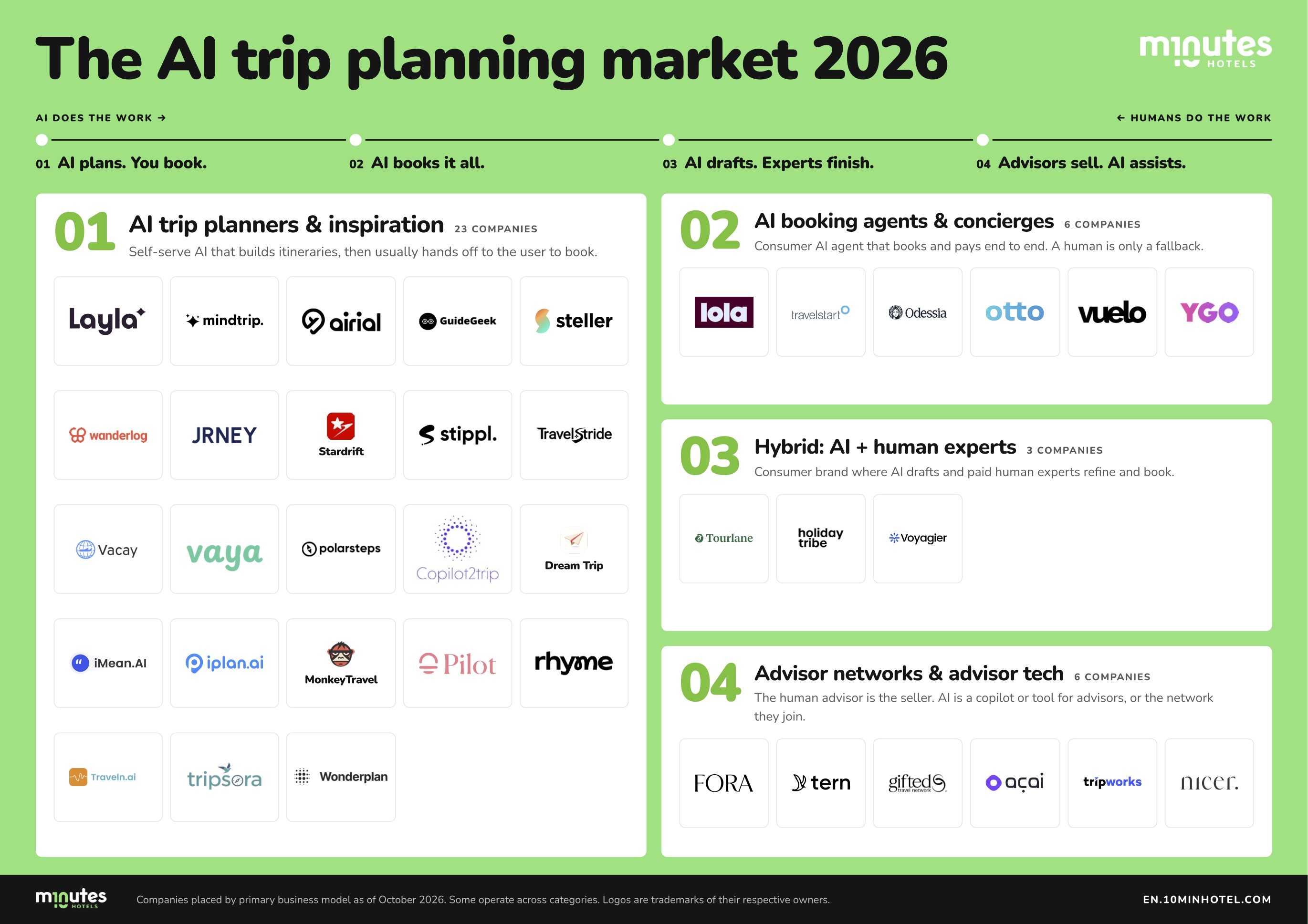
For the latest 10 Minutes Hotels market map, we looked at this emerging landscape and divided it into four categories based on one simple question: who actually does the work?
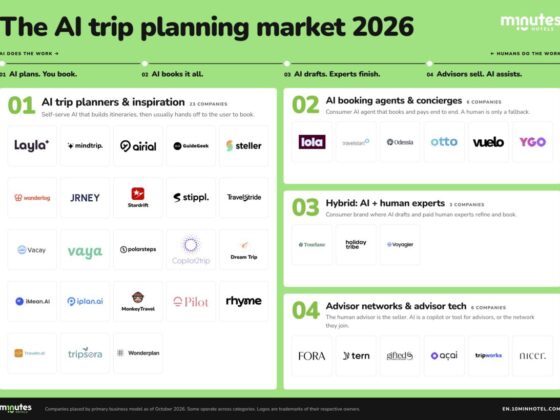
The result is 38 companies across four models, ranging from 23 AI trip planning and inspiration platforms to six fully fledged AI booking agents, three AI and human hybrid services, and six platforms built around human travel advisors.
Planning is easy. Booking is much harder.
The first category, “AI plans. You book,” is by far the largest.
These are products such as Mindtrip, Layla, Airial, Wanderlog and GuideGeek. Give them a destination, dates and preferences and they can build surprisingly sophisticated itineraries. Some can turn social media posts into trips, recommend hotels and restaurants, organize routes and increasingly incorporate live travel information.

This is also the easiest part of the problem for AI to solve. Generating ideas and assembling an itinerary requires information, intelligence and a good interface. Actually completing the trip requires something else entirely.
That is why the second category, “AI books it all,” may be the most important part of the map.
Here the AI needs access to real inventory, pricing, availability, payments, booking systems, cancellation policies and potentially post-booking servicing. Suddenly the challenge is no longer simply having a clever AI model. It is having the pipes into the travel industry.
Companies including Odessia, Otto, Vuelo and YGO are pursuing variations of this model. Odessia, for example, launched in 2026 with $6 million in seed funding led by Sequoia and says travelers can plan and then book a trip without leaving the platform. Mindtrip is moving in the same direction. It has raised $22.5 million and has brought in strategic investors including Capital One Ventures and United Airlines Ventures.
This is where the battle becomes particularly interesting for hotels. The AI interface may be relatively easy to build. Getting reliable access to the room that can actually be sold, at the right price, with the right conditions, is considerably harder.
What if AI actually brings back the travel agent?
The most counterintuitive development may be happening at the other end of our market map.
Instead of replacing travel advisors, AI could make them far more competitive.
The fourth category, “Advisors sell. AI assists,” includes companies such as Fora and Tern. The traveler still deals with a person, but that person increasingly has AI doing research, assembling itineraries, processing information and taking care of administrative work behind the scenes.
Fora is perhaps the clearest indication of how seriously investors are taking this model. The company raised another $60 million in July 2026 at a $1 billion valuation, bringing total funding to $138.5 million. Its advisors have now booked more than $3 billion in travel. Tern has raised $17 million, including a $13 million Series A, and is using AI specifically to eliminate much of the repetitive work performed by advisors.
For years, online travel was about removing the travel agent from the transaction and allowing the consumer to do the work. AI could reverse some of that logic.
If one advisor can use AI to research destinations, compare options, prepare proposals, process confirmations and manage many more customers than before, the cost of human assistance falls dramatically. Travel advising starts to look less like an expensive service reserved for complicated luxury trips and more like something that could be offered at scale.
In other words, AI might help create something resembling a gig economy for travel advisors.
The money is already moving
There is meaningful capital behind all four models. Based on publicly disclosed funding for companies included in our research, the combined figure already runs into hundreds of millions of dollars, although comparisons need caution because some companies existed before the current AI wave, some funding supports broader businesses, and some rounds include debt rather than equity.
Fora alone accounts for $138.5 million. Mindtrip has raised $22.5 million. Tern has raised $17 million. Odessia launched with $6 million. Layla had raised approximately €5 million before being acquired by Expedia in July 2026.
That acquisition is another signal of where this is heading. The startups are experimenting with new interfaces and business models, while the existing OTAs have enormous advantages in inventory, connectivity, payments, customer bases and servicing infrastructure. We should expect considerably more convergence between the two.
And we deliberately left some very big names out
Our map does not include every company putting the words “AI” and “travel” together.
We excluded traditional OTAs and travel platforms where AI is essentially an additional feature inside an existing product. We also excluded general-purpose assistants such as ChatGPT, Gemini and Claude.
That second exclusion is particularly important because those assistants may ultimately become some of the biggest trip planners of all.
As general assistants become increasingly capable of researching, planning and eventually executing tasks, the traveler may not consciously decide to use an “AI travel planner” at all. They may simply tell their everyday assistant that they want four days somewhere warm in November and let it figure out the rest.
Hotels need to watch the distribution layer
For hotels, the immediate question is therefore less about which interface wins and more about whether the hotel is available when an AI wants to recommend and book it.
Today that availability might come through an OTA, GDS, bedbank, booking engine, travel advisor network or direct connection. Tomorrow an AI agent could sit on top of several of them simultaneously.
Hotels need to understand how their inventory, rates, content, policies and availability are reaching these new intermediaries. Being invisible to an AI booking agent could eventually become just as significant as being poorly represented on an OTA or missing from Google.
The market is still extremely young. Some of the companies on this map will disappear. Others will change categories. Some will be acquired, as Layla already has been. And completely new models will emerge.