KeyData’s UK Autumn Index shows higher rates helping to offset softer occupancy, with short-term rentals outperforming hotels on RevPAR across England, Scotland and Wales
Santa Rosa Beach, Fla., 14 October 2026 — UK short-term rental operators increased rates in every region during the third quarter of 2026, keeping revenue close to last year’s level even as occupancy softened, according to KeyData’s UK Autumn Index. Looking ahead, December is the standout month of the final quarter, with occupancy, rates and revenue per available rental (RevPAR) all pacing ahead of last year.
Rates rise in every UK region
Average daily rates (ADR) increased year over year in all three months of the quarter, rising 4% in July to £189, 2% in August to £203 and 4% in September to £140¹. Rate growth extended to every region in the Index, ranging from 2% in North East and North West England to 6% in Scotland.
Higher rates offset softer demand
Occupancy softened as the quarter progressed, falling 4% in August and 5% in September after a flat July, although higher rates absorbed most of the decline and kept RevPAR within 2% of last year in both months. Booking activity remained slightly below last year at the end of the quarter, but the gap narrowed in September, and revenue generated across the market finished close to last year’s level. Both measures have also moved within a much narrower range through 2026 than in 2024 and early 2025, suggesting a more stable, albeit softer, booking environment.

Mid Wales the only region to grow occupancy
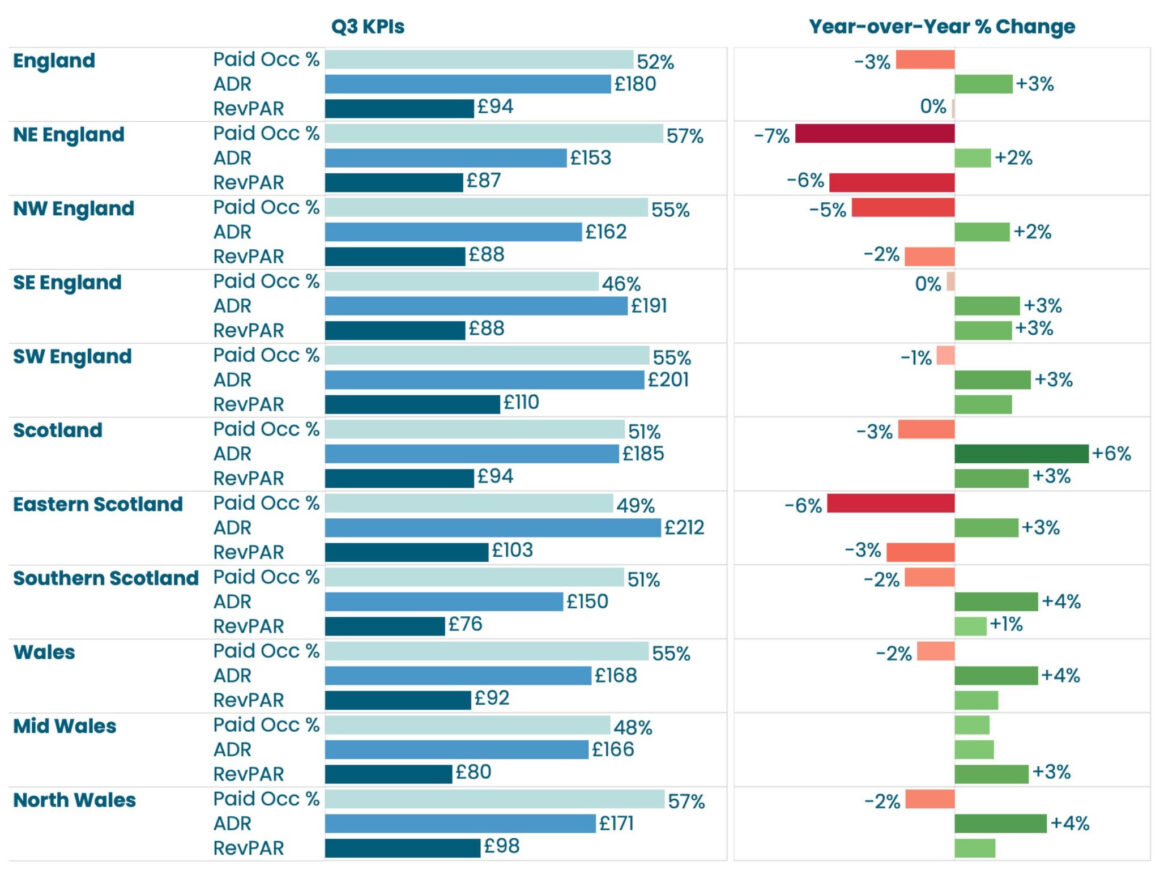
Mid Wales was the only region to record occupancy growth in Q3, up 1%, and combined it with a 2% rise in ADR to deliver 3% RevPAR growth. South East England matched that RevPAR growth on flat occupancy and a 3% rate increase, while Scotland reached the same result despite a 3% fall in occupancy, supported by the strongest ADR growth in the UK at 6%. North East England came under the most pressure, with occupancy down 7% and RevPAR down 6%. England overall finished the quarter flat on RevPAR, with a 3% rise in ADR offsetting a 3% fall in occupancy.
Short-term rentals outperform hotels on RevPAR
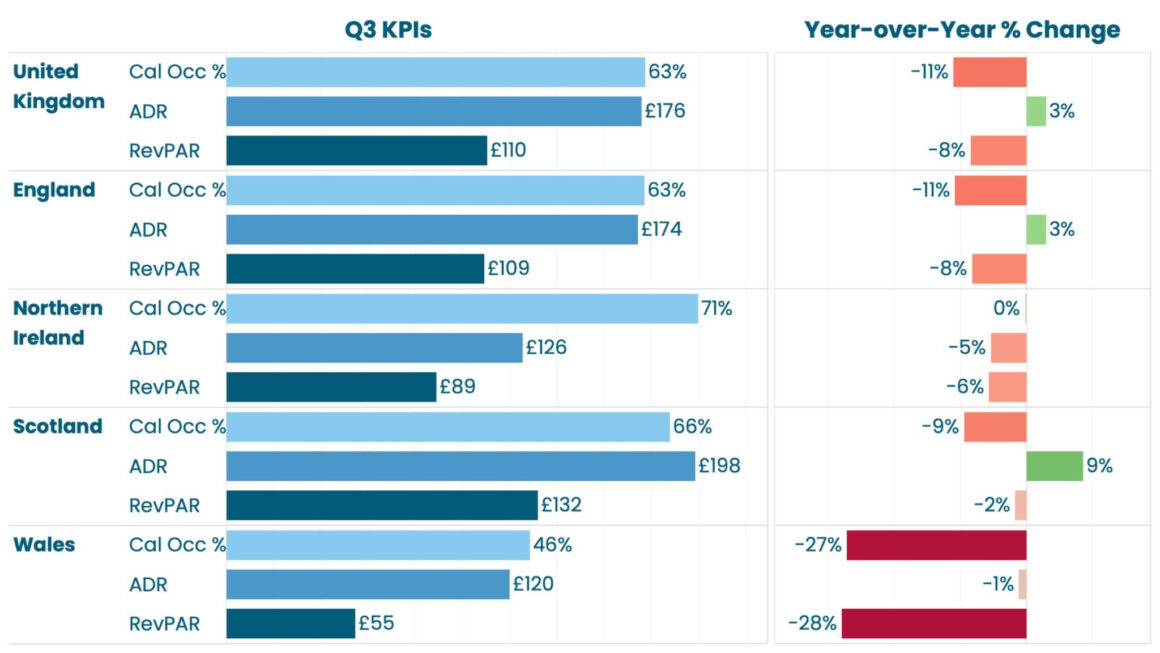
KeyData’s hotel comparison shows short-term rental RevPAR proving more resilient than hotels over the same period. UK hotel RevPAR fell 8% year over year in Q3, while short-term rental RevPAR was flat in England, up 3% in Scotland and up 2% in Wales. The gap was widest in Wales, where hotel RevPAR fell 28% following a 27% drop in calendar occupancy.
Direct bookings continue to deliver the highest-value guests
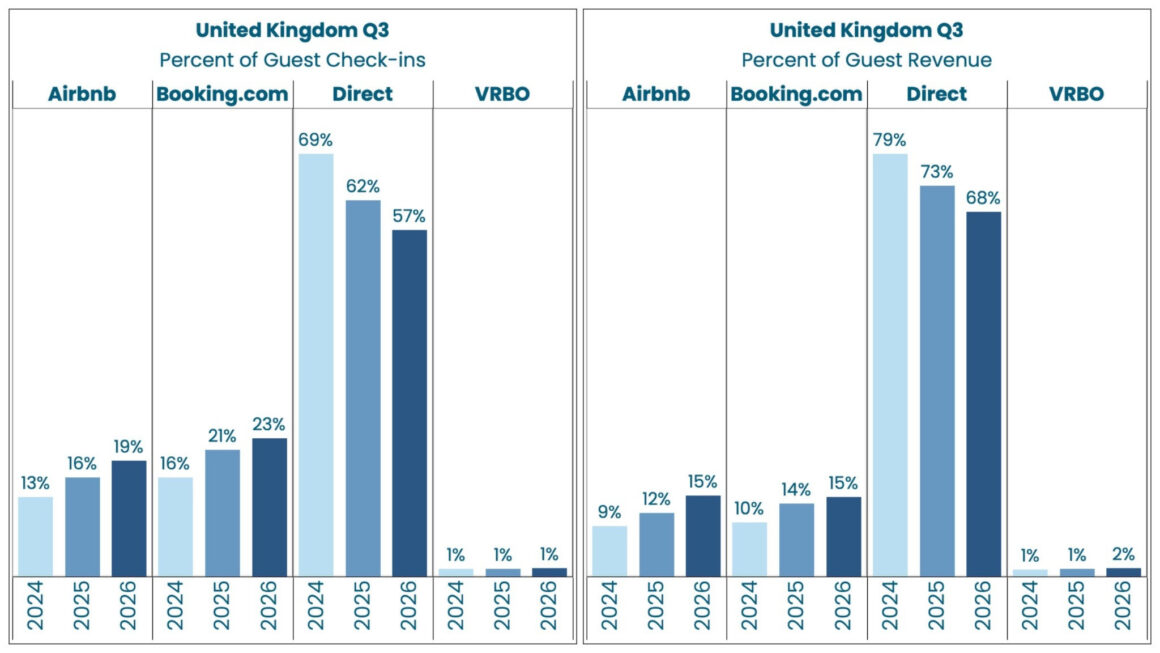
Direct bookings accounted for 57% of UK guest check-ins in Q3 2026, down from 62% in 2025 and 69% in 2024. Over the same two years, Airbnb’s share rose from 13% to 19% and Booking.com’s from 16% to 23%. Direct guests still generated 68% of revenue, well above their share of check-ins. Booking.com showed the largest shortfall between volume and value of the major channels, accounting for 23% of check-ins and 15% of revenue.
December leads the Q4 outlook
On-the-books data shows occupancy pacing 6% behind last year for both October and November, while December is 2% ahead. ADR is pacing higher across all three months, up 4% in October, 3% in November and 5% in December at £216. RevPAR is slightly behind in October (-2%) and November (-3%), but it is pacing 6% ahead in December.
Sally Henry, VP of Market Intelligence and Insights at KeyData, said: “Q3 showed UK operators holding their nerve on price. Rates rose in every region we track, and in most markets that was enough to keep RevPAR close to last year even with fewer nights sold. The challenge now is October and November, with occupancy pacing behind last year. Operators will need to watch booking pace closely and fill gaps without sacrificing the rate gains that have helped protect revenue. December is already ahead on occupancy, rate and revenue, giving operators a more encouraging outlook for the festive period.”
With October, November and December stays currently booking slightly further in advance than last year, operators have greater forward visibility and more time to adjust pricing and stay rules. Average length of stay is also pacing 3% shorter in both November and December, making stay restrictions and gap management important areas to monitor.
Read the full KeyData UK Autumn Index Report here.
About KeyData
KeyData is the leading performance analytics and benchmarking platform for the short-term rental industry. Trusted by property managers, owners, investors, and destination organizations worldwide, KeyData delivers the most accurate, real-time insights available across 500+ global markets. With 45+ KPIs, intuitive dashboards, and daily updates, KeyData empowers users to make smarter management, marketing, and growth decisions. Learn more at www.keydata.co.