Global Hotel Guest Experience Holds Strong in Q1 2026, But the Biggest Opportunities Are No Longer Where Most Hotels Think
The first quarter of 2026 delivered a clear message for hoteliers around the world: the fundamentals of hospitality are becoming increasingly standardized, while the real competitive battleground is shifting toward experience, personalization, and emotional connection.
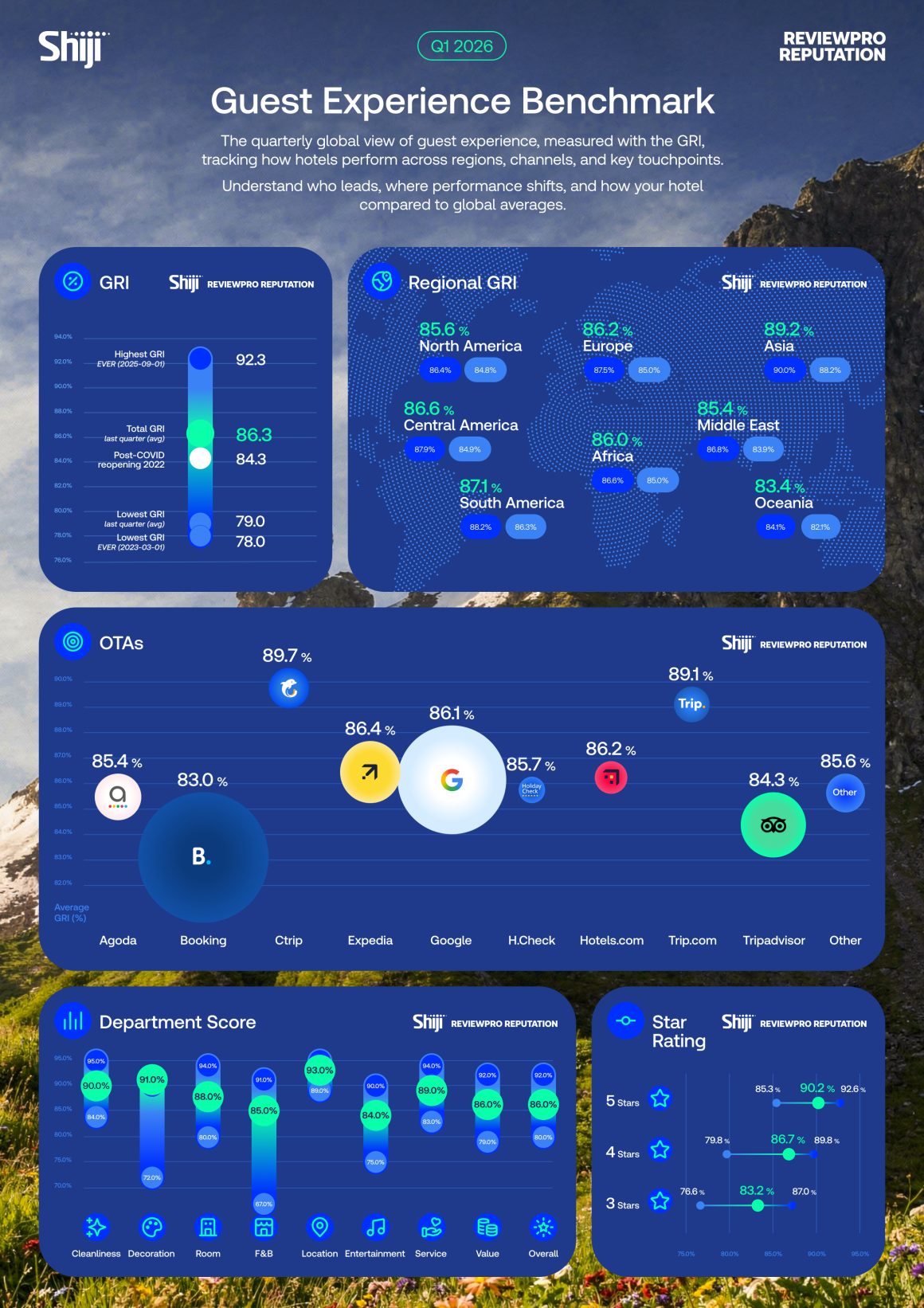
According to Shiji’s ReviewPro Guest Experience Benchmark for Q1 2026, the global Guest Review Index (GRI) reached 86.3%, remaining comfortably above the post-pandemic reopening benchmark of 84.3%. While the industry has not yet returned to its all-time highs, guest satisfaction remains remarkably resilient despite continued labor shortages, rising operational costs, and increasingly demanding travelers. More importantly, the data reveals where hotels are succeeding, where they are falling short, and where the next wave of differentiation is likely to emerge.
Asia Continues to Lead Global Guest Satisfaction
Asia once again recorded the highest regional GRI at 89.2%, significantly outperforming every other region. Europe followed at 86.2%, while North America came in at 85.6%. Central and South America posted strong results at 86.6% and 87.1% respectively. Oceania recorded the lowest score at 83.4%.
The nearly six-point difference between Asia and Oceania is substantial when measured across millions of guest reviews. While individual market dynamics vary, the results continue a pattern seen over several years. Asian hotel markets consistently deliver strong guest satisfaction through a combination of service culture, operational consistency, investment in property quality, and a relentless focus on the guest experience.

For international hotel groups, the regional data also serves as an important reminder that guest expectations and satisfaction benchmarks are not uniform across the globe. A strong score in one region may be considered average in another.
The Booking.com Paradox
Perhaps the most surprising insight comes from the review platform comparison.
Booking.com remains by far the largest source of guest reviews globally, generating significantly more feedback than any other channel. Yet despite this enormous volume, it records the lowest average satisfaction score among the major platforms at just 83.0%.
This creates an interesting paradox. The platform that provides hotels with the most guest feedback is also the platform where guests appear to be the least satisfied.
Several factors may contribute to this. Booking.com serves virtually every hotel category and traveler segment imaginable, creating a highly diverse review base. It is also heavily driven by comparison shopping and price sensitivity, which can lead to expectations that are difficult for some properties to meet. When guests book primarily based on pricing or promotional positioning, disappointment can occur more easily if reality does not perfectly match expectations.
At the opposite end sits Ctrip with an impressive 89.7% satisfaction score. Although the review volume is significantly smaller, the result reinforces the strong performance of many Asian hospitality markets and highlights how traveler demographics and platform dynamics can influence guest sentiment.
Google sits almost perfectly in the middle at 86.1%. Given its massive review volume and independence from any single booking channel, Google may increasingly represent one of the most balanced indicators of overall guest satisfaction. Unlike OTA reviews, Google captures feedback from guests regardless of how they booked, making it a useful benchmark for reputation management.
TripAdvisor presents another surprise. For years, many hoteliers viewed TripAdvisor as the industry’s most critical review environment. Yet its average score of 84.3% sits above Booking.com. While TripAdvisor reviews are generally longer, more detailed, and often written by highly engaged travelers, the data suggests that Booking.com users may now be expressing dissatisfaction more frequently than the industry’s traditional reputation watchdogs.
Hotels Have Mastered the Basics
The department score analysis reveals a broader shift occurring across hospitality.
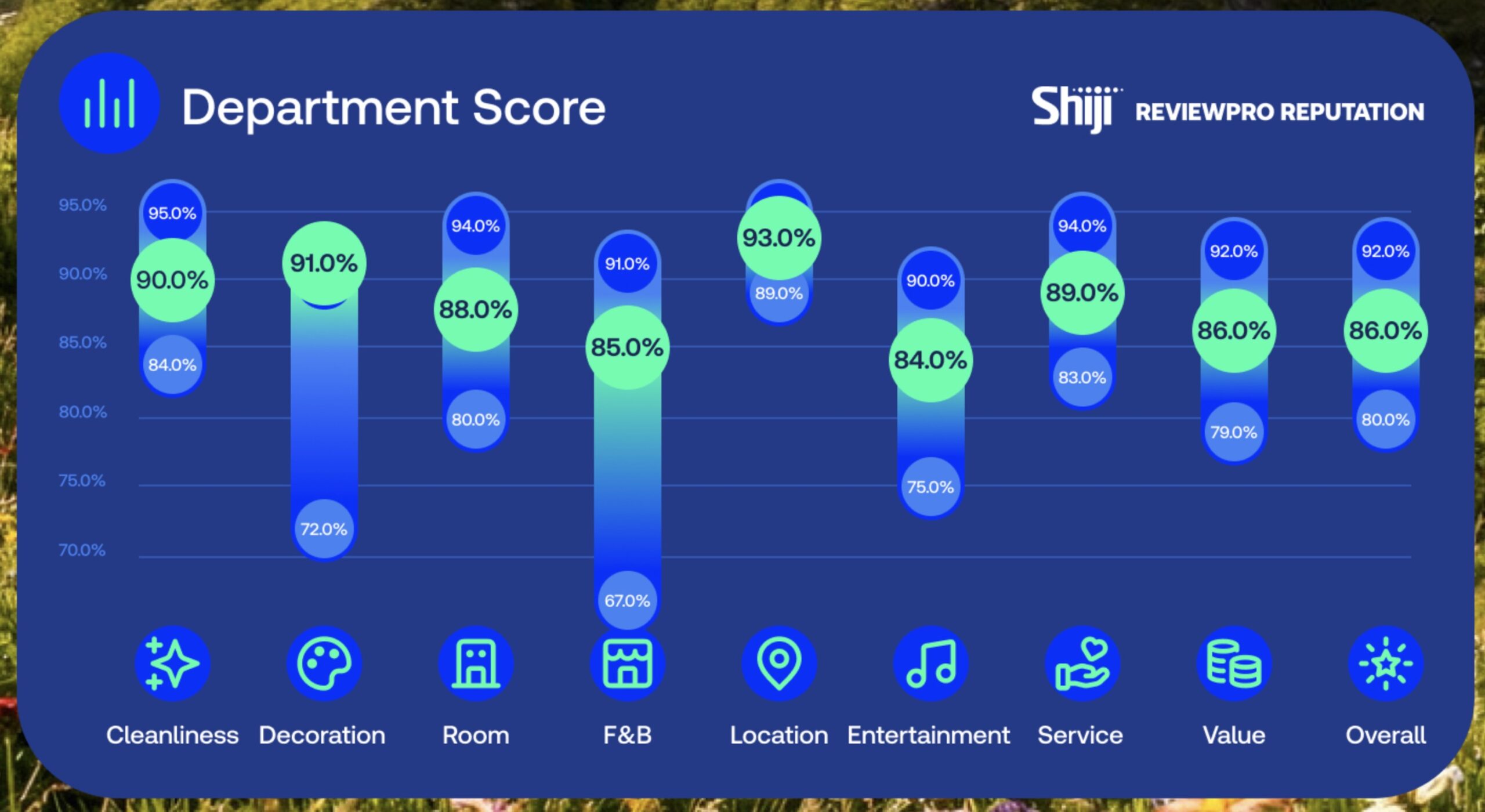
Location shows one of the smallest performance gaps between the best and worst hotels. This is hardly surprising. Guests know where they are booking, maps are accurate, and location information is easier to verify than ever before. As a result, there is relatively little disagreement between expectation and reality.
Cleanliness tells a similarly positive story. Not only does it achieve one of the strongest average scores, but it also shows one of the smallest spreads between top and bottom performers. This is particularly encouraging because cleanliness is one of the few aspects of the guest experience that hotels can fully control. Years after the pandemic, the industry appears to have maintained many of the elevated hygiene standards that guests now expect.
Taken together, these findings suggest that hotels have become increasingly effective at delivering the fundamentals. Guests generally receive what they expect in terms of location and cleanliness, and there is less variation between properties than there was in previous years.
Experience Is Where the Real Battle Happens
The largest gaps appear in areas that are far more emotional and subjective.
Decoration, food and beverage, and entertainment show some of the widest differences between top-performing and bottom-performing hotels. Unlike cleanliness or location, these categories are heavily influenced by personal preferences, cultural expectations, and a property’s ability to create memorable experiences.
Food and beverage may be the most significant opportunity. Great restaurants, bars, and dining concepts can elevate an entire stay and become key drivers of positive reviews. At the same time, poor dining experiences can quickly undermine an otherwise successful guest journey. The size of the gap suggests that while some hotels are creating exceptional culinary experiences, many others continue to struggle.
Entertainment follows a similar pattern. Expectations vary dramatically depending on destination, guest profile, and hotel type. What delights a leisure traveler at a resort may be completely irrelevant to a business traveler staying in a city-center hotel. This naturally creates greater variation in guest satisfaction scores.
Decoration is equally revealing. Design has become an increasingly important differentiator, particularly for lifestyle, boutique, and luxury brands. However, design is also highly subjective. A concept that one guest considers memorable and distinctive may be viewed by another as impractical or overdone.
The Surprising Room Gap
One of the most unexpected findings involves guest rooms themselves.
Given the amount of photography, virtual tours, floor plans, and room descriptions available during the booking process, one might expect guest expectations to be relatively well aligned with reality. Instead, room scores still show a substantial gap between top and bottom performers.
This suggests that many hotels continue to struggle with consistency. Aging inventory, differences between room categories, maintenance issues, or overly optimistic photography may all contribute to the disconnect.
For an industry whose core product is still the room, this remains a critical area for improvement. Guests may forgive minor shortcomings in other areas, but disappointment with the room itself continues to have an outsized impact on overall satisfaction.
Service Remains One of Hospitality’s Greatest Opportunities
Service scores are generally strong, averaging 89%, but the variation between leaders and laggards remains larger than many operators might expect.
Unlike location, service is entirely within a hotel’s control. The fact that some properties consistently outperform others suggests that culture, training, leadership, and staff empowerment continue to play a major role in shaping the guest experience.
As technology becomes increasingly capable of standardizing operational processes, human interaction may become even more important as a differentiator. The hotels achieving the highest guest satisfaction scores are often those that combine operational efficiency with genuine hospitality.
Guests Judge Performance, Not Stars
The benchmark’s star rating analysis reinforces a lesson that many operators have learned over the past decade.
Five-star hotels achieved an average GRI of 90.2%, compared to 86.7% for four-star hotels and 83.2% for three-star properties. Yet the ranges within each category tell a more interesting story.
The best three-star hotels outperform many average four-star properties, while weaker five-star hotels often perform much closer to the middle of the four-star segment than to the leaders of their own category.
Guests are increasingly evaluating hotels based on whether they deliver on their promises rather than on their official classification. A well-run three-star hotel that consistently exceeds expectations can often generate stronger guest sentiment than a luxury property that fails to meet them.
The Next Frontier of Guest Experience
The overall picture from Q1 2026 is surprisingly positive. Global guest satisfaction remains strong, and the industry has largely succeeded in creating consistency around the fundamentals. Location, cleanliness, and core operational delivery are no longer the primary battlegrounds they once were.
The greatest opportunities now lie in the elements that are harder to standardize: service culture, food and beverage, design, entertainment, and the emotional aspects of hospitality that transform a stay from satisfactory to memorable.
For hotel operators, the message is clear. Meeting expectations is no longer enough. The hotels that will lead guest satisfaction rankings in the coming years are those that can consistently exceed expectations in the areas where guests feel the experience most personally. In an increasingly competitive marketplace, that may be the difference between simply earning a booking and creating a guest who returns, recommends, and advocates for the brand.