Anthropic recently released a set of blueprints showing how companies can build commerce agents with Claude. Companies including Priceline, Shopify, Intuit, Wix and Square are already using Claude to build agents that can help customers search, make decisions and take actions.
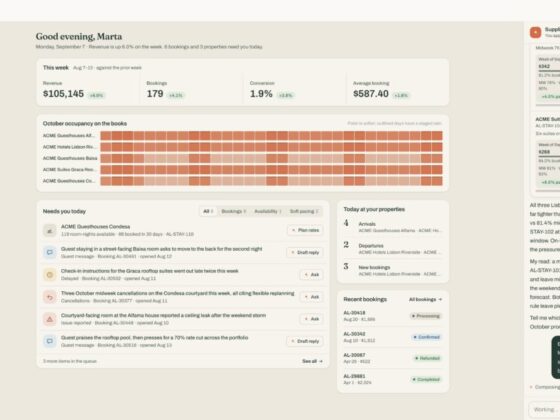
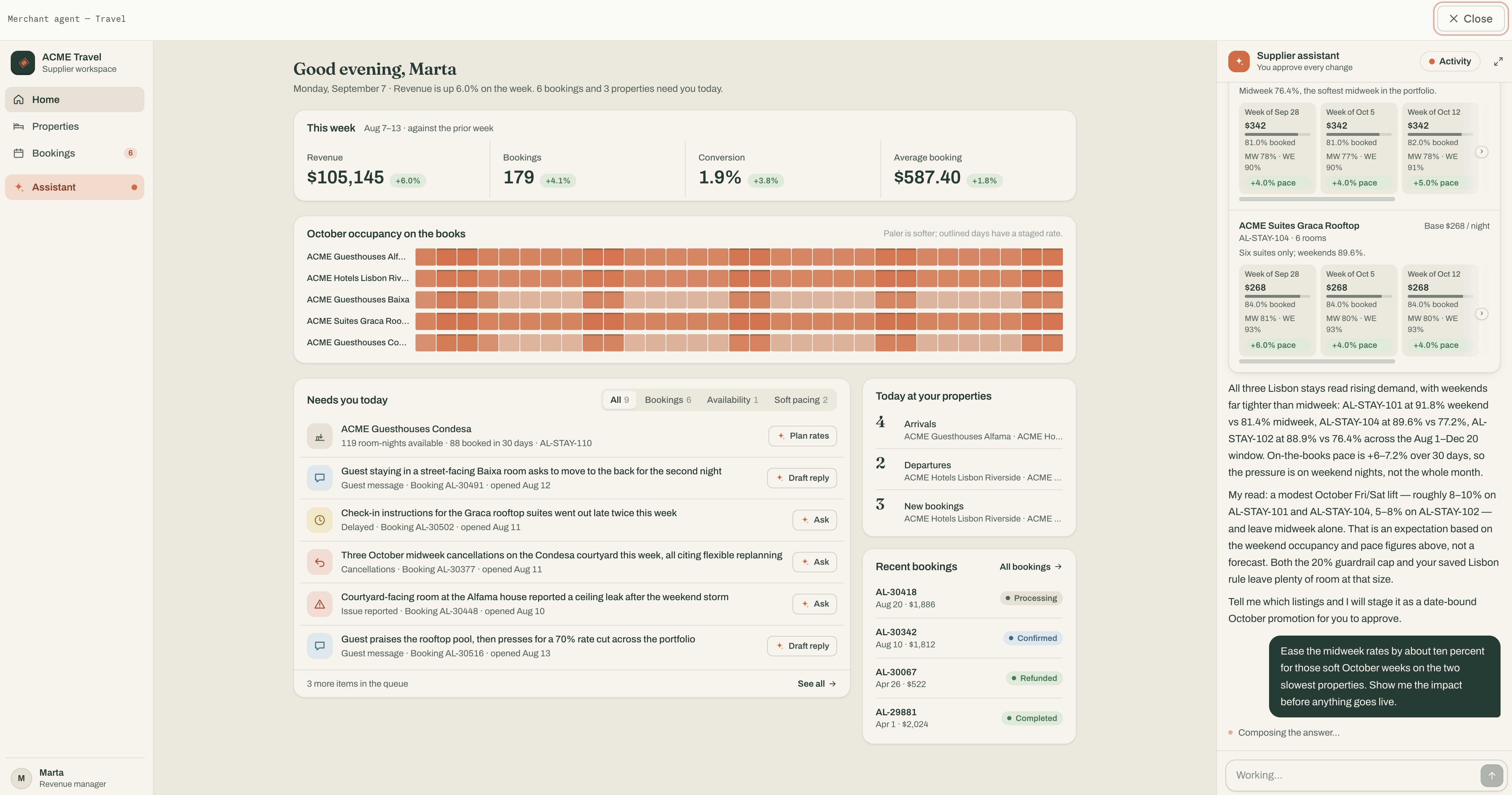
But one of the more interesting examples for the hotel industry is Anthropic’s own demo. They created a fictional travel company called ACME Travel and built what looks remarkably like a lightweight revenue management system. It shows occupancy, revenue, bookings, conversion and property performance. More importantly, the agent analyzes demand, identifies weaker periods, recommends pricing changes and can stage those changes for approval. In the example, the revenue manager simply asks it to reduce midweek rates by around 10% at the two weakest properties and show the impact before making anything live.
Of course, this is a demo. Building something that looks like an RMS is very different from running one reliably across hundreds of hotels. Integrations, data quality, security, permissions, edge cases and support remain difficult problems. And there is another obvious limitation: how many hoteliers actually want to become software developers? Probably very few. Most hotels don’t want to build an RMS. They want revenue management to work.

But that may be missing the bigger change. The cost and difficulty of building specialized business software is falling very quickly. Things that previously required a sizeable engineering team, substantial funding and months or years of development can increasingly be prototyped by a small team in weeks or even days.
That potentially changes the economics of hotel technology. The threat to existing vendors may not be thousands of hotels suddenly building their own PMS or RMS. It could be a revenue management expert, hotel operator or entrepreneur who understands a very specific problem and can now turn that knowledge into working software with a fraction of the resources previously required.
Priceline is already using Claude as part of Penny, its agentic travel assistant. So this isn’t simply an experiment in generating attractive interfaces. Major travel companies are already putting this technology into production.
Where does it lead? Nobody knows. We may end up with thousands of terrible homemade tools. We may see a wave of highly specialized hotel tech companies built by tiny teams. Or perhaps some of today’s large software categories eventually get broken into much smaller components that agents assemble and operate as needed.
None of that happens tomorrow. But the barrier between understanding a hotel problem and being able to build software that solves it is getting remarkably thin.
And that should probably get the hotel technology industry’s attention.